
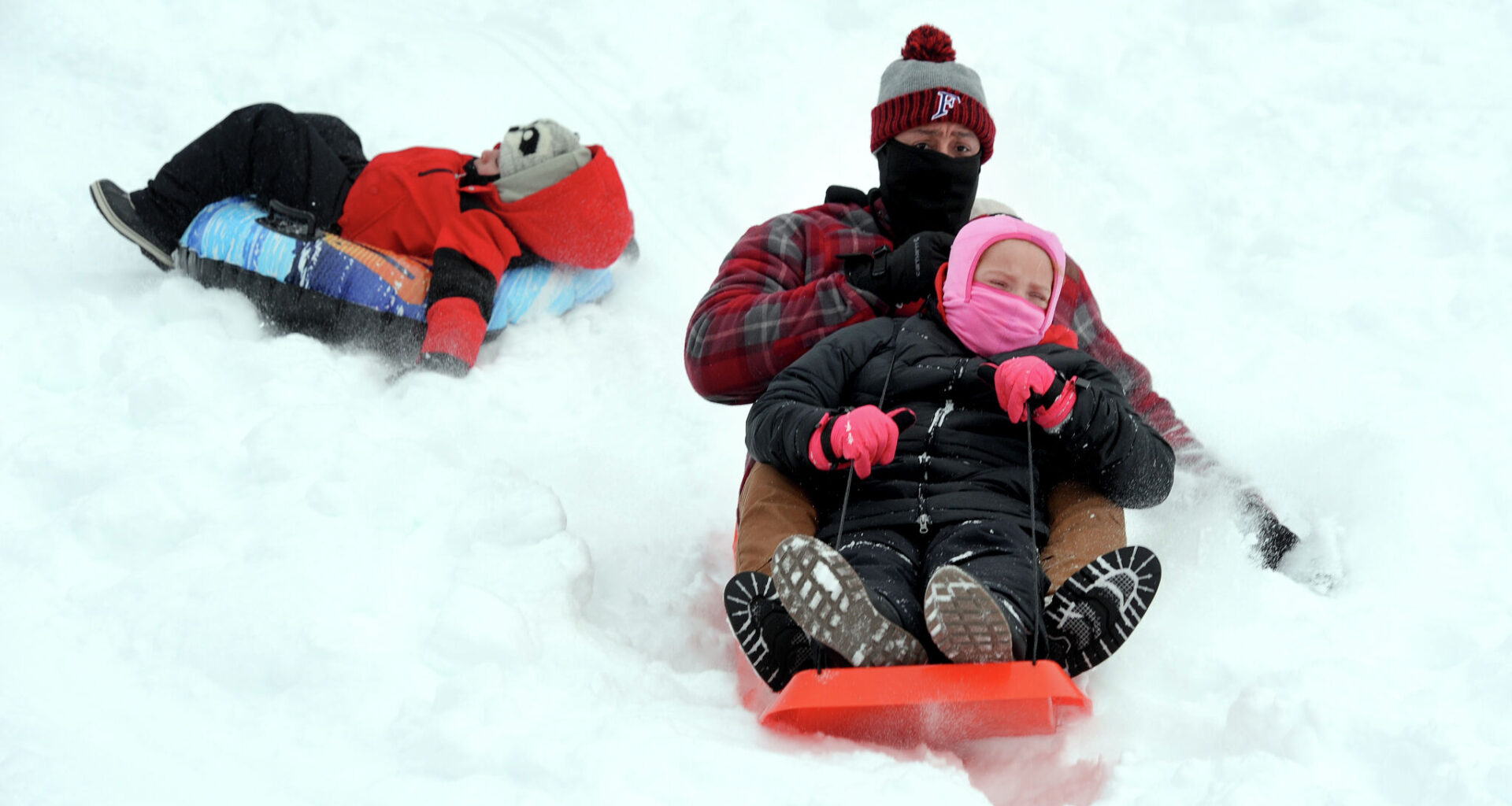
Schools across Connecticut were closed Monday due to the winter storm, which allowed kids to enjoy the snow. Howard Kelly of Bridgeport sleds down a hill at Beardsley Park in Bridgeport with his daughter, Madison, 9, on January 26, 2026 after a foot of snow fell the previous day. Kelly’s son, Jackson, 4, sleds behind them.
Arnold Gold/Hearst Connecticut Media
Children across Connecticut woke up to a winter wonderland Monday after snow from a massive storm blanketed the state and slammed swaths of the country over the weekend.

And unlike in nearby New York City, where school was held remotely, they could spend the day building snowmen, joining snowball fights or going sledding instead of logging into online classrooms.
Article continues below this ad
A huge slew of schools and districts across the state were reported closed Monday, as school leaders across Connecticut told CT Insider ahead of the storm that they do not hold virtual learning days when they shut down their schools over unsafe weather conditions.
In Connecticut, the classic snow day is alive and well, and the power of local decision-making combined with the state’s remote learning policy indicate that likely won’t be changing any time soon.
Who decides a snow day?
Students can generally thank their superintendents for opting for a traditional no-school snow day, as decisions regarding weather-related school closures are made at the local district level.
Article continues below this ad
Make CT Insider a preferred source on Google to see more of our journalism when you search.
Add Preferred Source
District leaders tend to review the weather forecast, road conditions, safety and timing as well as consult with local officials,such as police and road crews, before making a cancellation call.
But state policy also plays a key role, particularly when it comes to remote learning.
What counts as a school day?
Under state law, Connecticut public school districts must provide a minimum of 180 school days each year for grades K to 12. Pivoting to virtual learning for a snow day does not count toward that requirement, according to the state Department of Education.
Article continues below this ad
After the COVID-19 pandemic, state law was amended to allow remote days to count as official school days but with certain criteria. According to state statute, schools can implement remote learning if the local board of education chooses to adopt comprehensive remote learning policies and programs in compliance with state standards.
“These are actual, systemic programs, and not occasional days when schools are closed due to weather conditions or building issues such as a damaged roof,” said Laura Stefon, chief of staff for the Connecticut State Department of Education. “Although on such days a school can still offer remote instruction for purposes of maintaining continuity of instruction, such a day would not count toward the 180-school-day mandate.”
So, Connecticut schools largely opt for the traditional snow day.
Why snow doesn’t count
Patrice McCarthy, executive director of the Connecticut Association of Boards of Education, said she did not know of any school districts in Connecticut that pivot to remote learning instead of a true snow day. Besides it not counting as an instructional day, a remote day is a logistical challenge, she said.
Article continues below this ad
“Switching immediately from in person to remote is not that easy,” McCarthy said. “To have a meaningful instructional day with very relatively short notice is challenging for both educators as well as students and their families.”
Teachers need more time to adapt their lesson plans to remote learning than a snow day cancellation typically gives them, she said, and there are also technological factors and family circumstances to consider.
But another reason is simply the desire to safeguard the classic snow day, McCarthy said.
“I think a secondary reason is a feeling of kids should have the opportunity to enjoy a snow day, go out and play, build a snowman, go sledding, whatever it is that they end up doing,” she said.
Article continues below this ad
Ahead of Sunday’s snowfall, one superintendent said that “kids should be kids on snow days.” And other Connecticut school leaders echoed that sentiment.
“I hope our students, in particular, are able to take a break from smart devices and video games today and spend some time trekking outdoors, sledding, building snow forts, or simply enjoying the fresh air,” Danbury Public Schools Superintendent Kara Casimiro said in a message to families Monday. “Finding time to play and connect to nature are important and part of a healthy balance in our increasingly digital lives.”
When are snow days made up?
When schools close for a snow day, it doesn’t necessarily mean kids get a free day off. School districts typically have to make up those days at the end of the year to make sure school is in session for the required 180 days.
Article continues below this ad
So, for a number of schools, Monday’s closure means students will start summer a day later.
However, districts may try to get ahead of potential closures to avoid pushing school later into the summer vacation, McCarthy said.
Some Connecticut school districts, such as New Haven, build a few extra days into their school year and adopt a calendar that is more than 180 days, McCarthy said. “That gives them that flexibility in the event that they do have a school closure,” she said.
Other districts might adopt a 180-day calendar but plan to take snow days out of scheduled breaks, McCarthy said. That can happen if districts are in danger of not finishing their 180 days of school by the end of June, or just want to avoid stretching too far into summer vacation, she said. “No one wants to be in school the last day in June,” she said.
Article continues below this ad
For example, the district websites for Meriden, Region 14 and Cheshire say that snow days are typically added to the end of the year, but with enough of them, the districts may end up subtracting days from their spring breaks in April.
Future of the snow day in Connecticut
In New York, remote learning under emergency conditions does count as an instructional day, and New York City Mayor Zohran Mamdani cited the 180-day school year requirement as a reason for holding school remotely Monday.
“I can tell you as a New Yorker who loved snow days growing up and would sit and watch local news at 5 a.m. to see if my school was mentioned on the ticker at the bottom, I know what this means for students,” Mamdani said at a press conference Sunday.
Article continues below this ad
“However, New York City also operates in accordance with state law where we have to have 180 days of instruction. And given the additions of holidays over the past few administrations, it reduces the flexibility that we can have to have an old-fashioned snow day,” he said.
It’s always possible that legislation could come up to change Connecticut’s snow day and remote learning rules, McCarthy said. But she said she had not heard of strong efforts around that issue, and she wasn’t sure school officials felt it was needed, either.
“Particularly in recent winters, we really have not had that many snow days,” McCarthy said. “So it hasn’t been a major disruptive factor.”
Article continues below this ad
And the decision would likely remain at the local level, where there has been strong support for protecting the traditional snow day, she said.
“The individual snow day, I think, remains intact,” McCarthy said.