
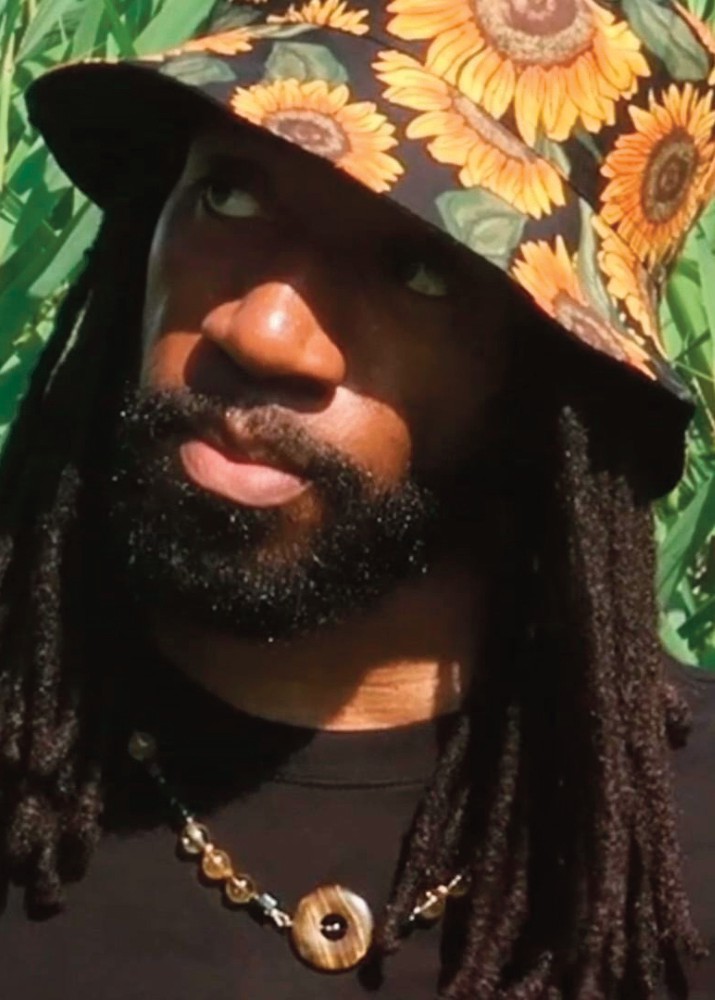

Michael E. Wilson Jr. is a vegan musician and storyteller born and raised in Brooklyn. However, Flushing has been Mike’s home since 2019 where he is a garden member, an open mic performer, and business owner. Mike (aka The Real Mike Wilson) provides song and poetry writing workshops that include lyrics analysis, production/engineering lessons, and song recording through his company. He performs live versions of his recordings with a live band throughout the city. In 2021, Mike published his first collection of short stories called “Faces.” The summer of 2025 he published another book called “The Wonderful Life of Mr. Silverlinning,” two short stories centering on a twenty-something named Andrew navigating work, romance, and friendships. Mike is studiously writing his next novel and producing songs for upcoming projects and local artists.
NB: Other than the amazing diversity, what do/did you love most about living in Queens (or Queens in general)? How has Queens changed over the years?
MW: Queens might have the best food. I’ve tried plenty of restaurants and rooftop bars over the past few years. Since going vegan late 2022, I’ve been able to enjoy wonderful vegan cuisine at restaurants like Amitabha, Urban Vegan Roots, and The Vegoist No. 5. Flushing has gotten a bit crowded over the years. And with the possibility of a casino next door to Shea Stadium, I’m worried the crowding issue will soon get much worse.
NB: How does Queens inspire you? What are some of your favorite places to be inspired in Queens?
MW: Having moved from nightlife heavy Clinton Hill to family-oriented Flushing, the neighborhood is a lot quieter. Despite the large crowds during the day (who are usually shopping at one of the local marts), nightlife is regulated to a handful of rooftop bars and karaoke spots. This creates a quieter, more neighbor-friendly environment where a night-in is more the norm, allowing for peaceful creative evenings. One of my favorite places is the aforementioned Urban Vegan Roots. The restaurant often hosts events, and Hip-Hop legends like b-boy Kid Freeze (creator of the head-spin) once celebrated his birthday there. My friend and collaborator were able to get a picture with him.
NB: What advice do you have for readers who are hoping to develop their writing, artistic, or musical practice? Is artistic talent innate and/or can it be taught/developed? How important is daily practice? Do you ever get stage fright/camera shy/performance anxiety or have advice about overcoming it?
MW: I always tell students, peers, and friends to just do it. As cliché as that might seem, I think we are currently hyper intellectual about everything. But art of any kind doesn’t need that. The more you do something, the better you’ll be at it. Now, there is something to be said about natural ability, and I think it’s important to recognize and develop natural talents. But doing something you’re bad at can be cathartic if you’re willing to be bad at it. It might even be fun.
When it comes to performing, I try to practice between shows. To me, it’s best to be prepared at all times. This also helps alleviate stage fright.
NB: How important is personal connection and communication (networking) in your industry?
MW: Networking is very important in the artistic community. And I hate networking, so I basically never do it. What works for me is developing a real relationship with another artist around shared interest. I don’t look for people with a big following or promising connections. If I like you, I want to work with you.
NB: What is the best piece of advice you’ve ever received? What is something you wish you knew a decade or two ago?
MW: “You may not be where you want to be, but you’re not where you were.” Barbara, a matriarch at one of my old jobs, said this to me when I was lamenting about something I can’t even remember. It’s still the best advice I’ve ever received. Whenever I need to feel grounded from stress and worries, I say this to myself.
NB: Who are some of your favorite artists, musicians, writers, other creatives, and business owners with a Queens connection?
MW: Hip-Hop legend Nas, a proud Queens native, is one of my favorite rappers of all time. Illmatic is still on rotation and arguably one of the best hip-hop albums of all time. But it was Queens native 50 Cent’s freshman album, Get Rich or Die Tryin’, that I purchased with my first check from Summer Youth. I’m also a big fan of the vegan bakery Sensible Edibles. They offer some of the best vegan desserts I’ve had and even vendor some packaged goods to cafes and restaurants throughout the city.
NB: What are your favorite restaurants, cafes, theaters, bookstores, exhibits, museums, open mics, communities, and venues in Queens? Favorite places to perform?
MW: Restless Open Mic and Show And Telly are two of my favorite open mics. Unfortunately, Restless shut down last year, but I met two of my closest friends and some other really cool people through the weekly open mic. Show And Telly has a weekly Sunday night open mic at Astoria Food Pantry. It’s music-focused and the host (wonderful people and amazing performers) have this thing where they perform songs in between sets with a key word in each. If you can guess the keyword by the end, you win a “useless” prize. It’s always a ridiculous fun time.
NB: What do you wish more people knew about being a musician, writer, and business owner? What is something you wish you knew before you became a musician, writer, and business owner?
MW: Support small businesses and independent artists any chance you get. Usually, the quality is better and the money you spend goes a lot further for us. As AI continues to dominate tech and take jobs away from creatives and gig workers, it’s important for us to remember the humans whose livelihoods are destroyed from a homogenized auto-tech culture. Small businesses and artiste really are the backbone of America. Personally, I wish I understood this sooner. As an independent artist, I did support the likes of Spotify and other tech giants promising to help me share my art. But as time passed, I realized that many platforms have their investors as their greatest concern. Artists should concern themselves with other artists. Collaborate. Support each other. Invest in the little guy.
NB: If you could choose only one song or piece of writing to represent Queens, what would it be and why?
MW: The Bridge by MC Shan and Marley Marl, a classic record about Queensbridge. If you haven’t heard it, look it up asap. For extra credit, Christmas in Hollis by Hollis’ own Run DMC is a holiday must.
NB: Can you tell us more about being vegan?
MW: Initially, I became vegan to improve my health. I’d learned about the carcinogenic nature of red meat particularly and cut it out many years ago. About four years ago I sort of went pescetarian before becoming vegetarian for a month. Then I watched the documentary, What The Health, and decided to go full vegan. Since going vegan, I’ve expanded my palate and learned even more about nutrition. I’ve also learned more about animal cruelty, particularly the treatment of farm animals. I hope to advocate for animals and educate others on the importance of proper nutrition.
NB: How do you know when your song or book (or piece, or any type of art) is “done” (finished editing, complete)?
MW: I usually have an idea of what my finished art should feel like. An incomplete work doesn’t feel like it’s delivering the message I desire. Usually when I make a song, I’ll work on it until it feels whole. When writing a book, I want my final version to feel full. Like adding more would be gluttonous. I know this breakdown is a little embellished, but it’s really about feeling for me. It’s not much of an intellectual thing. The message I hope to deliver in the end is honestly about how it feels.
NB: Can you tell us more about how you provide “song and poetry writing workshops that include lyrics analysis, production/engineering lessons, and song recording?”
MW: A few years ago I started working as a vendor with CASES. They’re a supervised release program that monitors people awaiting trial while they live at home or in the shelter. I provide a program that works as music education. My workshops include song and poetry analysis, teaching music production and sound engineering, and providing an open studio for participants to record. I’ve been working with the 16–26-year-old group and have really found a passion in providing a non-clinical setting for them to express themselves. Some come to me as hobbyists in music, while others try it out for the first time and discover a passion for it. I also collaborate with friends and provide private lessons for anyone interested.
—Nicollette Barsamian
The Local-Express interview series was originated on July 3, 2013 by Nicollette Barsamian.