
Ah, yes, it’s that very special time of year for New York Jets fans — the season of personnel improvement.
First comes January, the month featuring Jets headlines that have nothing to do with on-the-field news. Once every three or four years, these headlines run rampant about which head coach will next lead the team. Save for that joyous occasion, the season of hope features free agency and the NFL draft.
Considering the Jets hold the No. 2 pick in a perceived one-quarterback draft, this offseason is one that seemingly lines up as a non-quarterback-focused story. That’s not to say a quarterback won’t be drafted, rather that the top choice will be a “football player.”
(Yes, quarterbacks, you’re “football players” as well; we just like to have a little fun every now and then, mixing it up with your emotions while testing your “feels.” This is true, despite how Charmin-soft the NFL has allowed the sport to become. Seriously … we’re not messing with you; wink-wink.)
In any event, Aaron Glenn and Darren Mougey have the second choice in April’s 2026 NFL draft, which means a decision looms large.
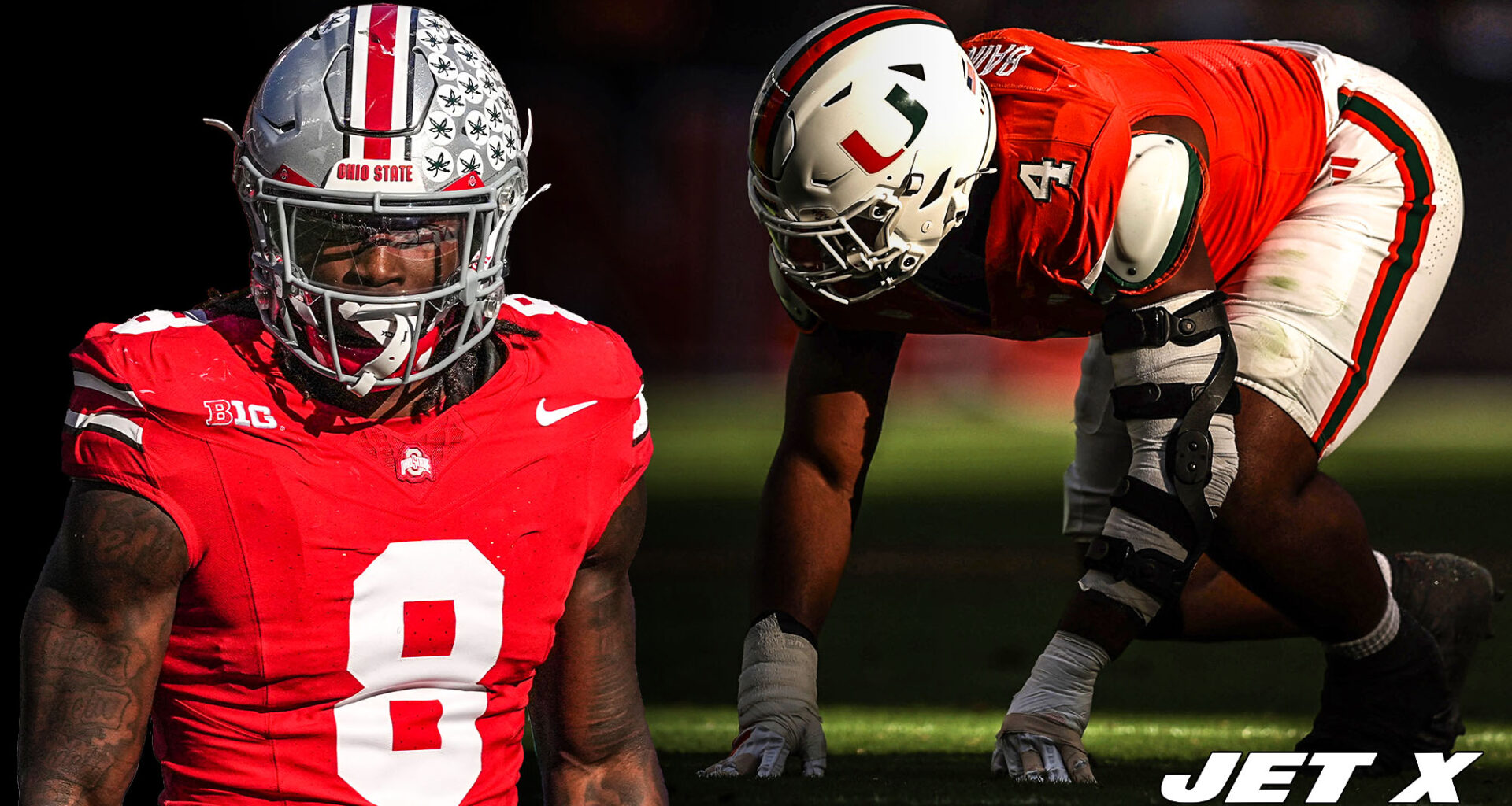
As of this very moment, Ohio State’s Arvell Reese is the clear-cut selection — as is currently showing in the mock draft consensus — and there’s an emphatic reason to cement that idea.
The options at No. 2
Other than Reese, Miami’s Rueben Bain Jr. is also in the running at No. 2. In fact, some recent polls reflect the fans’ preference for Bain, particularly with his noticeable performance against Indiana in college football’s national title game.
Here’s how the measurables shake out (none of which are official):
Arvell Reese (EDGE/LB-Ohio State): 6-foot-4, 245 pounds, 4.45-4.50-second 40-yard time, 410-pound bench
Rueben Bain Jr. (EDGE-Miami): 6-foot-3, 270 pounds, 4.75-4.84-second 40-yard time, 405-pound bench
Additionally, Texas Tech EDGE David Bailey, Auburn EDGE Keldric Faulk, Texas A&M EDGE Cashius Howell, Clemson IDL Peter Woods, and two other Buckeyes, LB Sonny Styles and S Caleb Downs, are first-round names to watch during the process.
Let us not forget about the offense.
While Miami OT Francis Mauigoa is projected as a top-five pick — the brother of current Jets’ linebacker Kiko Mauigoa — he’s not receiving much love at No. 2 for obvious reasons (the presence of Olu Fashanu and Armand Membou). The wide receiver position is a completely different story.
Ohio State’s Carnell Tate leads the way as a prime weapon for the Jets at No. 2. Whether he can compete with the defenders on the list is something that remains to be seen. USC’s Makai Lemon, Washington’s Denzel Boston, Texas A&M’s Kevin Conception, and Arizona State’s Jordyn Tyson are the receivers projected as Round 1 selections.
Trenches-out still?
It’s never as simple as one thought or motto when making a draft pick. Yet, abiding by a general rule of thumb when all things are equal is perfectly acceptable.
When two or three players (at the same position) are battling it out at No. 2, it’s wise to take the prospect who can be a monster in the open field. As sacrosanct as that feels to the old-school minds who firmly believe in the “trenches first” philosophy, it’s just the way the game is played today.
Make no mistake about it: The trenches still matter in a tremendous fashion. The old theory that a trench player’s production does more to lift the skilled positions than the skilled positions do to lift the trenches still holds true.
However, it’s important to recognize how that balance has shifted over the years. While the trenches-out theory could still be more valuable, it doesn’t carry the same weight it used to.
I mean, just think of it from a Jets fan’s perspective. For the first time in what felt like forever, the 2025 Jets actually deployed a competent offensive line. Competent is selling it short, in reality.
New York’s offensive line remained consistent all season.
Incredibly, Tanner Engstrand’s big heavies were the only offensive line to start all 17 games this past season. Think about that; it’s fantastical, especially when considering how brutal the Jets’ offensive line has been since the Nick Mangold-D’Brickashaw Ferguson days.
Nevertheless, the Jets finished with one of the worst offenses in the NFL again (29th in total offense, averaging just 263.6 yards per game). They also finished 10th in rushing with 123.3 yards per game, and this ranking dropped significantly in the last quarter of the season. For most of the year, the unit was top five.
Again, things have changed.
Reese is an open-field monster
Quarterback is, of course, critical. There’s little need to go into that angle, as the living, breathing football world realizes this already. Where many get lost is in the belief that skilled players are still as “plug-and-play” as they used to be.
Arvell Reese is an EDGE player at the NFL level, similar to Rueben Bain Jr. Yet, the two couldn’t be more different as players.
Reese is the EDGE who can also play second-level linebacker. Similar to Penn State’s Micah Parsons, Ohio State regularly played him on the second level, but also used him at EDGE when necessary.
Bain is a bigger EDGE who lacks the explosiveness to dominate in space. At 270 pounds, and with a projected 4.75-4.84-second 40-time at the NFL Scouting Combine, he’s just not that dude.
Hey, that’s not the end of the world. Instead, the team drafting him just needs to understand this. As opposed to relying on him in space, his squad must realize he’s more suited for crashes and inside steps.
But is he big enough for that routine work? That, along with his rumored (shorter) arm length, which matters greatly in the NFL when shedding those death grips from offensive linemen, clouds his future a bit.
That’s what makes the Reese vs. Bain argument so fascinating. One common argument against Reese centers on his “positionless” nature, yet Bain’s measurables make him even more positionless.
He’s sort of a “tweener” in a sense. Yes, he projects well against the run at the NFL level, but his lack of quickness in short areas immediately hampers a defensive unit when a smart offensive play-caller stretches him to the outside. On the inside, he might not be big enough to thrive.
To most coaches, he’s suited as a 3-4 defensive end (an interior defensive line position). That idea becomes tougher to swallow thanks to the NFL’s 11-personnel-dominant tendencies, which make it harder to play odd fronts.
Reese, on the other hand, is positionless in the positive sense (per the modern NFL).
Not only does he have the sideline-to-sideline speed to play second-level backer, but he can also impact the game while playing in space when the offense dares to stretch him to the sideline. That means Jets fans won’t have to worry about Micheal Clemons-esque chasedowns via jet-motion, zone-reads, and WR screens.
Better yet, his strength is freakish, and his mindset is ferocious. Rarely does a prospect translate such nastiness on tape. Bain has a lot of the same attributes, but Reese’s intangibles show whether he’s rushing the passer from the edge or breaking down to make a 1v1 open-field tackle.
In this league, the way this sport is played today, the New York Jets would be wise to snatch up the prospect who has a chance to be an open-field monster — on top of doing his usual frightening pass-rush thing.
If it were 2010, Rueben Bain Jr. might have had the advantage. In 2026, it’s Arvell Reese.
Either way, don’t worry: The film breakdowns for all of these guys are coming to Jets X-Factor soon.