
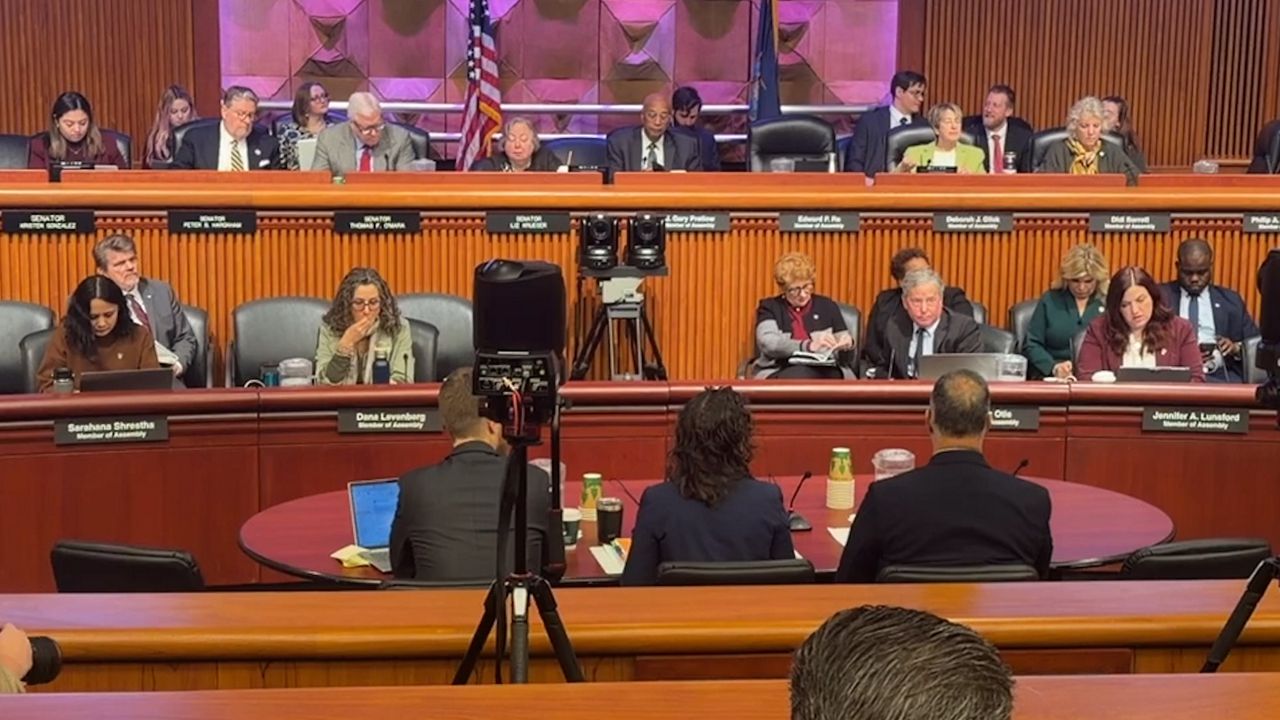
Questions over the future of the New York’s climate law cast a shadow over the state Legislature’s budget hearing on energy Wednesday.
While the hearing is part of a process of examining Gov. Kathy Hochul’s executive budget proposal and determining how the Legislature will respond — and many of issues related to the budget and affordability were covered, the future of the state’s climate goals and the potential for rollbacks came up in two notable ways.
Earlier this month, the Coalition for Safe and Reliable Energy filed a petition with the Public Service Commission to “evaluate whether to temporarily suspend or modify the obligations under the Renewable Energy Program” which is part of the state’s climate law, the Climate Leadership and Community Protection Act or CLCPA.
The petition cites a section of the law which allows for the wiggle room that many who are against the broad strokes of the state’s clean energy goals are looking for:
“The commission may temporarily suspend or modify the obligations under such program provided that the commission, after conducting a hearing as provided in section twenty of this chapter, makes a finding that the program impedes the provision of safe and adequate electric service; the program is likely to impair existing obligations and agreements; and/or that there is a significant increase in arrears or service disconnections that the commission determines is related to the program.”
With 30 days for public comment, the coalition which is largely made of business interests have managed to move the needle to opposition from climate advocates.
Rory M. Christian, chair and CEO of the New York State Public Service Commission, declined to discuss the petition at the hearing.
It’s no secret that Gov. Kathy Hochul has been batting around possible solutions to adjust the benchmarks and mandates set in the law, but Politico’s Marie French first reported Wednesday that there are ongoing discussions over how that could potentially happen as part of the state budget process.
State Sen. Pete Harckham took multiple cracks at getting Amanda Lefton, commissioner of the New York State Department of Environmental Conservation, reveal the governor’s plans, and while she didn’t provide any details, she also didn’t rule out changes.
“Yes or no, are we going to see efforts to roll back the CLCPA later in the budget discussions?” Harckham asked after a previous attempt at the question.
“The governor has made clear that she knows we need to continue to fight climate change, continue to drive down air pollutions and we need to ensure sure it’s done in a manner that looks at reliability affordability,” she responded. “I don’t know the governors specific plans to work with the legislature on that, but I do know that she is committed to achieving those multiple goals as a state.”
Harckham also pressed Lefton on how the state’s overall emissions objectives could be preserved in the event of a rollback.
The news gave hope to Republicans in the state Legislature who have long railed agains the CLCPA.
“We’ve seen just a crack in her energy plan which we all knew would fail, but in an election year she is finally saying what we knew all along. This isn’t a good plan, it’s not feasible,” said state Sen. Mark Walczyk.
Hochul has multiple opportunities to introduce more policy proposals into the conversation both as part of the 30-day amendment process, or as part of three way negotiations. Last year a major point of contention in the budget process was late policy adds as the process dragged on until early May, weeks past the April 1 deadline.
The governor’s current slate of budget proposals did get plenty of play during the hearing.
A frequent topic of discussion was Hochul’s proposal to modify the state’s environmental quality review for certain projects with the goal being to spur housing development, but the proposal has drawn criticism from some lawmakers and is expected to be a budget sticking point. State Sen. Rachel May carries a bill which similarly seeks to reform the process but she says the governors proposal is too broad and not equipped for some of the nuances found in housing projects upstate.
“Ours is much more targeted, its targeted to the kinds of locations you can put them, it has a lot of specifics when it comes to environmental protection that still apply— not just air, water and soil but floodplains and that sort of thing,” she said. “We worked very hard to make our bill something that environmental groups would either support or not oppose and partly because it’s aimed at reducing sprawl which is an environmental disaster. I’m concerned that environmental advocacy organizations won’t be as supportive and I’m hopeful that we’ll be able to negotiate in parts of our bill.”