
The last month has felt unreal — an indescribable rollercoaster of grief, rage, exhaustion, and resolve. Like educators across the country, I’ve been going to work, teaching, lesson planning, grading, all while at the same time trying to process the cascade of nauseating stories. The story of Keith Porter, a father who was shot and killed by an off-duty ICE officer on New Year’s Eve; Geraldo Lunas Campos, a father who was strangled in a detention center after asking for medicine; of Maher Tarabishi, the full-time caregiver to his son Wael, who died while Maher remains in detention; of five-year-old Liam Ramos, used as bait to arrest his father and now anxious, depressed, and malnourished in a detention center in Texas. When ICE murdered Renee Nicole Good, a substitute teacher and mother, two weeks ago in south Minneapolis, everything seemed to shift. Now, the situation has escalated further with ICE’s murder of ICU nurse and union member Alex Pretti.
For over a year, we’ve been building rapid response networks in our schools, holding trainings, forming committees at numerous schools around the city, and preparing ourselves to respond to attacks on our students, coworkers, or communities. But this month, it has felt more tangible. Students want to talk about what is happening. Our group chats and meetings have gotten more active. More people joined our weekly sanctuary team meetings. Conversations about what to do next filled the pauses in our days. Everyone has different concerns, sensibilities, strategies, and tactics, but all are bound by the refusal to accept this reality as normal.
Minneapolis became a turning point. We could feel it all the way in NYC, and we knew we had a responsibility to act from our position of collective strength as educators.
When our chapter leader texted us on January 14 to say that the United Federation of Teachers (UFT) had passed a resolution with over 90 percent support calling for a day of action and emergency mobilization for Renee Nicole Good and in solidarity with Minneapolis, we felt a wave of reassurance. Until then, a lot of this had felt like isolated conversations between coworkers squeezed into lunch periods and after-school meetings. That vote reminded me that thousands of educators across NYC were feeling the same anger, fear, and urgency, and were ready to do something about it.
Soon after, we heard that organizers in the Twin Cities were calling for a general strike (although the day of action was more accurately an economic blackout) on January 23 to demand ICE out — and that our union would be endorsing a solidarity action on the same day, alongside Teamsters Local 804, UAW Region 9A, SEIU 1199, PSC-CUNY, Hands Off NYC, DSA, and many others.
That Friday, ten of us got together in the art room to make signs. Cardboard boxes covered the tables. Paint and markers were everywhere. We wrote “Education, not deportation,” “Teachers against racist deportations,” and “Support students, not separation.” It was grounding to make something tangible together after weeks of talking and worrying.
After school, we met up with staff from another school in our building, took a picture together in the parking lot, and headed to Union Square on the train. When we arrived, the park was already filling up. I walked past SEIU members in purple hats, PSC-CUNY members in red, and then into a crowd of teachers holding blue UFT signs. I’ve been to protests before, but this one felt different. Everywhere I looked were groups of coworkers who had clearly come together from their schools — some who have been doing this for years, others for the first time — people who had finished their work day and decided that showing up here was also part of their role as an educator.
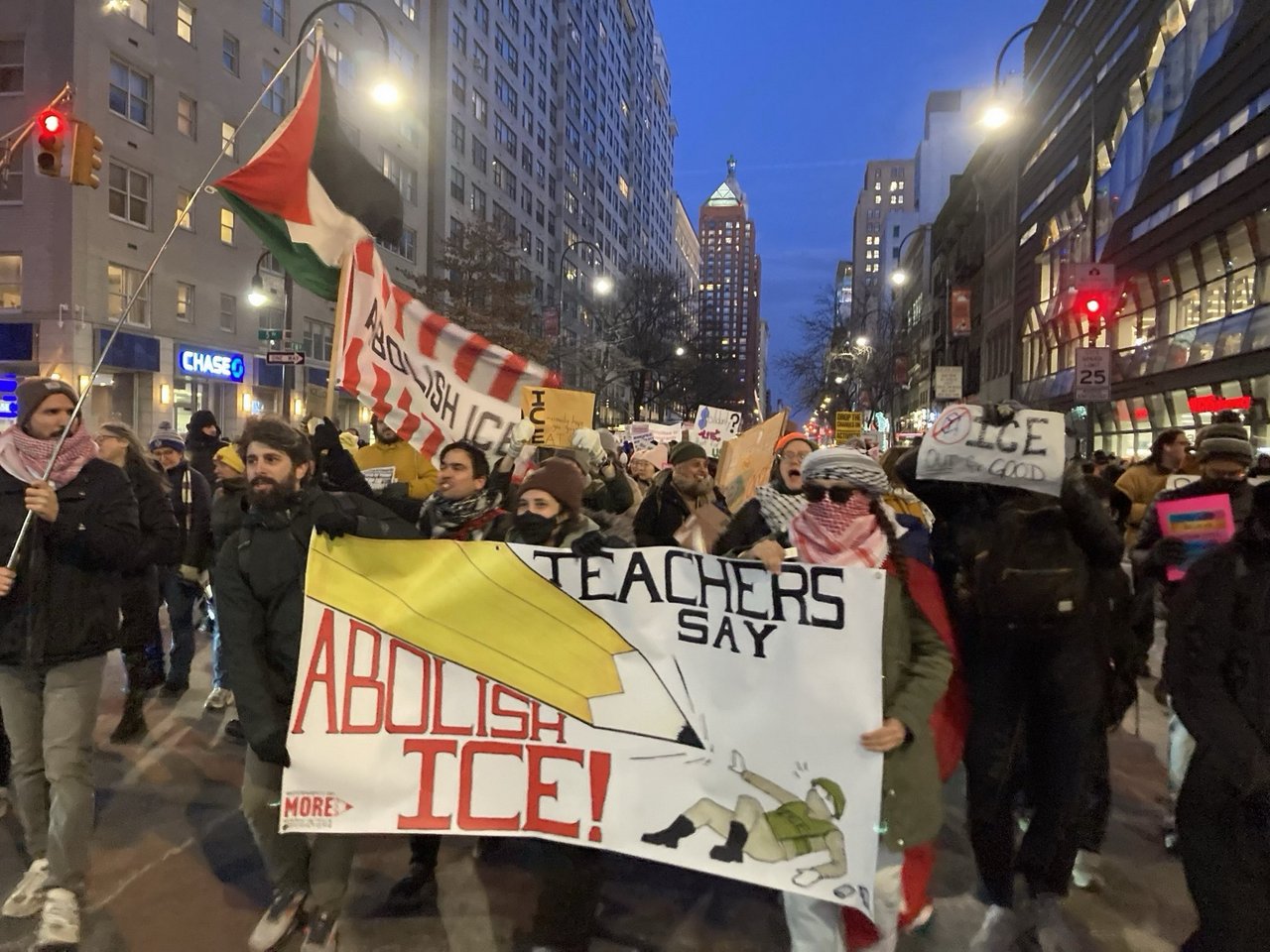
Handmade signs were everywhere. One banner showed a massive pencil pointed down at a tiny ICE agent with “Teachers say Abolish ICE.” Another sign read, “Ask students if they have pencils, not papers.” Each sign was like a declaration of our role as educators, about what it means to teach in a moment like this, and about our collective responsibility to defend our students and each other.
We unfurled our banner, painted last spring when our sanctuary team was formed: “Education Has No Borders,” written in big, bold, colorful letters and surrounded by butterflies — a collective effort of teachers, staff, and students. I thought about the students who had helped paint it — some no longer at our school, some forced to leave the country out of fear of deportation or family separation. I still wonder if they know how much we miss them, how often we think about them, how we’re still fighting for them.
What’s happening in Minneapolis impacts our schools here in NYC. The national situation shows up in our classrooms every day — in students’ questions, in their absences, in the fear some carry wordlessly with them. Our role as educators doesn’t stop at teaching content; it includes defending our students’ right to be safe.
Marching surrounded by coworkers and other educators, I felt overwhelmed in a different way than how I feel when I read the news. I felt overwhelmed by our collective power and what we can accomplish when we unite our struggles. We saw how the widespread community resistance to ICE in Minnesota forced Trump to retreat and remove ICE Border Patrol commander Gregory Bovino and the partial pullback of federal agents.
Now the question is what comes next — especially here in New York City. In recent days, Democratic politicians have rushed to take credit for ICE’s partial retreat in Minnesota, presenting it as the result of behind-the-scenes negotiations or electoral pressure. But we know the truth: Trump didn’t pull back because of strongly-worded speeches or press conferences, he pulled back because mass resistance made it impossible for them to continue as before. This partial victory belongs to all those who organized, walked out, shut things down, and refused to accept repression as inevitable.
That’s an important lesson for us in NYC. If we want to not only stop ICE but also win full rights for immigrants, our movement cannot be subordinate to the Democratic Party or to union leaders whose strategy is tied to it. We can make demands on our unions (and we must) but only a movement organized from the bottom up has the power to force those demands to be met.
That organizing is already underway. The rank-and-file caucus MORE-UFT recently held a virtual town hall with over 250 educators to discuss next steps, showing the depth of interest and urgency among teachers. The UFT resolution in solidarity with Minneapolis is a place to begin, but symbolic support is not enough. The UFT is one of the largest local unions in the country. If educators in this city move collectively and in coordination with other sectors, we have real power.
The words “general strike” — a concept that a century of anti-worker laws has tried to suppress — are once again in the national consciousness. And as the 2018 “Red State revolt” wildcat teachers strikes have shown us, labor laws made by the bosses are meant to be broken. That’s why we have to fight the Taylor Law — which prohibits public sector workers in New York State from going on strike — and organize ourselves to withhold our labor in defense of our students, our coworkers, and our communities.
But that kind of fight won’t be initiated from the top. We need to build strike power from the bottom-up; and that will only happen if rank-and-file educators organize ourselves to demand it. That means expanding democratic spaces in our chapters, strengthening the immigrant defense committees and sanctuary teams that already exist, and building networks capable of acting quickly and collectively like those activating in the Twins Cities. Support from our union leaderships that stops at statements and resolutions is not neutrality — it is a decision to leave immigrants to face the attacks alone.
Today, January 30, businesses are closing their doors. Students are staying home. Workers are calling out sick in protest. Across the country, a multiracial working class is rediscovering its power, and hundreds of thousands of workers have already shown they are willing to fight. In New York, I’ll be taking the streets again bundled in layers with coworkers and comrades at 4 p.m. in Foley Square.
Minneapolis is showing us the way forward. Students walked out, neighbors organized to defend their blocks, workers have begun to connect the fight to their working conditions and societal role. But that fight cannot remain isolated. As we’ve seen from Los Angeles to Chicago, if ICE can terrorize one city, it can do the same to any of ours — including New York.
Here in NYC, rank-and-file workers must organize to force our unions to commit real resources: money, mass meetings, and legal support. We must push for the expansion of workplace- and neighborhood-based defense committees that can respond immediately to raids, defend families, and act collectively — making it clear that there will be no raids, no repression, and no ICE violence without an organized response. And we must deepen the conversations that have begun about a national strike, what it means, how to organize to get there, and how to connect our struggle against ICE violence to the internationalist struggle against U.S. imperialism abroad.
If the labor movement in New York moves decisively, it can shift the balance of forces nationally. Minneapolis is showing us the seeds of what’s possible, and now we have to make that power impossible to ignore.