
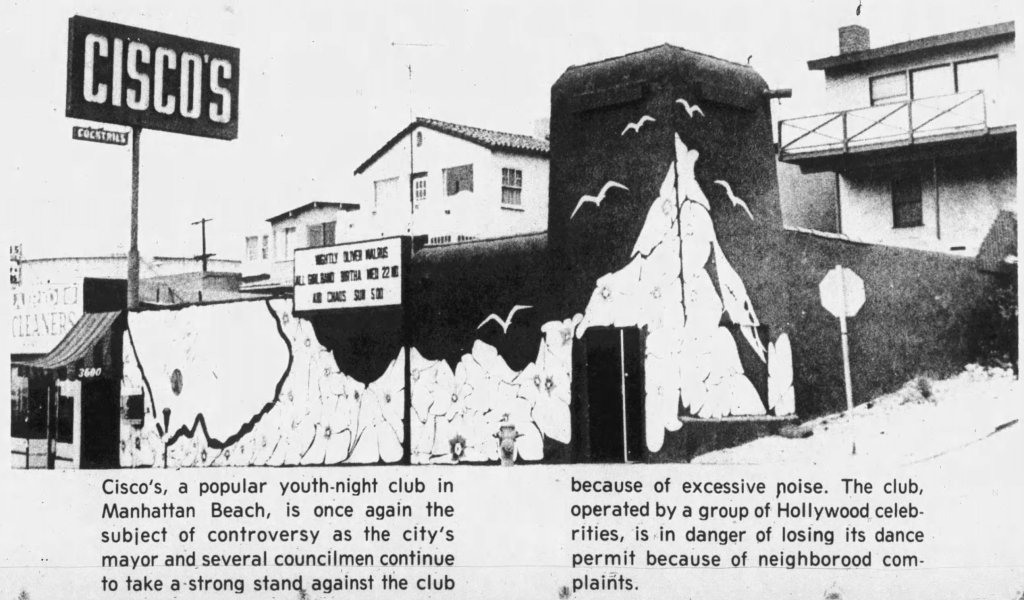
The original Manhattan Beach building that once housed Cisco’s restaurant and nightclub, 3600 Highland Ave., has long since been replaced. But longtime residents still remember the northwest corner of 36th Street and Highland Avenue in its prime as a bustling nightlife hot spot.
It wasn’t always so.
The earliest mention of the address in the Daily Breeze is in a 1935 advertisement as the location of Barney’s auto repair shop. In September 1954, Joe Provencio, owner of the Beacon Cafe at Rosecrans Avenue and The Strand, applied for a liquor license for Cisco’s restaurant using that address.
As did his Beacon Cafe, the new eatery offered Mexican cuisine. In addition to “Specializing in Finest Spanish Food,” per a June 1955 ad, it also featured Latin and Spanish-themed musical entertainment.
Provencio added on to the increasingly popular restaurant in 1957. In February 1960, he asked for and was granted a dance permit for the night spot, in time for a full-on “Cinco de Mayo Festival” held there over several days that May.
Music would continue to be a big part of the Cisco’s experience.
A 1962 appearance there by Los Angeles tenor saxophone legend Big Jay McNeely was recorded by Warner Bros. Records. The company released the album, “Big Jay McNeely Recorded Live at Cisco’s, Manhattan Beach, Calif.,” in 1963.
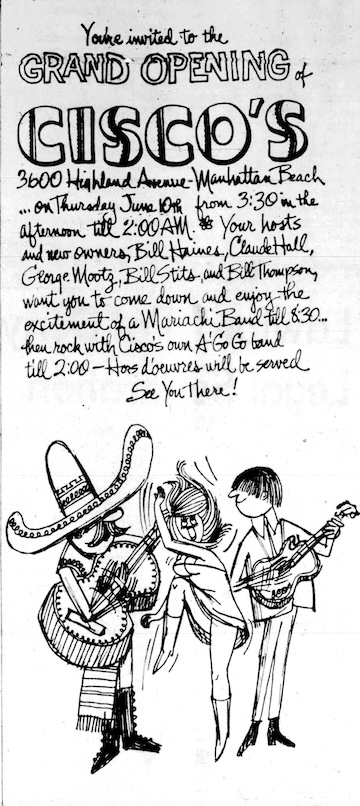
The grand opening ad for Cisco’s on Page 8 in the June 7, 1965, edition of the Daily Breeze. File photo
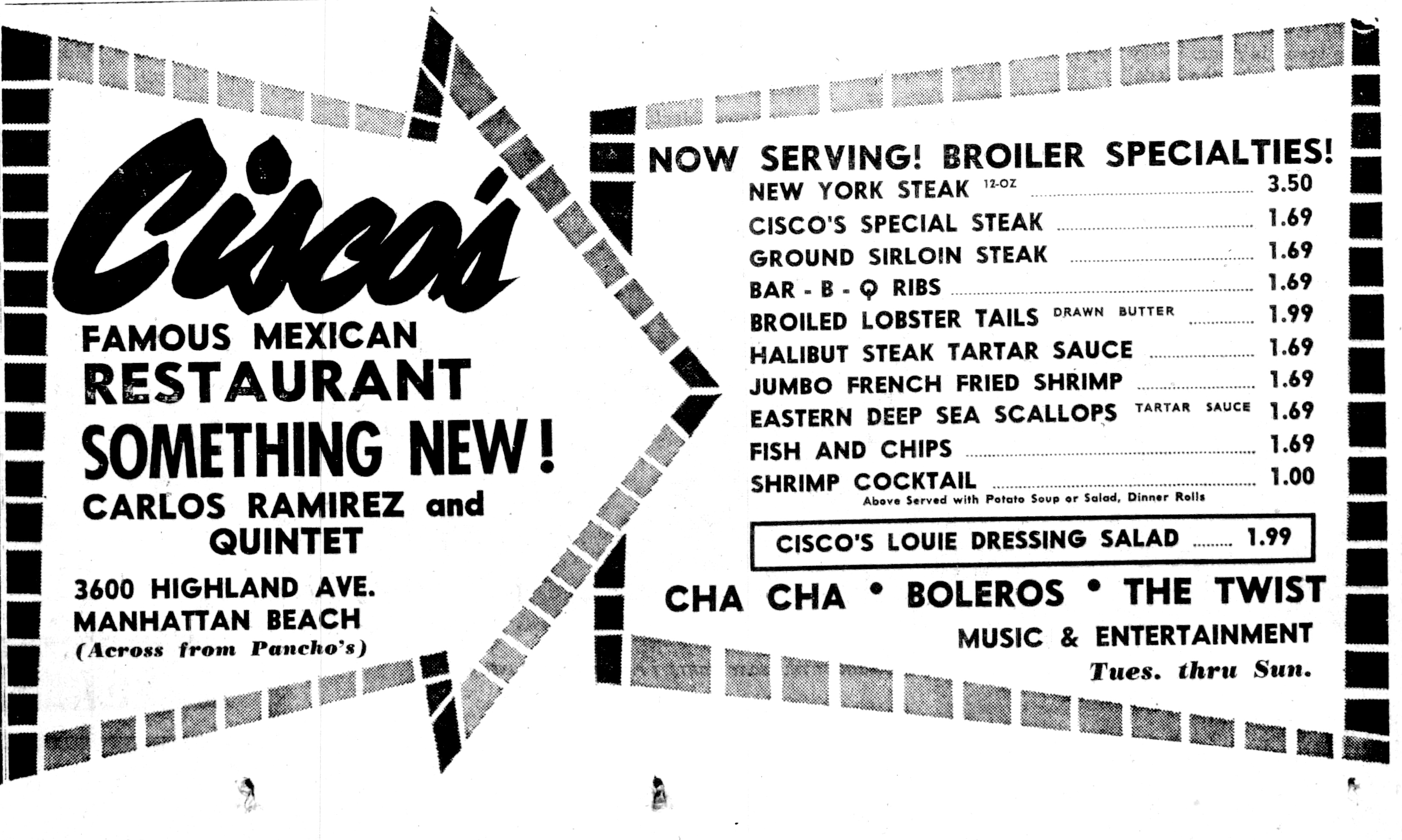
The Twist is on the entertainment menu at Cisco’s in this Daily Breeze ad on Page 3 from March 9, 1962. File photo
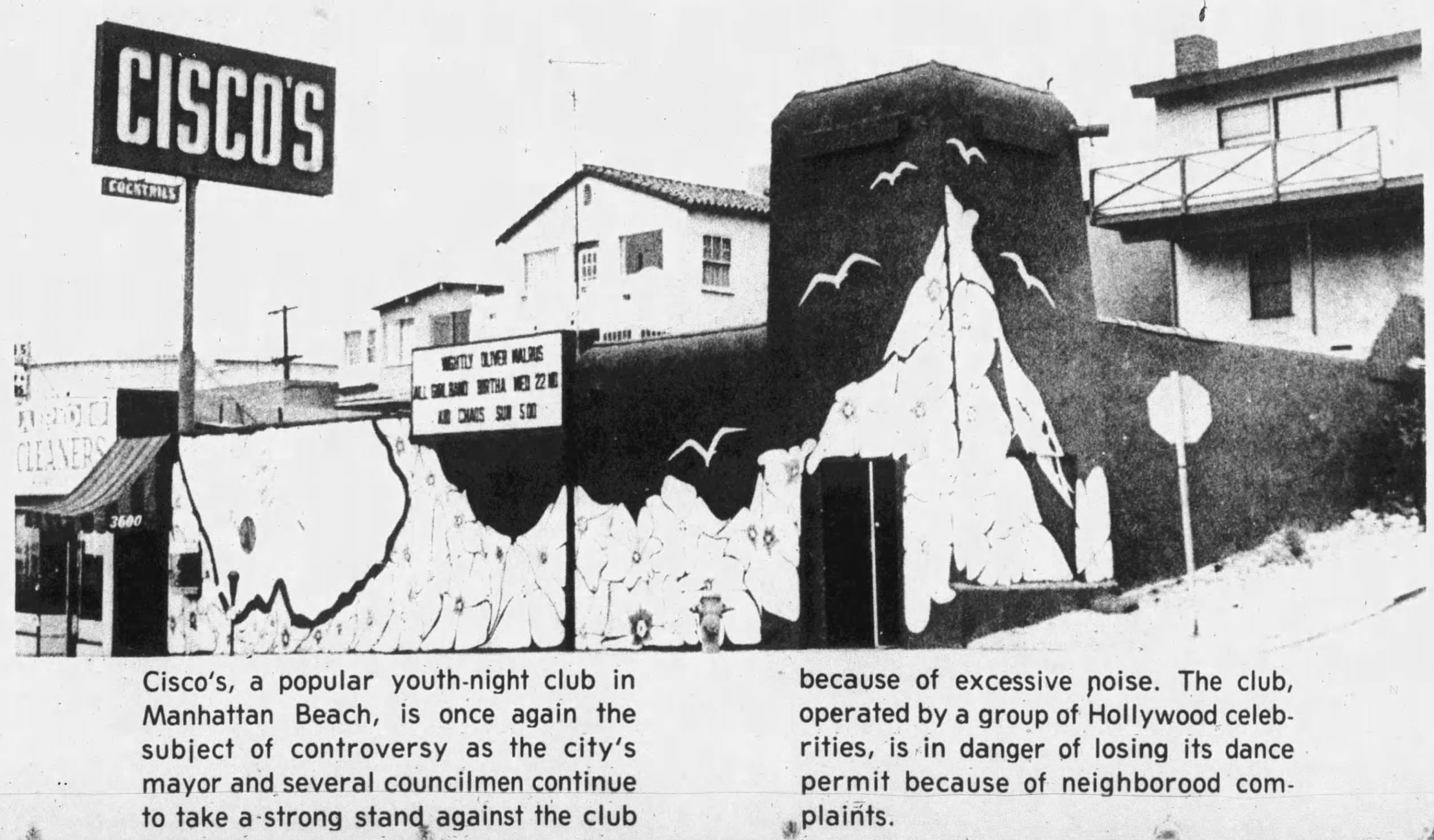
This Daily Breeze staff photo shows the close proximity of houses to Cisco’s in the March 19, 1972, edition, Page 15. File photo
Show Caption
1 of 3
The grand opening ad for Cisco’s on Page 8 in the June 7, 1965, edition of the Daily Breeze. File photo
By 1965, however, Provencio was ready to give up ownership in the club, selling it to four partners in the spring of 1965. The partnership group, Cisco’s Manhattan Beach, Inc., included William P. Haines, Claude G. Hall, George Mootz, William D. Stitts and William C. Thompson, all of them Manhattan Beach residents.
The quartet’s corporation became recognized by California on June 7, 1965. The club was completely refurbished inside and out to give it a more up-to-date look for its June 10 reopening.
After that, it quickly became apparent that the new owners were targeting a younger audience. In addition to the Latin dance bands, they began booking teen-oriented acts.
By the fall of 1965, local bands such as the Jesters, and Richard and the Bowmen were playing regularly there. On Nov. 10, British performer Ian Whitcomb played a night at the club on the strength of his national top 10 hit, “You Turn Me On.” Big Jay McNeely also returned for a two-week engagement in 1966.
In 1968, actor Jack Ging took over management of the club, bringing along with him two celebrity investors: actor Clint Eastwood, and comedian and Redondo Union High alum Tommy Smothers. Haines remained from the 1965 ownership team.
The new participants upped Cisco’s visibility by booking higher-profile acts. Ike and Tina Turner, for example, played dates there in 1969 and 1970. A March 1970 ad touted upcoming appearances by Bill Medley of the Righteous Bros, Jennifer Warnes, Rick Nelson, Etta James, and Kenny Rogers and the First Edition.
An undated poster exists for a Neil Diamond show at Cisco’s, though it’s unclear when it occurred. But Cisco’s attracted name acts like Diamond, Glen Campbell, Cheech and Chong, and others who could use the occasion to try out new material and work out performing kinks.
The club was beginning to live up to its advertised billing as “where the action is” but amping up the entertainment led to louder volume rock music and attracted larger, more boisterous crowds.
In August 1971, nearby resident Brenton Goodrich, representing 35 neighbors living near Cisco’s, brought a noise complaint to the Manhattan Beach City Council. It described overly loud music blasting into the neighborhood until 2 a.m. on most nights.
After warning the club of the complaint, the council declared Cisco’s a public nuisance on Dec. 7. But the club received a reprieve a month later when it was determined that its owners were working on the problem.
“If the loud music being played at Cisco’s was by Guy Lombardo or Lawrence Welk,” the soundproofing contractor doing the modifications told the council, “there never would have been any complaints in the first place.”
Still, during the March 7, 1972, City Council meeting, the local elected officials voted to revoke the club’s dance permit, effective March 21, on the grounds that the anti-noise measures had not been effective in solving the problem.
“Mayor (Mike) Sweeney has been operating like a Boss Tweed,” Smothers told the Daily Breeze. “He’s playing power politics because it’s an election year. He wants to get rid of everyone under 40 in this town.”
The furor died down somewhat after the city eventually established a zone around Cisco’s, outside of which excessive noise would not be allowed.
Perhaps discouraged by the whole dispute, however, Cisco’s owners called it quits, closing and selling the club entirely in February 1973. By October 1974, Cisco’s had reopened as Brennan’s, a branch of the popular Marina del Rey restaurant with a much lower entertainment — and noise profile.
After many more later changes, including a whole new building, the site is now occupied by a Baja Sharkeez restaurant/bar.
Sources: Daily Breeze archives. Los Angeles Times archives. Setlist.fm website. “South Bay/Los Angeles Days of Old California” Facebook page.