
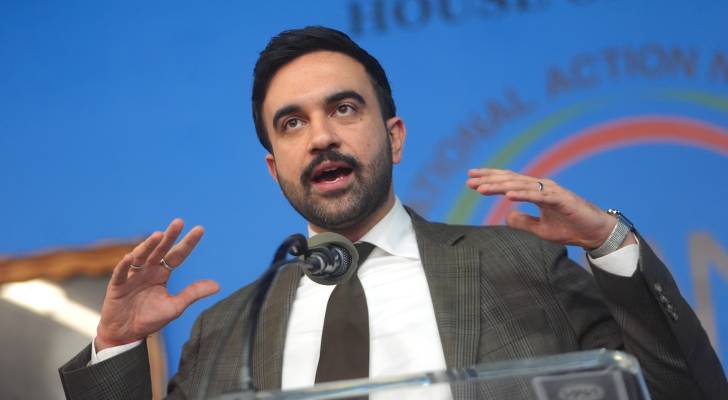
 Acar/Getty Images
Moneywise and Yahoo Finance LLC may earn commission or revenue through links in the content below.
Just four weeks after being sworn in as New York City’s mayor, Zohran Mamdani delivered a stark warning about the city’s finances — one he said rivals the worst downturn in recent memory.
“I will be blunt. New York City is facing a serious fiscal crisis,” Mamdani said at a press conference on Jan. 28 (1). “There is a massive fiscal deficit in our City’s budget to the tune of at least $12 billion.”
Mamdani squarely blamed his predecessor, former mayor Eric Adams, for the shortfall.
“We did not arrive at this place by accident,” he said. “This crisis has a name and a chief architect. In the words of the Jackson 5, it’s as easy as A-B-C. This is the Adams Budget Crisis.”
The warning follows recent figures from New York City Comptroller Mark Levine, who said the city is facing a $2.2 billion budget shortfall in the current fiscal year, along with a projected $10.4 billion gap in the next (2).
Mamdani described the situation in dire terms, arguing that the scale of the challenge eclipses even the financial fallout from the 2008 downturn.
“We are speaking about a fiscal crisis at [a] scale greater than the Great Recession,” he said (1).
Adams quickly pushed back, rejecting the claim that his administration left the city in fiscal distress.
“Bond raters gave my administration one of the strongest credit ratings in NYC history because we governed with discipline, not fantasy economics,” Adams wrote on X (3).
To close the gap, Mamdani said the city cannot rely on a single fix.
“There will not be one single thing that can answer that crisis,” he said (1). “It will require us to pursue every single avenue. That means looking inward into savings and efficiencies. That also means raising taxes on the wealthiest New Yorkers and the most profitable corporations. And it means recalibrating the relationship with the state.”
During his campaign, Mamdani proposed raising the city’s income tax rate by two percentage points on residents earning more than $1 million annually, along with increasing the corporate tax rate to match New Jersey’s 11.5% (4).
While city leaders can debate tax hikes and budget fixes to close multibillion-dollar gaps, most Americans don’t have that luxury.
When expenses rise or taxes creep higher, households can’t simply vote themselves new revenue — they have to adjust, plan and protect what they already have.
Over the past few years, inflation has taken a growing bite out of household budgets across the U.S.
One essential expense that has skyrocketed is car insurance. Nationwide, the average cost of car insurance has surged 55% since 2020, according to the Bureau of Labor Statistics (5).
Car insurance is a major recurring expense, and many people overpay without realizing it. According to Forbes, the average cost of full-coverage car insurance is $2,149 per year (or $179 per month).
However, rates can vary widely depending on your state, driving history and vehicle type and you could be paying more than necessary.
By using OfficialCarInsurance.com, you can easily compare quotes from multiple insurers, such as Progressive, Allstate and GEICO, to ensure you’re getting the best deal. Shopping around can help drive down your rates, and potentially get you a better deal.
Even better, in just two minutes, you could find rates as low as $29 per month. Keep in mind that you can often cancel your policy before it’s up for renewal, just look out for any early cancellation fees.
And it’s not just your car that might be costing you more than it should. Home insurance costs have also risen — and it’s another major expense where smart shoppers can save big.
With OfficialHomeInsurance.com, comparing home insurance rates is fast and hassle-free. Just fill in a bit of information and the platform will instantly sort through over 200 insurers to find you the best deals available in your area.
You’ll be able to review all your offers in one place and quickly find the coverage you need for the lowest possible cost, saving an average of $482 a year.
Read More: Approaching retirement with no savings? Don’t panic, you’re not alone. Here are 6 easy ways you can catch up (and fast)
One of the easiest ways to cut financial waste is by putting your spare cash to work instead of letting it sit idle.
If you’re building a financial safety net, a high-yield account like a Wealthfront Cash Account can be a great place to grow your emergency funds, offering both competitive interest rates and easy access to your cash when you need it.
A Wealthfront Cash Account can provide a base variable APY of 3.30%, but Moneywise readers get an exclusive 0.65% boost over their first three months for a total APY of 3.95% provided by program banks on your uninvested cash. That’s ten times the national deposit savings rate, according to the FDIC’s January report.
With no minimum balances or account fees, as well as 24/7 withdrawals and free domestic wire transfers, you can ensure your funds remain accessible at all times. Plus, Wealthfront Cash Account balances of up to $8 million are insured by the FDIC through program banks.
But even your spare change can be put to work. Micro-investing apps like Acorns let you invest small amounts automatically, turning everyday purchases into long-term investments.
When you make a purchase on your credit or debit card, Acorns automatically rounds up the price to the nearest dollar and invests the difference — the coins that would wind up in your pocket if you were paying cash — into a diversified portfolio of ETFs.
Buying a coffee for $3.40? The app rounds it up to $4 and invests the extra $0.60. Over time, those small amounts can add up — especially if you’re consistently spending and saving.
It’s a simple, set-it-and-forget-it way to build wealth from money you might not even miss — and, if you sign up today with a recurring monthly investment, Acorns will add a $20 bonus to help you begin your investment journey.
If you want to improve your finances, a key step is understanding where your money actually goes each month.
You could try tracking all your expenses for 30 days and sort them into two categories: essentials — like rent, groceries, utilities and healthcare — and discretionary spending, such as dining out, entertainment, shopping and hobbies.
This breakdown not only shows you where your money is going, but also highlights the hidden leaks — the forgotten subscription, the auto-renew you didn’t notice, or the small impulse purchases that quietly add up.
A quick daily check-in of your accounts can show you exactly where your money is going.
An app like Rocket Money can easily flag recurring subscriptions, upcoming bills and unusual charges by pulling in transactions from all your linked accounts.
This can help you cut unnecessary costs, and then you can manually redirect savings straight into your retirement fund. No spreadsheets, no guesswork, no stress. Small habits like this can make a big difference over time.
Rocket Money’s intuitive app offers a variety of free and premium tools. Free features include subscription tracking, bill reminders and budgeting basics, while premium features — like automated savings, net worth tracking, customizable dashboards, and more — make it easier to stay on top of your retirement contributions and overall financial goals.
We rely only on vetted sources and credible third-party reporting. For details, see our editorial ethics and guidelines.
NYC Mayor’s Office (1); New York City Comptroller Mark Levine (2); @ericadamsfornyc (3); Zohran for New York City (4); U.S. Bureau of Labor Statistics (5)
This article provides information only and should not be construed as advice. It is provided without warranty of any kind.