
MONUMENTS
MOCA Geffen Center & The Brick
October 23, 2025–May 3, 2026
Los Angeles
I’m writing this review from Vienna: just yesterday I took a walk in the local park, the Augarten, near my Airbnb, where there are two gargantuan flaktürm, or anti-aircraft bunkers built by slave-labor for the Nazis to defend the city against the Allies. The Germans intended, after a successful conclusion to the war—for their side—to clad the towers in marble and make them eternal tributes to the bravery of the fallen soldiers who had died in the service of Hitler and the Reich. What if the Austrians had gone ahead and made their bunkers into “Lost Cause” Nazi memorials? It seems perverse and unthinkably morally bankrupt, and yet this is what transpired in the American South after the end of Reconstruction. Thousands of memorials to a Lost Cause promoting human bondage and racial purity sprang up at the end of the nineteenth and well into the twentieth century, and it took over a century to begin to reject these coded objects intended to maintain an active resistance to basic decency and the rule of law. MONUMENTS—co-organized and co-presented by the Geffen Contemporary at MOCA and The Brick—presents a critical and at times effective response by artists of color to the still very present scourge of sculptural promotion of white supremacy in the United States.
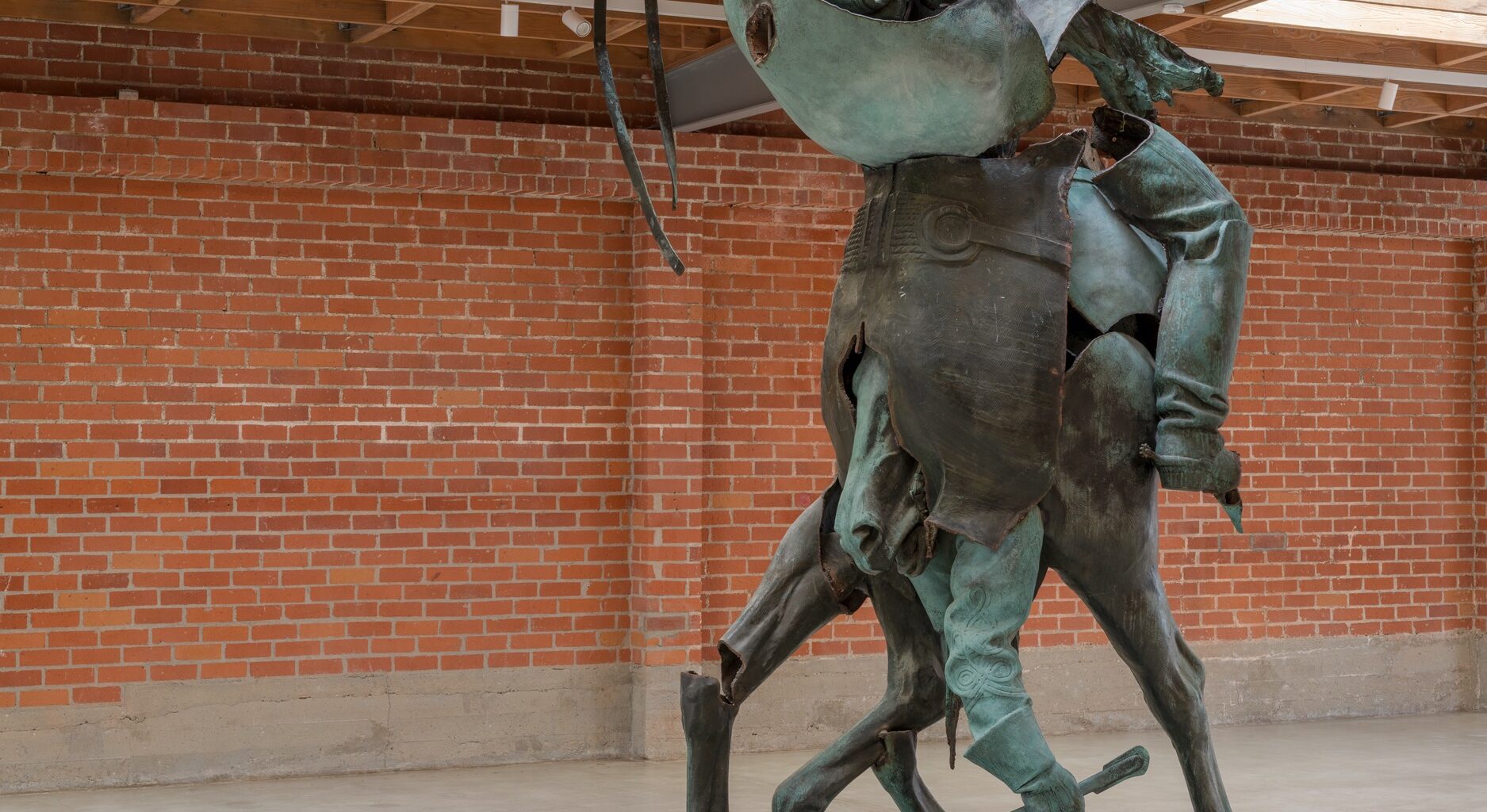
So how do you compete with almost indestructible marble and bronze monuments extolling the virtues of traitors such as Jefferson Davis and Stonewall Jackson? Torkwase Dyson’s Rate of Transformation, Distance (2018/2025) offers an equivalent counterweight to the Southern hero cult. Her glistening and precise black prisms, sunk into the floor as if they were crystals growing from the earth, push back against the narrative and sinuous contours of classic bronze statuary. Dyson’s monoliths’ Blackness rejects the gold-and-then-green coloring of the Confederate monuments. The massing is meant to convey Dyson’s ideas of Black movement and Black space, and her forms have an open side which offers a devouring maw that might consume the grandiose poses of generals and politicians in the face of the needs of a people. Kara Walker’s Unmanned Drone (2023) is a dismemberment of Charles Keck’s 1921 tribute to Stonewall Jackson, transforming it from a typical equestrian typology into simply a horse’s ass carrying a supine and flaccid Jackson whose sword drags in the dirt. Like a butcher, Walker has brutally cleaved the joints of the man and his horse, removing the neatness and perfection of the monument itself, which acted as a gloss for the horrors it overlooked while advocating the finer points of the supposedly utopian Southern social order.
Walker and Dyson represent the most effective means of formulating the anti-Confederate monument: blunt and total rejection. The alternate approach, that of criticality, falls flat—not due to the efforts of the artists specifically, but because it is an inherent weakness of the contemporary left to think that “unpacking” and satire can deflect the bald-faced hatred of well-armed men in white sheets who call themselves “wizards” and “grand-dragons.” In Hank Willis Thomas’s A Suspension of Hostilities (2019), an inverted replica of the General Lee car from The Dukes of Hazard plays on the inadvertent allyship of a young Black kid with Bo and Luke Duke, based on the seductiveness of pop culture. Unlike his Raise Up sculpture, which depicts desperate life-and-death moments of forceful oppression, the upside-down 1969 Dodge Charger is far too sweet and trusting. Karon Davis’s Descendant (2025), a realistic depiction of her young son Moses dangling a miniature Confederate General John Hunt Morgan by his horse’s tail, has the right proportion of dismissiveness and disdain for the pathetic-ness of Lost Cause rationalizations.