
Notes from the Radical Whirlwind
New Mexico Museum of Art Vladem Contemporary
October 24, 2025–August 9, 2026
Santa Fe, NM
Where did art history live in the 1970s? Inside a fantastically hackable machine called the slide projector, partly. At a recent talk in Albuquerque, feminist artist and longtime New Yorker Harmony Hammond recalled persuading university librarians to insert art by women into instructional decks used by “the boys.” Her friend Lucy R. Lippard, an established art critic and activist, projected slides by women artists on the façade of the then male-dominated Whitney Museum.
Both women now live far from New York in Galisteo, New Mexico. Their arrivals there (Hammond in the eighties, Lippard the nineties) perplexed the art establishment; after battling for recognition and getting it, why spirit yourself away? Lippard in particular had bolted over and over—away from MoMA’s halls after cutting her teeth there as a young staffer in the early sixties, then off to Boulder in the eighties for recurring stints as a visiting professor.
And yet the farther Lippard, Hammond, and their circle scattered from the ostensible center, the deeper they wound into new editions of the art history textbooks (and slide decks) they once had to crash. Lucy R. Lippard: Notes from the Radical Whirlwind is its own dense text, at times threatening to bottle the tempestuous figure it celebrates. But this rare display of Lippard’s vast collection ultimately affirms that you can’t fully close institutional walls around her.
Lippard isn’t precious about her collection; she calls it “stuff,” evoking the way works rolled into her life like any quotidian object. They’re gifts or jetsam from now-famous friends and collaborators: Faith Ringgold, Judy Chicago, On Kawara. Many works pooled in her SoHo apartment (dubbed the “sniper’s nest”) where she spent decades freelancing for publications as varied as Artforum and The Village Voice, often seeing twenty or thirty exhibitions a week.
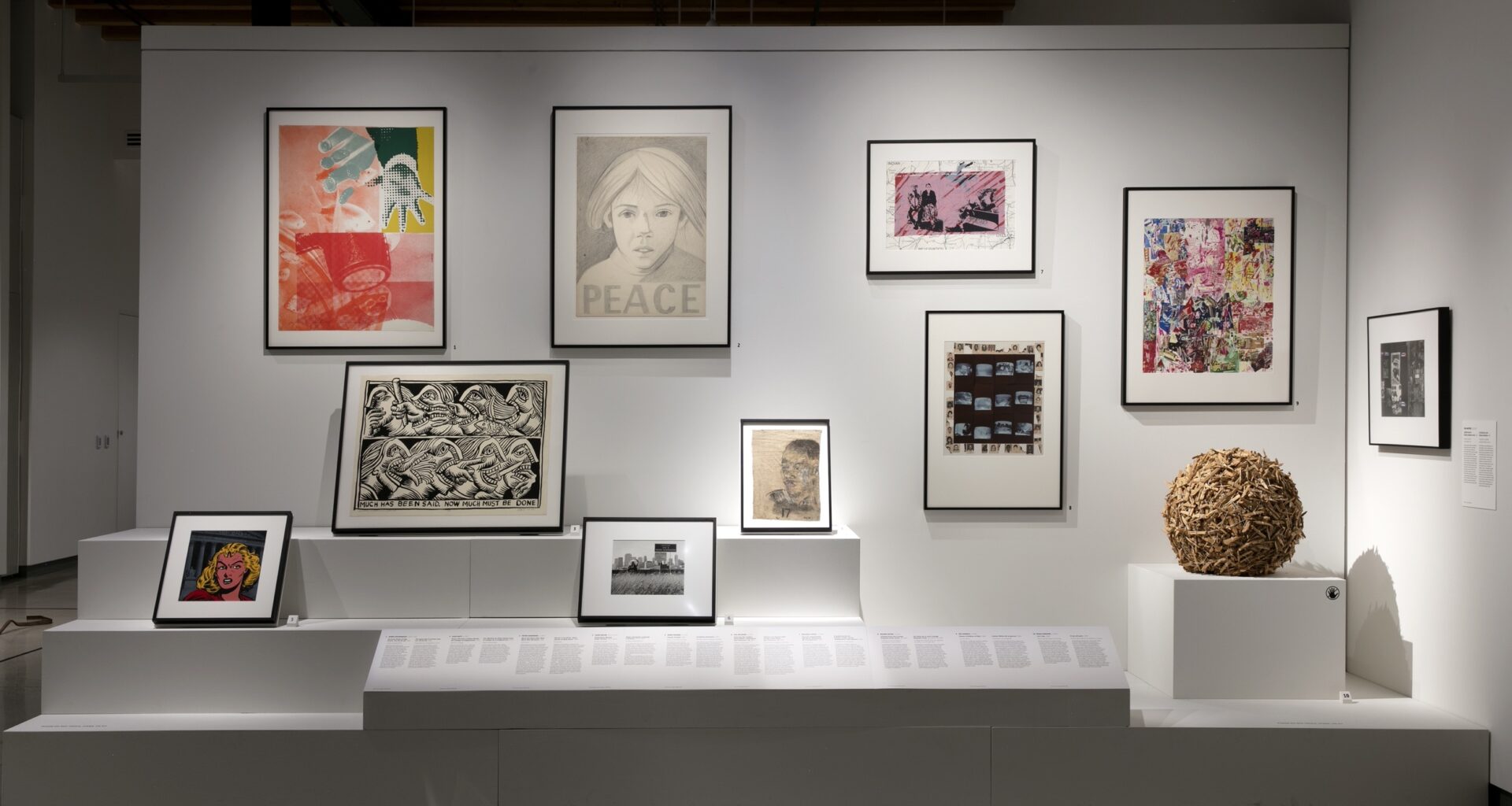
Curator Alexandra Terry carves the two-level Radical Whirlwind from more than five hundred artworks, artist’s books, and ephemera from Lippard’s 1999 gift to the New Mexico Museum of Art. The ground floor is devoted entirely to artworks, arranged into five crystalline historical pillars.
The opening passage, “A Concrete Actuality,” examines Lippard’s lithe support of both minimalism and post-minimalism in the 1960s. In one corner, she assists Ad Reinhardt in declaring his works the “last paintings,” as exemplified by the severe screen print Untitled (Black Square) (1964). On a far wall, she champions Eva Hesse, whose ink-and-graphite garden of concentric circles reactivates the picture plane and hints at her sculptural wildness.