
Christian Marclay: Doors
Brooklyn Museum
June 13, 2025–April 12, 2026
It is not accidental that the doors come after the clocks. Christian Marclay’s recent Brooklyn Museum exhibition Doors, curated by Kimberli Grant and Indira A. Abiskaroon, presents his 2022 eponymous single-channel film, which transposes the temporal composition of The Clock (2010) into a spatial movement. Through this shift from temporality to spatiality, the Swiss-American artist reminds us that the act of splicing and editing in film is, at its core, the very stitching-together of time and space.
Doors constructs fleeting passages that traverse disparate scenes depicting doorways, carefully excavated from a vast archive of actual movies. Marclay skillfully orchestrates scenes of characters entering and exiting doors, weaving them into a 55-minute temporal collage. Though these spliced scenes lack narrative continuity, they evoke a sensation of connection, inviting viewers into an unexpectedly absorbing state of drift across a woven network of cinematic spaces. In Doors, this sense of spatial flow is rendered with meticulous craftsmanship. The transitions unfold so smoothly, producing quasi-phantasmatic impressions of a single figure drifting from one door to the next—its appearance shifting at every passage, slipping across diverse eras and locales, oscillating between black-and-white and color. A trench-coat detective in sunglasses dissolves into a middle-aged man in a bathrobe; a woman in a luxurious evening gown gives way to a curious young boy. In a sense, this motif of ceaseless metamorphosis functions as an analogy for cinema itself, where the actor or star figure bears a sense of biographical continuity that stitches together multiple worlds. In Doors, each passage through a door opens onto a new narrative, with the editing forging a perceptual link between otherwise unrelated spaces.
On the level of production, one could readily imagine the immense labor of collecting that went into making Doors. At first glance, it might seem similar to that of The Clock: just like scouring thousands of film clips to find the exact scene where a clock shows 4:15 p.m., here too Marclay and his team must have combed through countless films in search of scenes where someone opens or closes a door. But suddenly, one realizes the task must have been far more complicated. What was required were not scenes of opening or closing, but those of opening and closing. To sustain the sense of continuity, a door must not only open onto one scene but also carry over to the next. In these particular spaces with one or more doors, the characters do not linger; they enter through one only to open another, or exit immediately through the same. Like birds that never land, they are permanently in transit.
Perhaps that is why many of the clips that make up this nearly hour-long patchwork film are chase scenes. The fugitive and the pursuer—sometimes armed—enter in turn, only to exit through another door. What they are running from and chasing after, and why, remain veiled, since they never stay long enough for us to find out. One after another, characters appear with determined expressions, walking straight ahead and disappearing through another doorway. There is little dialogue, shedding the heavy narrative weight of a typical chase scene. One might even call this a kind of “cinema of attractions,” in Tom Gunning’s sense, in that Marclay’s “film” exists solely to exhibit an endless play of transitions or transformations. The figures are either lost, as they retreat through the same door they entered, or adrift, as they simply pass through.
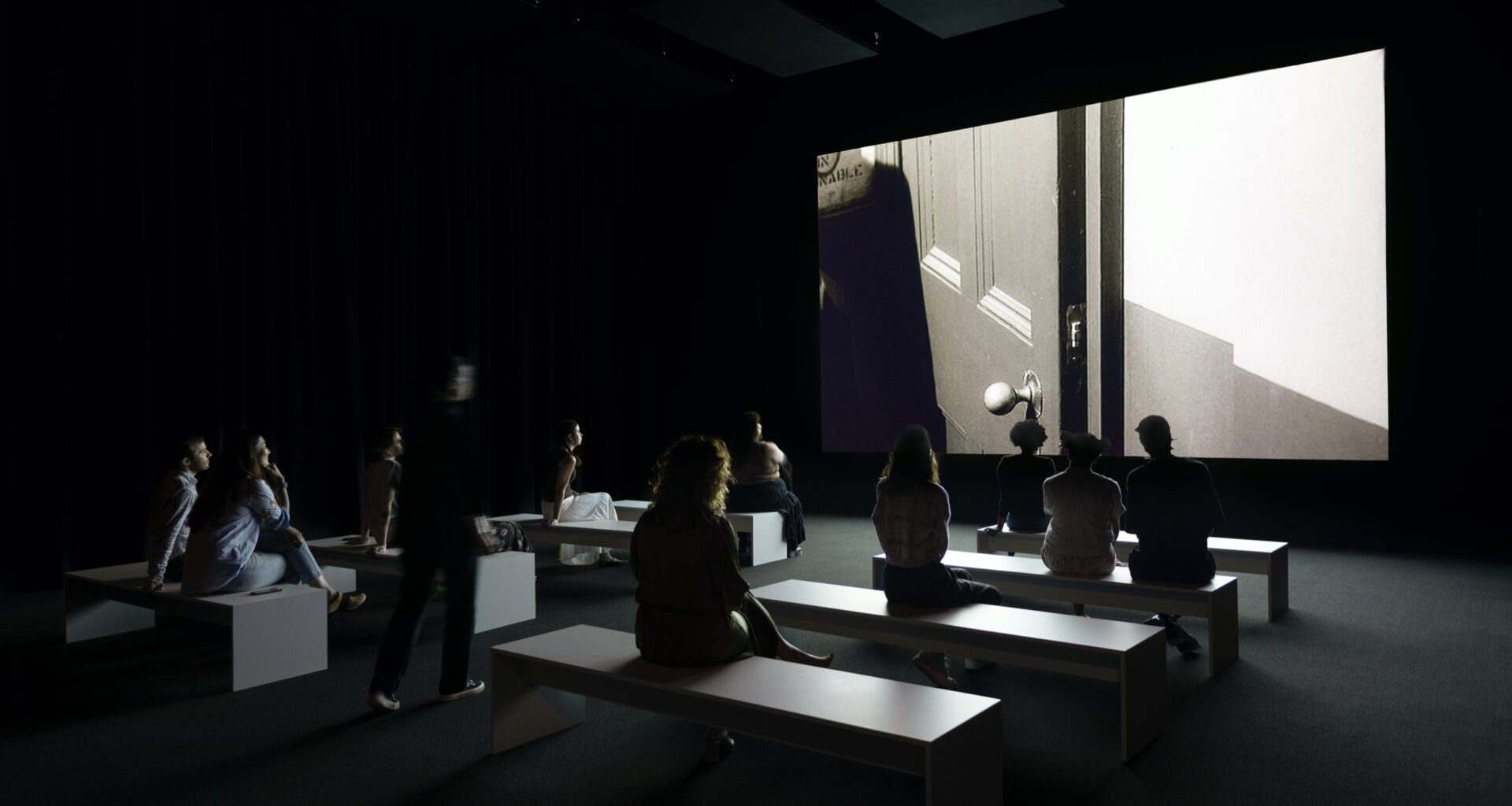
In terms of installation, Doors is distinguished from some of Marclay’s other works that adopt more typical gallery-based modes of presentation. Telephones (1995), for instance, was shown on a television monitor in a white cube gallery, and Subtitled (2019) allowed visitors to wander freely or sit casually on the floor within a dimly illuminated room. By contrast, Doors, echoing The Clock, evokes a classical cinematic apparatus, pointedly retaining the absorptive theatrical setting that preoccupied film theory of the 1970s. Both works rely on a distinctly cinephilic structure of collective viewing, staged in a darkened black box space set apart from the rest of the museum. Viewers sink into rows of seats, becoming, in Robert Smithson’s words, “hermits dwelling among the elsewhere.” This mode of spectatorship was in fact central to The Clock, where the viewers sit suspended within the loop’s temporal enclosure, reveling for the most part in the endless play of visual linkage and variation, only occasionally interrupted by moments of pleasurable surprise at recognizing clips from familiar movies. A similar spatial choreography is sustained in Doors. Visitors first enter a vacant hall in the museum’s fifth floor Moving Image Gallery, where they are ushered into the viewing space by the show title and wall text. Only after passing through the side openings do they come upon a black box theater, a darkened space equipped with rows of benches facing a projection screen centered on one wall.