
New York City rents surged through the end of last year, but the deeper crisis is that tenants are not moving—and Mayor Zohran Mamdani’s signature rent freeze policy threatens to choke the city’s already scarce housing supply.
The Big Apple’s rental market is essentially frozen in place, with local tenants less willing to relocate than renters nationwide, despite the typical asking rent reaching $3,585 by December, up $223 compared with a year ago, according to the Realtor.com® New York City rental report for Q4 2025.
Researchers parsed the latest available American Community Survey data and found that in 2024, nearly 90% of New York City tenants remained in the same apartment they occupied a year before, up from roughly 86% in 2010.
For comparison, less than 79% of renters across the U.S. stayed in place in 2024, up from 70% in 2010.
New Yorkers are also more tethered to their units when compared with residents of other major metros, including Los Angeles, where the stay-in-place rate was under 87%, followed by San Francisco (81%), Chicago (80%), and Boston (79.6%).
“As more renters stay put in NYC, fewer apartments become available for new households,” says Realtor.com economist Jiayi Xu. “And when units do hit the market, they’re often snapped up almost immediately, creating fierce competition and making the city’s rental crunch feel even tighter than the numbers suggest.”
Among the five boroughs, the Bronx stands out for having the highest recorded stay-in-place rate of nearly 94%, followed by Queens (90.2%), Brooklyn (89.5%), Staten Island (89.4%), and Manhattan (84.2%).
Bronx tenants also tend to stay in their apartments the longest, with the median move-in year being 2015, which is two years earlier than the city’s median move-in year.
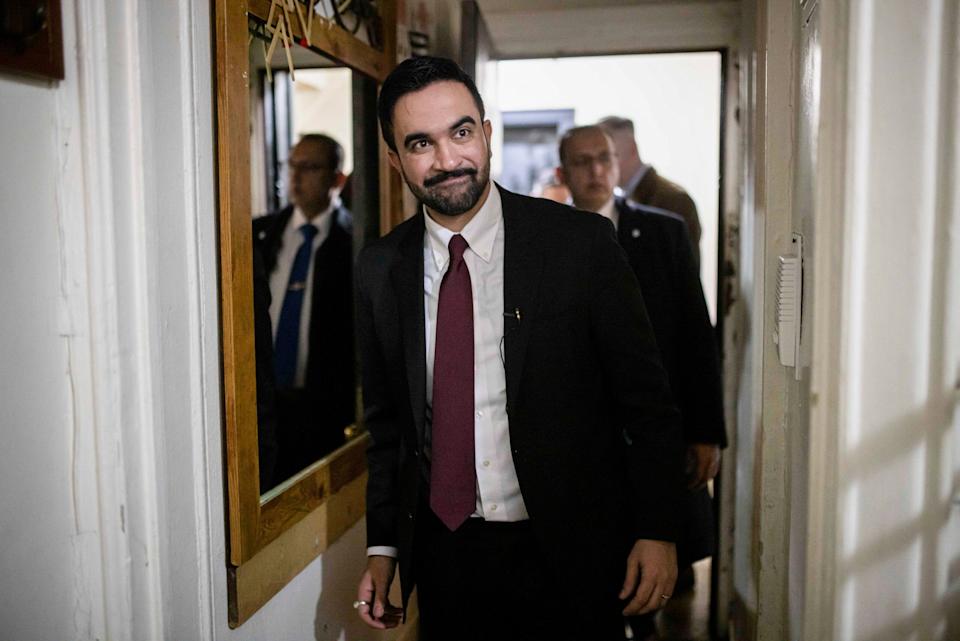 NYC Mayor Zohran Mamdani campaigned on imposing a freeze on rent-stabilized apartments.
About 40% of all occupied rental units in NYC are rent-stabilized, meaning they are protected by laws limiting annual rent hikes and granting tenants the right to lease renewals.
Xu notes that while rent stabilization benefits tenants, it also discourages them from moving. Renters of stabilized units tend to remain in place for years, sharply limiting inventory turnover.
Perhaps unsurprisingly, according to the 2023 NYC Housing and Vacancy Survey, the vacancy rate of rent-stabilized apartments was below 1%—nearly half that of market-rate rentals.
And the inventory crunch could be exacerbated if Mamdani’s freeze on rent-stabilized units goes into effect as planned on Oct. 1.
Under the policy, which was the centerpiece of Mamdani’s mayoral campaign, roughly 1 million rent-stabilized units across the five boroughs will see 0% annual rent increases with the approval of the Rent Guidelines Board—an appointed panel that votes on renewal rates for stabilized leases each year.
Story Continues
The policy aims to reduce housing cost burdens on families—a critical mission given that rents in the last quarter shot up year over year across all five boroughs, with Manhattan seeing the sharpest spike of 7.3%, pushing the typical asking rent to $4,889 per month.
Brooklyn saw the second-biggest annual increase of 5%, followed by the Bronx (4.2%) and Queens (1.2%). Data for Staten Island was not immediately available because it is under review.
Notably, a rent freeze is only one component of Mamdani’s larger housing strategy, which centers on a $100 billion, 10-year plan to create 200,000 new rent-stabilized homes for households earning less than $70,000 a year, while also heavily investing in the preservation of existing public housing.
A key component of Mamdani’s approach to solving the housing crisis is to speed up the city’s notoriously long permitting process by fast-tracking new affordable housing projects.
But significant economic, logistical, and potential legal challenges remain. In addition, the Independent Budget Office and housing experts estimate that New York is short by as many as 500,000 units over the next decade, which is more than double Mamdani’s building goal.
Critics argue that freezing rents could lock up inventory by deterring tenants from moving and cause landlords to delay building maintenance, leading to a decline in the quality of housing over time.
“With tenants staying put longer, fewer apartments would turn over, shrinking the already limited supply for new renters,” says Xu. “This heightened scarcity is likely to push rents even higher for the rest of the rental market, fueling competition and bidding wars over an ever-smaller pool of available apartments.”
Yonah Freemark, principal research associate at the Urban Institute, argues that the degree to which a rent freeze would be associated with increased rents in other apartments depends on overall market trends.
“If demand to live in New York City continues to grow at a high rate, a rent freeze will contribute to increased rental costs in other units as more people compete for them,” Freemark tells Realtor.com. “But if demand stabilizes, the rent freeze would not be likely to have that effect.”
In the longer term, Mamdani’s rent freeze policy could dampen new construction in NYC by making it a less attractive market for developers.
Realtor.com has asked the mayor’s office for comment.
According to Xu, the policy might have additional unintended consequences, including prompting renters living in budget-friendly units to delay major life milestones, from moving for a job to starting a family, or upgrading to a home that better fits their needs.
Stalled renter mobility may produce a deadlock effect, leaving families trapped in overcrowded units while older tenants delay—or entirely forgo—downsizing to smaller homes.
Freemark, however, notes that at the root of this argument is something of a double standard.
“U.S. housing policy assumes that it’s appropriate for people who own homes to stay in place and to be able to afford to do so, but we do not accord the same to renters,” he says. “In a city like New York, where most people are renters, that’s unfair given people’s need for housing stability.”
The best way to address NYC’s chronic housing shortage, according to the researcher, is through the construction of additional units, particularly subsidized ones that would be affordable for low- and middle-income families.