
Notwithstanding any problems, Harlem still offers all who live here the possibility of a better life, in the world’s best place.
Improving every day, Harlem’s quality of housing, its comparative spaciousness and relative affordability, its sense of place and historic ambiance, are all unrivaled on Manhattan Island. As a Black man, l’m a preservationist and an historian because of Harlem’s Black heritage. It represents immeasurable accomplishment in the face of adversity and disdain. Imbued in every brick of each old building here is the best of America. By celebrating Blackness, by including us, Harlem embodies me; all that I am.
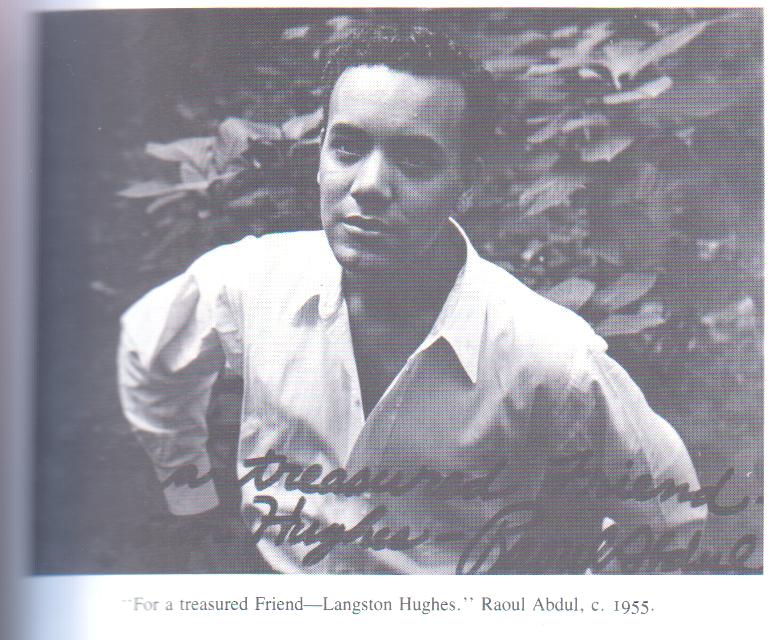
Over the years, what drew me here had also lured other Ohio natives. Langston Hughes was one (although not born there, he grew up in Cleveland). Another was Raoul Abdul (née Raoul Abdul Rahim), the classical singer, author, and AmNews music critic, who would become Hughes’s last personal assistant and secretary.
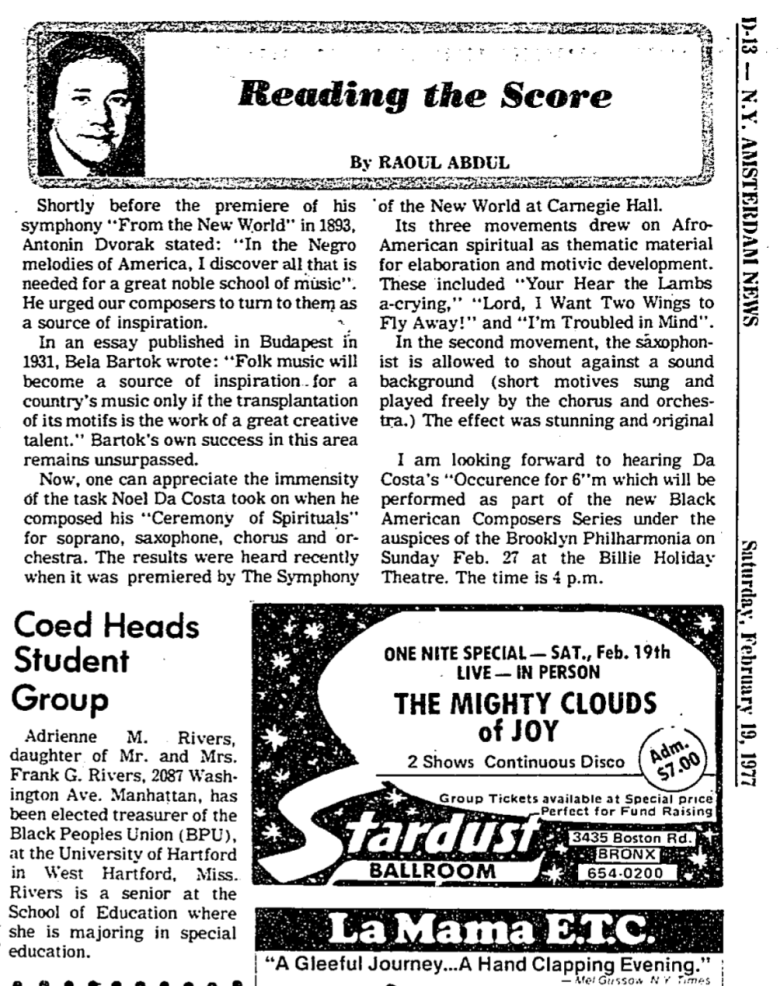
When I first arrived in Uptown, one initial surprise was reading a review in Raoul’s column, “Reading the Score.” He’d written about a production of “Tosca” at the Metropolitan Opera. Discovering, in an otherwise normal newspaper, something so esoteric, yet easily readable; such nuanced insight and scholarly erudition, astonished me. “Who was this African American connoisseur,” I wondered, “’and how did he come to have such an unusual name?”
Becoming friends with Raoul by the early 1990s, in time I learned he was born not far from my home in Akron — in Cleveland, Ohio, on November 7, 1929. Raoul Abdul’s father was from Calcutta. His patrician Black mother was able to trace her ancestry back to the pre-Revolutionary War period. His aunt married Count Basie.
In 1990, in the AmNews, he explained this for himself: “When I was eighteen years old, Leonard Hanna, Jr. (grandson of Mark Hanna, who put McKinley in the White House) treated me to my first trip to New York City. As I boarded the bus, he pressed into my hand a slip of paper with the [message]: ‘Dear Jimmy, this is Raoul Abdul. Give him anything he wants and save the bill for me.’”
 Credit: MICHAEL HENRY ADAMS
Educated at John Hay High School, precocious Raoul was participating in children’s theater productions by age 6. After secondary school, he began working as a journalist for Northeastern Ohio’s leading Black newspaper, the Cleveland Call & Post. Attractive, highly gifted, and gay, Raoul was noticed and encouraged by the rich art patron Leonard Hanna, whose further backing allowed the 22-year-old to move back to New York permanently in 1951.
A concert baritone and German lieder expert, Raoul studied voice with renowned Russian baritone Alexander Kipnis from 1959 to 1962. It was under Kipnis’s tutelage that Raoul eventually earned a diploma from Vienna Academy of Music. Raoul also studied at the Cleveland Institute of Music, New School for Social Research, New York College of Music, Mannes College of Music, and Harvard.
Singing with such notables as William Warfield (who married diva Leontyne Price) and the legendary Marian Anderson, a founding director of Harlem’s Coffeehouse Concerts, Raoul served as literary assistant to Hughes from 1961 until Hughes’s death in 1967. Cast through this position into the sometimes unwelcomed role of confidant, Raoul, for me, put to rest a spate of academic equivocating about his boss and friend’s sexuality, stating, “Unfortunately, I was obliged to sleep with Mr. Hughes twice.”
On his first evening in town, he told me, “I took a taxi (as instructed) down to Eighth Street in the Village and presented myself with just my valuable scrap of paper as a letter of introduction, to Mr. Jimmie Daniels, the handsome and debonair gentleman who held court nightly at the very fashionable playground of the rich called Bon Soir. Phyllis Diller and a just-starting-out Barbra Streisand also performed there.”
One problem Raul never had that plagued lots of other creative queer men was an unsupportive family, pressuring him to do something more marketable. I did experience that. “You can’t be an artist or an interior designer,” my father told me. “White people won’t hire you!” Hughes, Jules Bledsoe, and James Lesley “Jimmie” Daniels heard much the same thing.
Born in Laredo, Texas, Daniels grew up in Little Rock, Arkansas. Talented as a performer, he was smart enough to move to New York to attend classes at Bird’s Business Institute in the Bronx. Upon completing, he even returned home and worked as an administrative assistant to the president of the Century Life Insurance Company. By 1928, though, he was back. In those first years in Harlem, he hosted cocktail-musicales where he sang, for a dollar per person, at the Bronze Studio (227 Lenox Avenue, extant). Built as a grand townhouse, it was a catering hall owned by Iolanthe Sidney, the patron of low-cost housing for artists, dubbed by Zora Neal Hurston “Niggeratti Manor” (267 West 136th Street; since demolished).
Performing at the Hot-Cha nightclub (2280 Seventh Avenue; extant), where Billie Holiday started, Daniels met architect Philip Johnson in 1934, who told me he was “the first Mrs. Johnson.” Daniels was living at this time with writer Wallace Thurman as his roommate. They were the subtenants of their friends, actress Edna Thomas; her husband Lloyd Thomas; and Edna’s lover, English aristocrat Olivia Wyndham, all occupying the spacious co-op they owned on Harlem’s most posh boulevard (1890 Seventh Avenue).
In short order, he had his own Harlem nightspot: Jimmie Daniels’s supper club (114 West 116th, operating 1939–1942; extant).
On January 27, 1940, Marvel Cooke wrote of Daniels’s progress in the AmNews, “When Jimmie first came to Harlem a dozen or so years ago, he had no idea that someday he would be the toast of sophisticated circles on both sides of the Atlantic and that he would number among his friends European royalty, the kings and queens of stage and screen[,] and the princes of industry. The story of Jimmie Daniels reads like something out of a book.”
Some castigated Daniels’s singing voice as having been “slight,” comparable to Bobby Short’s or even to Rex Harrison’s! Not Raoul, though. “His voice? His diction and style, were a revelation. One of the special characteristics of Daniels’s vocal performances was always his exemplary English with such precise particularity!”
With his own thorough training, advantageous connections, and prodigious talents, what became of the similarly glittering career that everyone expected for Raoul Abdul?
“I had two rather bad addictions,” Raoul explained once over lunch. “Yes! I was an excellent musician, and I cared greatly about music, but I cared more about drinking and sex.”
Publishing his first book, “3000 Years of Black Poetry,” in 1970 with author Alan Lomax, he added “The Magic of Black Poetry,” “Famous Black Entertainers of Today,” and “Blacks in Classical Music” over the next several years. Appreciating how arduous writing and getting into print can be, Raoul was quite complimentary about my 2001 book, “Harlem Lost and Found, an Architectural and Social History, 1765-1915.” As to my forthcoming “Homo Harlem, Lesbian and Gay Life in the African American Cultural Capital, 1915–1985,” Raoul was beside himself, with both praise and support. After the Gay Pride Parade in 1995, he wrote in his column in the AmNews, “Michael Henry Adams is a knowledgeable young man who has studied Harlem’s history and architecture. He is writing a book about Harlem’s gay and lesbian past, and I only hope that some of you can take some of the things he’s discovered …”
Relocated in Riverdale from his West 22nd Street apartment, after the death of his long-term white lover, attorney Richard Haber after heart-by-pass surgery, Raoul Abdul died quietly on January 15, 2010, at the age of 80.
Like Harlem music lovers, I lost a true friend.
Like this:
Like Loading…
Related