
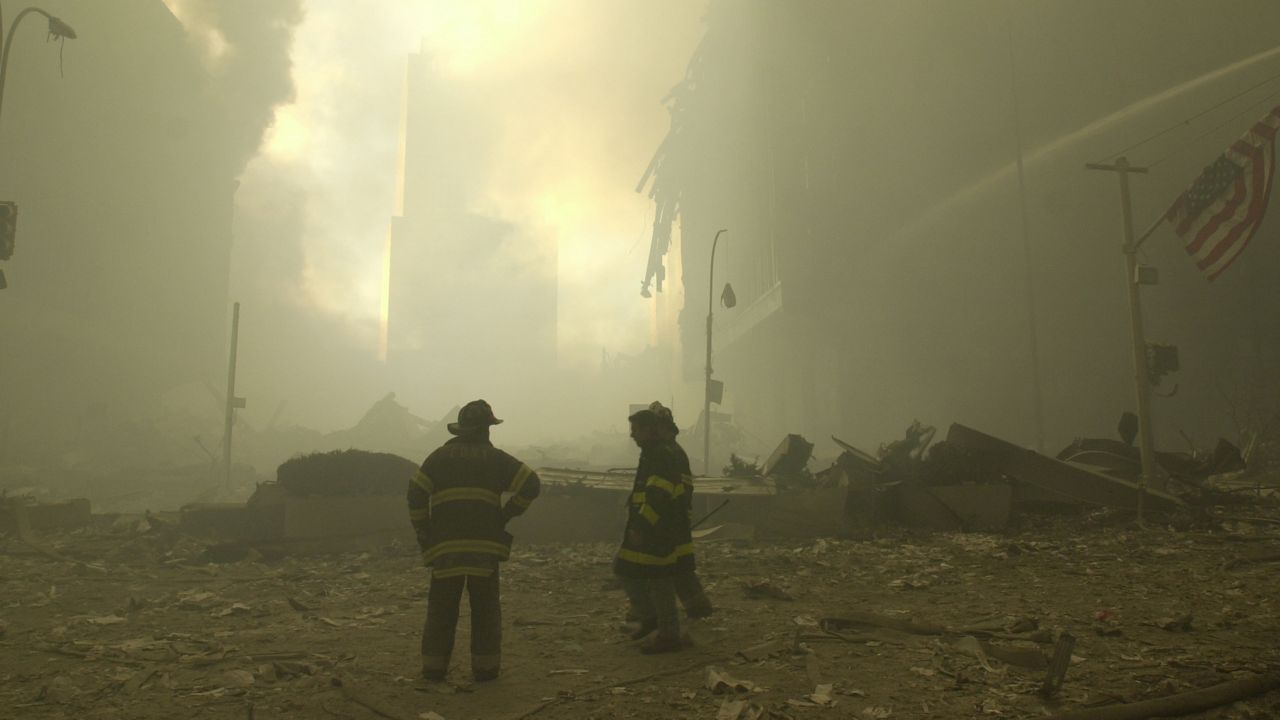
One World Trade Center towers above the memorials for the Twin Towers and the 2,753 people killed in the Sept. 11, 2001, terrorist attacks. Just feet away stands another place of remembrance: the Memorial Glade, honoring those who later became sick from the air they breathed in lower Manhattan.
It is now widely acknowledged that the air contained toxins.
Over the years, NY1 has reported on people who say they were harmed after returning to the area. For a long time, city officials publicly maintained the air was safe.
Five days after the attack, a New York City Health Department press release said asbestos test results showed “the general public’s risk for any short or long term adverse health effects are very low,” while advising people to “guard against dust and soot.”
In early October 2001, responding to public questions about air quality, then–Health Commissioner Neil Cohen said tests of particulate matter “do not pose long-term health risks to the general public.”
In February 2002, Cohen’s successor, Tom Frieden, told a U.S. Senate committee, “None of the test results done to date would indicate long-term health impacts.”
Now, for the first time, NY1 has obtained a document that appears to show the city was also privately preparing for the possibility of lawsuits tied to air quality concerns.
What You Need To Know
A memo obtained by NY1 suggests the city privately anticipated lawsuits tied to post-9/11 air quality while publicly assuring residents the air was safe
The document estimated up to 35,000 potential plaintiffs and cited health advisories that may have prompted people to return too soon
City officials have said tests showed no long-term health risks, though thousands have since filed claims for 9/11-related illnesses
The memo surfaced in a journalist’s archive, not from the city, after years of public records requests seeking air quality documents
The memo was sent to Bob Harding, then–Deputy Mayor for Economic Development under Mayor Rudy Giuliani, sometime before Harding left city government in December 2001.
It says the city’s Law Department estimated New York could face “approximately 35,000 potential plaintiffs as a result of the events of September 11.”
One potential cause cited was that “health advisories caused individuals…to return to the area too soon…causing toxic exposure.”
When asked if this was an admission that the city failed, in some regards, in its response to the air quality after Sept. 11, City Council member Gale Brewer responded, “Yes, I think most definitely what this memo shows.”
Brewer said she saw the memo for the first time this week.
“And it kind of confirms what we thought: that the city had more information than they shared in the last 20 years,” Brewer said.
The memo, which summarizes a discussion with the Law Department, does not disclose details about unsafe conditions or state that the city knowingly sent people back into hazardous environments. Still, Brewer said it concerns her that the document has surfaced only now, despite previous efforts to obtain records related to air quality after the attacks.
NY1 has been unable to independently verify the memo’s authenticity. The network contacted Harding on Wednesday morning, asking about the contrast between the city’s private deliberations over potential lawsuits and its public assurances that the air did not pose long-term health risks. He did not respond. A spokesman for Giuliani also did not respond.
“It made me feel sad because I might still have my brother,” said Karen Klingon after learning about the memo.
Her brother, Rob Klingon, lived blocks from the World Trade Center in 2001. She said he returned to the neighborhood about a week after the attacks, trusting assurances from health officials that the air was safe. Around that time, the city reopened City Hall and the New York Stock Exchange.
In 2020, Rob Klingon died from brain cancer, one of the illnesses the federal government says can be linked to toxins released in lower Manhattan after the collapse of the towers.
“We were told it was safe. Why would you go back home thinking that it was — you know — you were entering a toxic cloud? You would not do that,” she said.
According to the National September 11 Memorial & Museum, more people have now died from 9/11-related illnesses than were killed on the day of the attacks. More than 105,000 claims from all 50 states have been filed with the federal Victim Compensation Fund by people who say they became sick from exposure to toxins.
“We’re just trying to get information out to the public,” said Andy Carboy, the attorney who obtained the Harding memo and shared it with NY1.
“Why would these officials identify a risk of lawsuits almost instantly after September 11th if they did not have some concern that there was a mismatch between the messaging?” Carboy asked.
More than two years ago, Carboy filed a public records request seeking documents related to the city’s response to air quality concerns after the attacks. The request went to seven city agencies, but Carboy said he did not receive the memo from the city.
Instead, he found it in the archives of the late journalist Wayne Barrett, who wrote a book about Sept. 11. Barrett’s papers are housed at the University of Texas at Austin.
Carboy said the mayor’s office has told him at least 10 times over more than two years that it needs more time to respond and has not turned over records.
“Why should first responders and the families of all of those affected by this tragedy have to go to Texas to learn more about the city’s management of risks following the World Trade Center collapse than from the city itself?” he said.
The city’s Law Department did not respond to questions about the Harding memo. On Wednesday, Mayor Zohran Mamdani’s nominee to lead the department, Steven Banks, addressed document requests during testimony.
“We’re going to review what records there are and release what records can be released,” Banks said.
Meanwhile, the memorial near the World Trade Center for people like Rob Klingon remains, even as the number of those who fall ill is expected to grow and questions about the city’s handling of air quality continue.
“It’s painful to think of the city withholding this kind of information that has such a profound effect on its citizens,” Karen Klingon said. “And I hope that the city learns from this and maybe does things differently in the future.”