
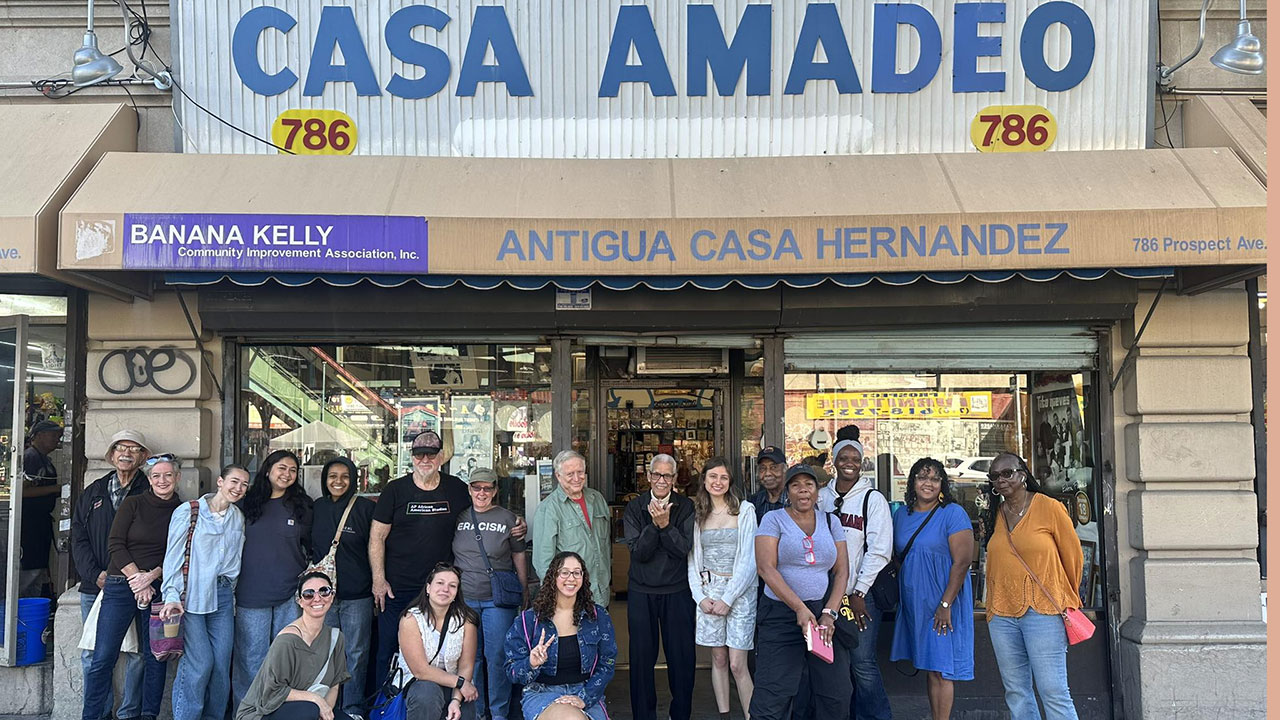
Every day, countless people around the world get an up-close and personal view of the residents of the Bronx, thanks to Fordham’s Bronx African American History Project (BAAHP).
And that interest is growing fast. The project recently surpassed 30,000 downloads of its oral histories in a single year—from users in 120 countries.
“It’s clear there is a global audience for research on African American history and the Bronx,” said BAAHP founder Mark Naison, PhD, a professor of history and African & African American Studies. “It’s incredibly moving to know that people all over the world are accessing our interviews.”
Naison said one of the first things he does every morning is load the project’s public dashboard, which shows, in real time, where people around the world are downloading any of the project’s 511 archived transcripts, videos, and essays. As of Feb. 5, the total number since the project’s inception was 87,730.
“It’s mind-blowing to wake up and see, for instance, that in one day, eight of our interviews are being accessed by scholars in different parts of Brazil,” he said.
The project began in 2002 as a way to collect and preserve the rich history of the roughly 500,000 African Americans living in the Bronx. The collection includes interviews with musicians, religious leaders, restaurant owners, and many other community members.
Last year, the BAAHP broadened its archives by including oral histories conducted by the Bronx County Historical Society, a longtime partner.
A Student-Led Digital Initiative
Graduate student Anthony Abd-al Shafi Rosado is overseeing that integration. He also supervises the Fordham undergraduates who transcribe and upload videotaped interviews conducted by Naison, Fordham students and faculty, and community historians.
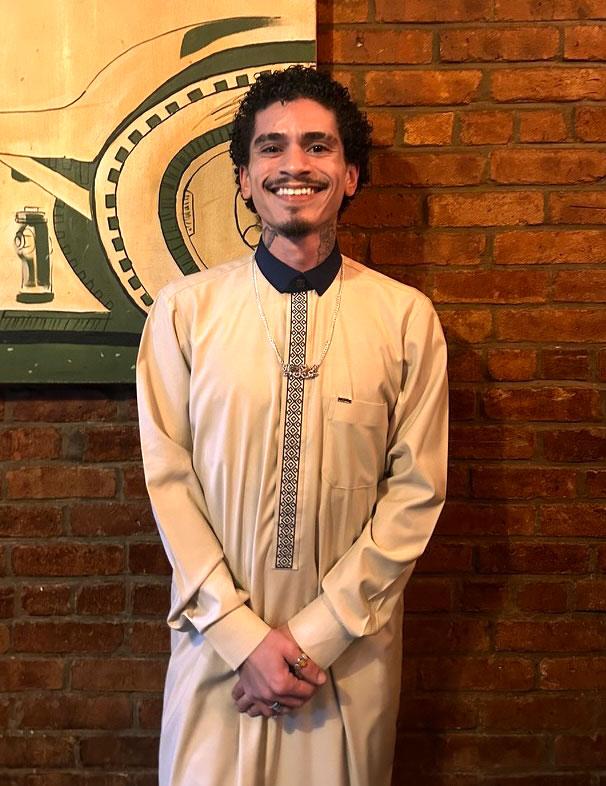
Anthony Abd-al Shafi Rosado
Photo by Cleopatra Allen
Rosado said that overseeing an oral history project like BAAHP complements his doctoral research in history. As part of his PhD studies, he’s researching Latino Muslims in the United States, a group in the Bronx that the project has begun to add to the archive. Oral histories will be key to Rosado’s own dissertation, which will focus on late 19th-century Black visibility in transatlantic art museums.
“Oral histories were the crux of my master’s thesis, and they remain the crux of archival research, which is the foundation of my doctoral work,” he said.
In addition to supervising, Rosado also conducts interviews himself for BAAHP. One of his most recent conversations was with Fordham’s director of Muslim life, Imam Ammar Abdul Rahman (Watch the video interview here).
Rahman, a first-generation immigrant from Ghana who moved to the Bronx in 2012, sat for his interview at the LITE center, the University’s multimedia facility at the Walsh Library. BAAHP interviews are currently focusing on Muslim Bronxites, something that resonates with Rosado, who said he reverted to Islam in November.
In a conversation that Rosado led along with professor Jane Kani Edward, PhD, Rahman discussed how he rebelled as a teenager against his religious upbringing before returning to the faith, and how his views on his African American neighbors in the Bronx shifted as he learned more about the struggles they’d faced during the Civil Rights era.
“As a Muslim, I have a profound level of respect for African Americans because, in order for me to dress this way and work in an institution like Fordham, their ancestors had to sit on buses, face off with police, go to jail, and be killed,” he said in the interview. “Whatever I do now, I’m standing on the shoulders of giants who came before me.”
‘No Better Place’ to Showcase Immigrants’ Contributions
Although the BAAHP archive has been available to the public for several years, Naison speculates that the uptick in interest is connected to a desire to push back against anti-immigrant sentiment currently sweeping the United States and other countries.
Researchers and activists are drawn to the Bronx because films, novels, and a new Hip Hop museum have given the borough greater cultural cachet, Naison said—fostered in part by immigrants whose stories comprise a large part of the archives.
“The Bronx has been an incubator of more forms of popular music than any place in the world, because of the mixture of cultures of people from different parts of the world living together,” Naison said.
“If you are making a pro-immigration argument, there’s no better place to base it on than the Bronx.”