
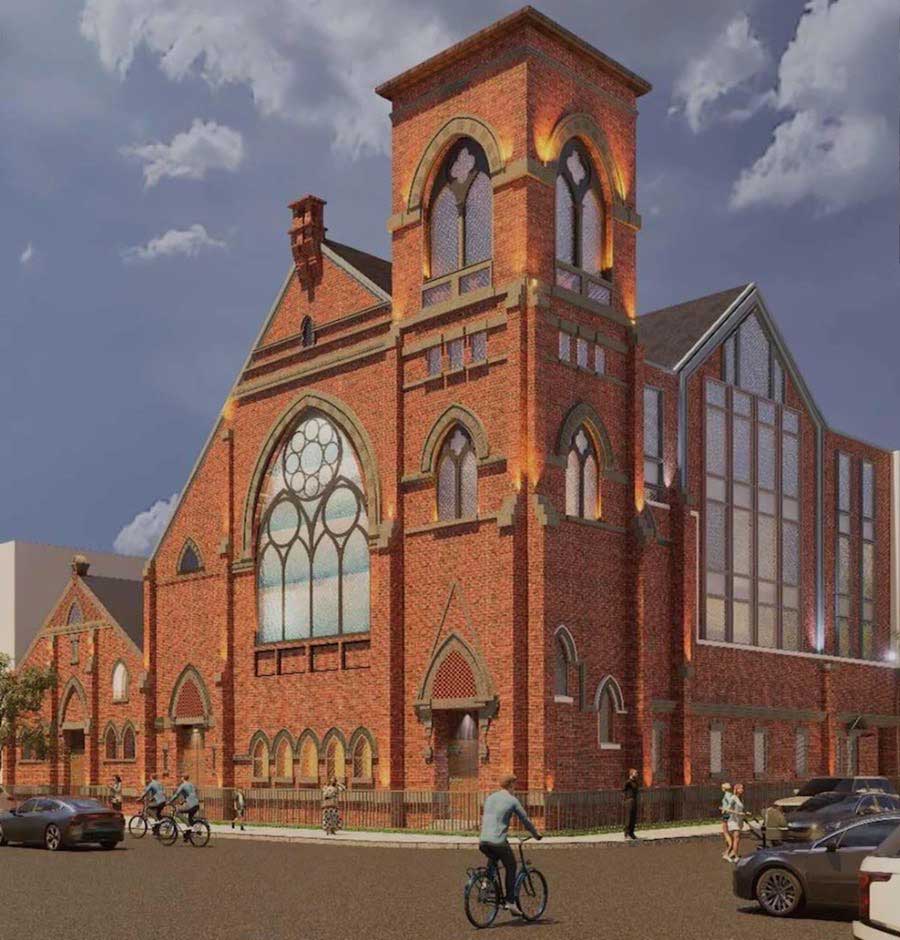
 A rendering of the North Baptist Church at 598 Jersey Avenue. Pereiras Architects Ubiquitous.
A new proposal has emerged to renovate a 140-year-old church in Jersey City’s Harsimus Cove. North Baptist Church, built in 1886, has remained vacant since a fire in the 1970s.
The plan is currently being reviewed by the city’s Historic Preservation Commission. However, the architect is cautioning its members that delaying too long could jeopardize the building’s structure.
“Every day that goes on, we’re risking the collapse of this building — that is a sad reality,” said Manny Pereiras, principal of the Union City firm, Pereiras Architects Ubiquitous.
Pereiras’s namesake firm was also involved in the project back in 2021. This time, however, he presents new renderings to the HPC, introducing additional masonry elements intended to blend with the original building.
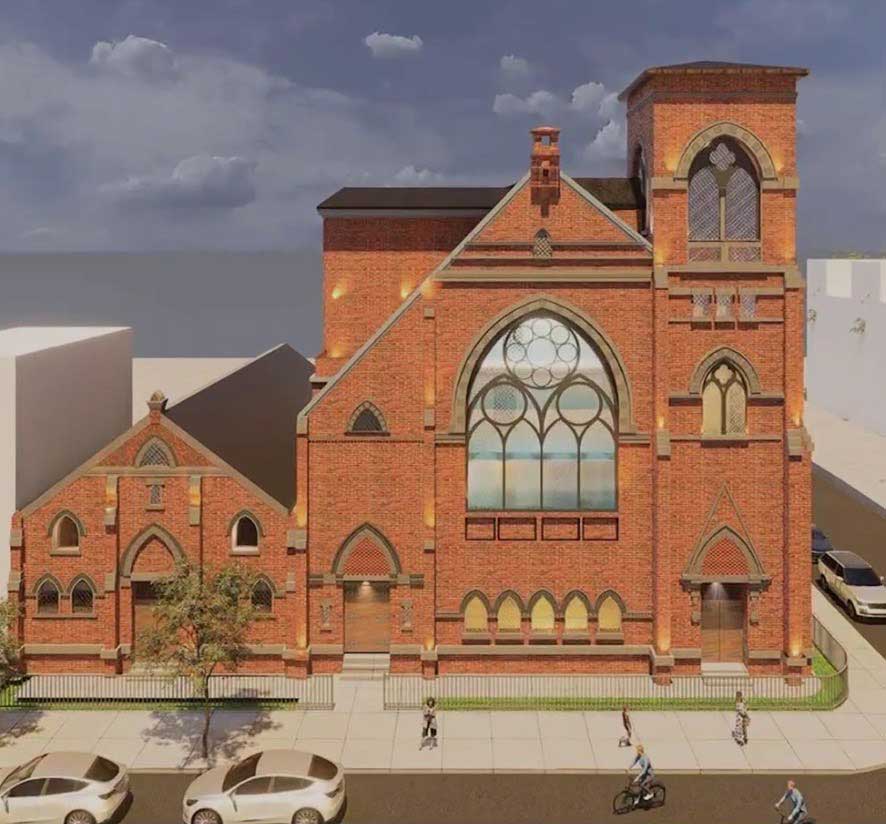 In the latest plan, the rose window, which shattered in 1937, will be recreated. Pereiras Architects Ubiquitous.
But there was some debate at the December HPC meeting about the architect’s modern design for the facade along Fourth Street, where much of the building will be demolished and rebuilt, with some commissioners discussing wanting the church to be faithfully restored rather than reinterpreted.
“Why are we doing a modern interpretation on that facade?” asked Commissioner Tony Sandkamp. “We, on a regular basis, have people who are working on their homes restore missing portions of the building.”
Pereira said he didn’t want to “imitate” the historic style, only give it a “nod” toward the historic, noting that the restoration of the facade, along with the adjacent chapel along Jersey Avenue, will be restored back to the original appearance.
“This is an adaptive reuse — the use of the building is no longer a church,” Pereira said. “We’re marrying the two uses of what was there historically and what we’re proposing.”
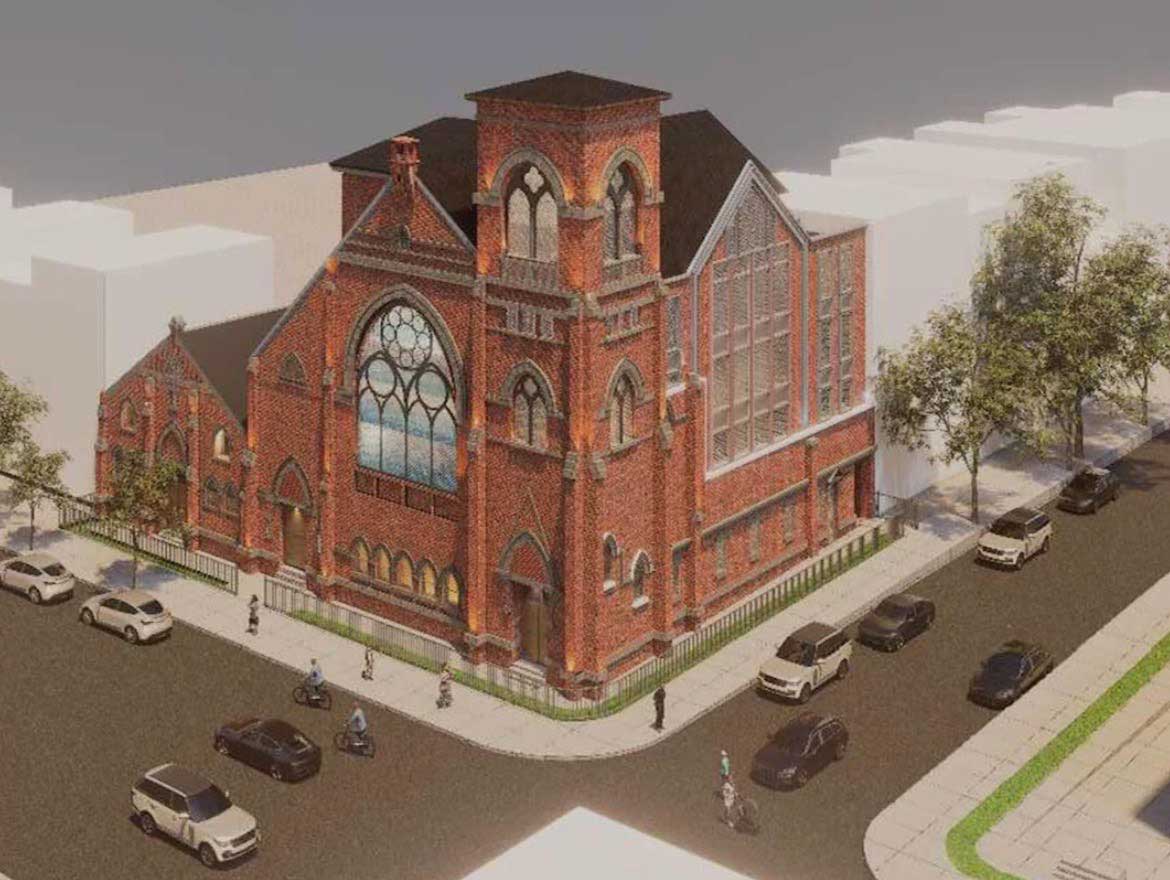 The North Baptist Church has been vacant since a fire in the 1970s. Pereiras Architects Ubiquitous.
Other aspects of the design — including reinstalling the rose window, which shattered in 1937 and was filled in with brick — were uncontroversial and, in some cases, praised. Due to the fire, little more of the building remains than the facade. But that alone is significant because the church is ornamented with intricate terracotta details that have stood the test of time.
“We’re looking to salvage and restore all of these elements of this existing church in our proposed adaptive reuse project,” Pereiras said. “We’re dealing with a great amount of history that’s impactful.”
Owned by JCH Development, the proposed building will contain 13 apartments, including duplexes. Perhaps one of the standout features in the building is the incorporation of the bell tower in the master bedroom of one of the apartments.
Commissioner Brian Blazak agreed with Pereira’s approach to the adaptive reuse.
“I’ve been walking by this building for 15 years. I don’t think I ever imagined someone completely rebuilding the south-facing facade,” Blazak said. “It’s incredible that it’s still there, quite frankly. So I think we’re all happy that something is being done here.”
The last few years have seen an encouraging trend in Jersey City of seeing approvals to restore historic churches, notably St. Mark’s and the Reformed Church of Van Vorst. Perhaps the most anticipated proposal is the restoration at St. John’s Baptist Church, which dragged on for three decades. One commissioner warned prolonged delays could turn the North Baptist Church project into “another St. John’s.”
Daniel Wrieden, an officer in the city’s Historic Preservation Office, cautioned the commission that he is a “little fearful” about the stability of the structure and not to let “perfect be the enemy of the good.”
“I am aware that the building is in terrible shape,” Wrieden said. “I was surprised at the degradation that has taken place in the past, less than 18 months, on the inside.”
But he added that the application is still missing important details, including information about light fixtures, that must be included before a vote can be taken.
“I think the modern construction is the way to go,” Wrieden said. “On one level, there is some refinement to be done, but at a deeper level, we need more in the way of actual details.”