
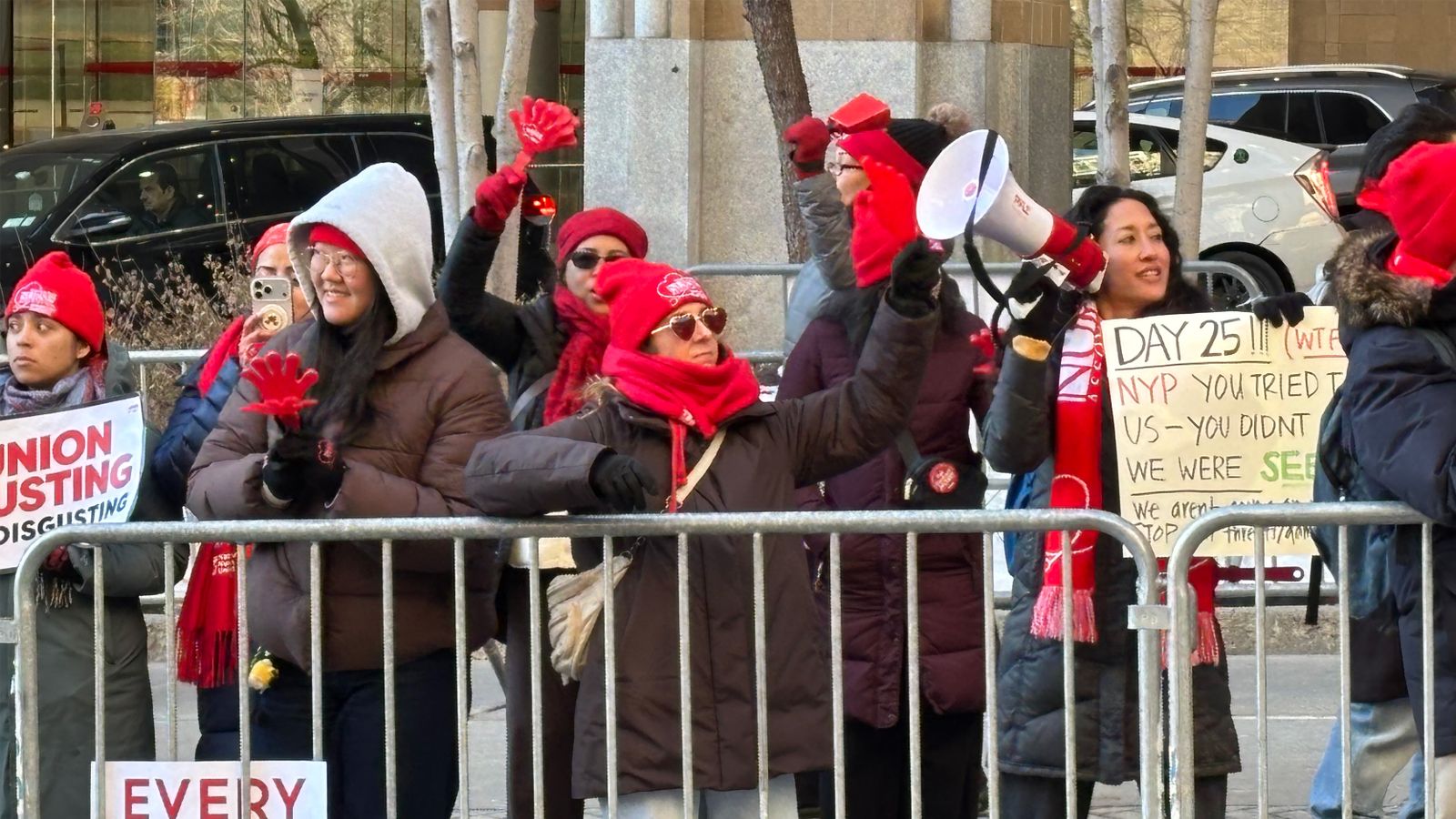
New York City police arrested at least 13 nurses Thursday during Day 25 of the four-week strike by 15,000 nurses across the city. The arrests took place outside the headquarters of the Greater New York Hospital Association (GNYHA) on Manhattan’s West Side, marking a sharp escalation by the administration of Mayor Zohran Mamdani as negotiations continue behind closed doors.

Loading Tweet …
The arrests underscore that the strike has entered a new stage and pose the necessity for a broader movement of the working class in defense of the nurses. Police action against healthcare workers fighting for safe staffing and basic protections demonstrates that the struggle cannot be confined to closed-door negotiations or isolated protests. What is required is the expansion of the strike and the mobilization of broader sections of workers to defend nurses and to provide the material support necessary to sustain their struggle, including full strike pay.
Nurses were arrested after blocking the entrance to the hospital lobbying group’s offices at 555 West 57th Street, where they had gathered as part of a strike action targeting hospital executives coordinating management’s response to the walkout. Cops in riot gear, including units from the NYPD’s notorious Strategic Response Group (SRG), were deployed to carry out the arrests. GNYHA represents more than 280 hospitals and medical centers and plays a central role in negotiations with the New York State Nurses Association (NYSNA).


The arrests were carried out under the authority of Mayor Mamdani and NYPD Commissioner Jessica Tisch, whom Mamdani retained from the previous administration, asserting continuity in policing policy in order to reassure the city’s billionaire corporate and financial oligarchy. Mamdani has recently publicly embraced a law-and-order posture, including praising the police shooting of 22-year-old Bangladeshi immigrant Jabez Chakraborty during a mental health crisis in his home.
At the state level, Mayor Mamdani has aligned himself with Governor Kathy Hochul, whose administration continues to invoke emergency powers to open the doors for out-of-state scab nurses. This ongoing intervention by the state government underscores that the arrests on Thursday are part of a broader, coordinated effort by the Democratic Party apparatus to suppress the nurses’ strike and force a return to work on management’s terms.
Earlier in the day, NYSNA promoted a “day of action,” bringing in officials from the AFL-CIO, the NAACP and Democratic Party figures to join nurses on the picket line at Mount Sinai Hospital. The union highlighted tentative agreements on artificial intelligence protections and some local hospital issues, while continuing negotiations with hospital management at the Javits Center, presenting these developments as evidence that talks were moving forward. But recent reports indicate that NYSNA is prepared to accept a concessions contract, including its retreat on wages from 30 to 18 percent over three years, and an agreement on health insurance that creates a future committee to identify cost savings.
The role of the union bureaucracy has been to channel nurses’ opposition into carefully managed protests and appeals to Democratic Party officials while insisting that the struggle remain confined to closed-door negotiations with hospital executives. In spite of massive support for the strike from the city’s population, this strategy has left nurses increasingly isolated as hospital management, backed by city and state authorities, moves to impose a settlement favorable to corporate interests.


The arrests of nurses were not an isolated incident. Just blocks from Mount Sinai Morningside Hospital, police also arrested students at Columbia University protesting federal immigration enforcement, amid an ongoing crackdown on campus opposition that last year included the detention and threatened deportation of student activist Mahmoud Khalil. The proximity of the arrests underscores the broader turn to repression as social opposition intensifies in New York City.
The events of Thursday make clear that the Mamdani administration’s response to continued resistance by nurses is the open use of state force. Nurses cannot rely on appeals to politicians or negotiations conducted behind closed doors by the union apparatus. What is required is a new strategy based on the expansion of the strike, the provision of full strike pay, and the mobilization of broader sections of the working class.
The ongoing strike by 31,000 healthcare workers at Kaiser Permanente in California and Hawaii, and the growing support for a general strike in response to the ICE murders in Minneapolis, demonstrate the potential for a broader movement of the working class against inequality and dictatorship.
The New York Nurses Rank-and-File Committee, founded last week to “assert democratic control over bargaining and strike strategy, declared in its founding statement: “Healthcare workers defend life. When wealthy executives starve hospitals of staff and resources, they endanger patients; when the state kills a nurse in the streets, it signals that no one in the working class is safe from repression. Our struggle for staffing ratios, living wages and full benefits is inseparable from the defense of democratic rights.”
Sign up for the WSWS Health Care Workers Newsletter!