
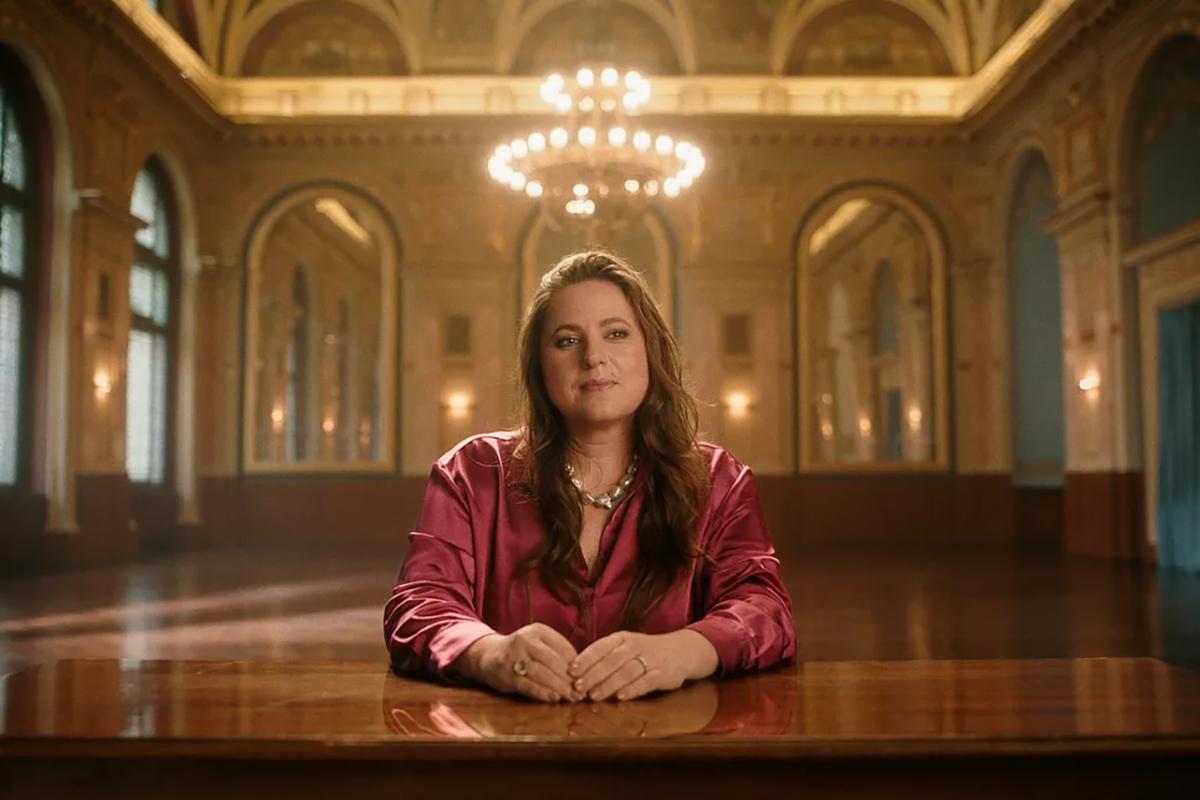
Documentary Queen of Chess (now streaming on Netflix) is a biography of women’s chess luminary Judit Polgar, with an emphasis on her battle of the sexes-style rivalry with all-time great Garry Kasparov. Director Rory Kennedy’s film accentuates the positive of Polgar’s achievements, which found her fracturing norms and boundaries as she transformed from child chess prodigy to international champion. But the film had the potential to be thornier than that, considering the contextual politics of the time and the sexism baked into the sport, and how Polgar’s story raises significant ethical questions about the method behind her rise to prominence – topics that are addressed, but perhaps not as thoroughly as they likely demand.
The Gist: Judit Polgar’s father calls it “an experiment.” He believed that geniuses are “made,” not born. So in 1981, Laszlo Polgar pulled his three daughters out of school and trained them to be chess players, studying eight-to-nine hours a day, every day, with no holidays, birthdays or weekends. Judit was five when she began training alongside her older sisters Susan and Sofia. The Polgars were citizens within a totalitarian communist regime in Hungary, and a self-described poor family, but they scraped together enough money to pay outside chess experts to teach their girls, sometimes cycling through three instructors in a single day. Laszlo entered Susan, Sofia and Judit in national tournaments, and watched them mop the floor with graying men in what was then primarily a boy’s chess club. “The girls had a great time!” he insists now.
We might question that assertion, but 49-year-old Judit supports it somewhat when she says she liked the “powerful” feeling she got when she’d win a game. She was six when she began developing her signature aggressive playing style, and making a dent in a competitive arena in which chess superstar Bobby Fischer, when asked why there weren’t more women in the sport, replied, “They’re just not that smart.” At the time, the Soviet chess movement, both male and female, was dominant internationally, and spawned Garry Kasparov, a brilliant player who surely would identify himself as confident while others called him arrogant. The Polgars had blown through their national competitors and had their sights set on international tournaments, but the Hungarian government didn’t like that the girls were being homeschooled, or the family’s insistence that women were just as good at chess as men. Passports were revoked until the government bowed to pressure and watched as the Polgar girls went to the 1988 Chess Olympiad in Greece and knocked off the Russians. What happened when they came home? State officials praised them as representatives of Hungarian greatness, of course. Hypocrites.
“We went from black sheep to golden girls,” Judit says. But among her sisters, Judit stood out: “She turned opponents into victims,” one commentator gushes. Now that bureaucratic roadblocks had been broken, she quickly became the world’s best female chess player at age 12. In 1991, she beat Fischer’s record of being the youngest chess grandmaster by two months, and won a national championship – all by making bold moves in a single all-or-nothing match. Of course, Judit idolized Kasparov; he was the Michael Jordan of chess, after all. She had watched him at tournaments, but although the walls between the sexes were slowly eroding, she had yet to play against him.
Her father pushed the chess establishment to pit her against the world’s best regardless of gender, and eventually, finally, in 1994, Judit sat down across from Kasparov at Linares, “the Wimbledon of chess.” What happened is legend: the “touch-move controversy.” Most everyone knows that a move is complete once the player’s hand is no longer touching the chesspiece, but Kasparov broke the rule when he realized he was making a strategic mistake. Nobody noticed but Judit. She didn’t speak up, fearing the blowback. She lost the game, but video footage proved Kasparov’s violation. During the years following, Judit would shed her father’s coaching, get married, learn new strategies, climb the international rankings – and lose to Kasparov over and over again. She was 0-14 against him. But when she faced him once again in 2002, that 15th match is the one that would truly matter.
Photo: Netflix
What Movies Will It Remind You Of? Of course, Searching for Bobby Fischer and Netflix hit limited series The Queen’s Gambit are big ones. But the BOATS (Based On A True Story, of course) drama you should seek out is Queen of Katwe (it’s on Disney+, FYI), the overlooked biopic of Ugandan chess star Phiona Mutesi.
Performance Worth Watching: Throughout the documentary, Judit shows significant grace and humility despite her amazing achievements, and maintains an upbeat tone without ever indulging any corny you-go-girl rhetoric – exactly what a true role model does.
Sex And Skin: None.
Photo: Courtesy of Netflix
Our Take: One of the very last statements we hear in Queen of Chess comes from chess journalist Dirk Jan ten Geuzendam: That she “remains a very normal and pleasant person… is a miracle.” Laszlo still uses the word “experiment” to describe his approach to teaching chess to his daughters, a word that’s, well, a bit dehumanizing. Others threw around even less flattering terms like “Daddy Dearest,” “Frankenstein” and “guinea pig.” Laszlo wanted to prove the power of nurture over nature, and his overtures come off as a combination of self-aggrandizement and, seemingly secondarily and tangentially, a form of admirable feminism. To be grossly reductionist: It’s complicated.
Kennedy doesn’t dig deep into this though – perhaps a compromise to lure all the key players, including Laszlo, Kasparov, Sofia and Susan, into participating in the documentary – tacking on a cursory acknowledgment of the thorny subject matter in the final few minutes. She asks Judit how she feels about her father’s modus operandi, and she pauses for a long time before giving a wishy-washy answer that smacks of diplomacy. The takeaway is, she’s spinning it positive, and that’s understandable, even admirable. Her ability to share her story with composure and self-assurance sure seems to trump Laszlo’s “nurture” with her sense of personal agency. But one question remains unanswered: How’s their relationship today? (To Laszlo’s credit, he acknowledges her independence, although he also implies with a bit of sexism that her husband has greater influence on her now.)
Praise Kennedy for keeping the focus on Judit instead of her patriarch, a trap that other films haven’t avoided – e.g., King Richard which, for the sake of “drama” I guess, focused on Richard Williams instead of his far less problematic tennis-champ offspring Venus and Serena Williams. But rather than investigate the tougher throughlines of Judit’s story, Kennedy leans heavily into Judit’s rivalry with Kasparov, which is nonetheless entertaining. Kasparov has toned down some of his braggadocio, but is still slippery about the touch-move controversy, and his tone with regards to Judit’s achievements is about a 60/40 ratio of appreciation and dismissal. (We also walk away from the film without a firm grip on Judit and Kasparov’s current relationship, if they have one. Maybe they text each other funny chess memes?)
And so we primarily get a Wikipedia-esque tick-tock play-by-play of the most dramatic moments in Judit’s career, with plenty of necessary contextual commentary and archival footage, and just enough pithy explanations of chess strategies and lingo to keep chess newbs in the loop but never in the weeds. Kennedy fills the soundtrack with 1990s riot-grrl rock songs, but otherwise mostly sidesteps feminist cliches. She also finds talking heads to enliven the potentially snoozy third-party descriptions of chess tournaments with color: “Her rooks just started GOBBLING pawns!” chess grandmaster Maurice Ashley declares in his description of Judit’s victory over Kasparov – not that Judit’s hunger for greatness was ever in doubt.
Our Call: Queen of Chess leaves a few too many rocks unturned to be truly substantive. But as a surface-level summary of Judit’s impressive, inspiring achievements, it works rather well. STREAM IT.
John Serba is a freelance film critic from Grand Rapids, Michigan. Werner Herzog hugged him once.