
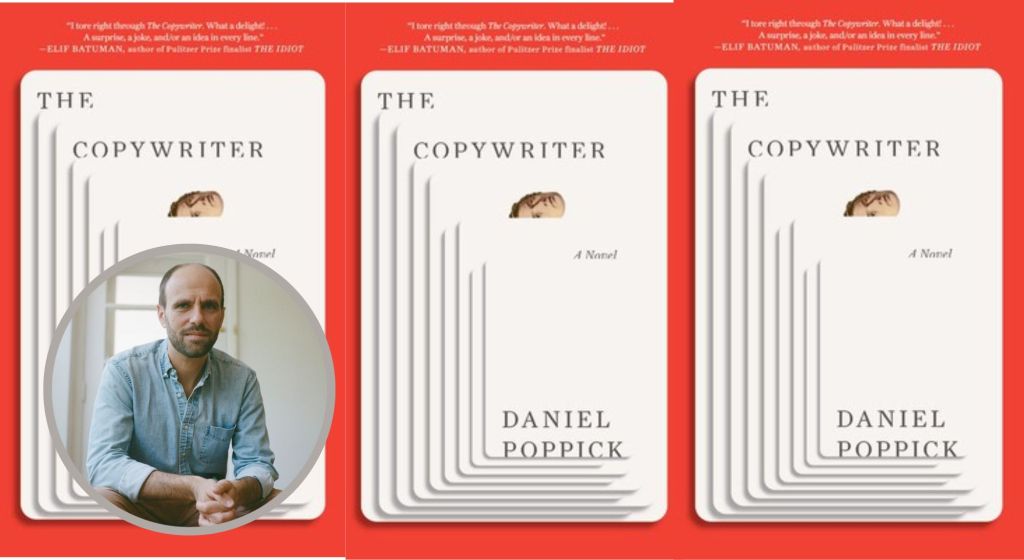
Daniel Poppick has published two collections of poetry, the National Poetry Series-winning “Fear of Description” and “The Police.” “The Copywriter,” his debut novel, was published this week.
Q. Please tell readers about your new book, “The Copywriter.”
“The Copywriter” is a novel about poets in the workplace. There’s a misconception that poets are people who just float around on a cloud attuned to mystical signals from the universe, scribbling down lines, ruining weddings and dinner parties… I’m a poet myself and I’m here to tell you that all of this is true, but it’s not the whole truth. Poets also have to pay rent. I wanted to write a book about what poets do to pay rent.
SEE ALSO: Like books? Get our free Book Pages newsletter about bestsellers, authors and more
Q. You’ve published poetry collections before this. What has been the biggest challenge switching to fiction?
I realized that I was writing a novel very gradually. My friend Rachel Mannheimer, an excellent poet and keen reader, looked at an early draft and told me it was a novel, but I didn’t take it seriously for several years. I initially thought of it as a long narrative poem in notebooks. The biggest single breakthrough was probably when I realized that a novel could be a form of poetry, and that Rachel was right. Instead of a novel in verse, my poet friends joked that I was writing “a novel in prose.”
Q. Have you worked in the types of jobs you write about in the novel?
Cat’s out of the bag: I did once write a product description for a “YAS QUEEN” throw pillow.
Q. What are you reading now?
A book of interviews with the composer John Cage by Richard Kostelanetz, “Conversing with Cage.” Very inspiring.
Q. Do you remember the first book that made an impact on you?
When I was five or six, my mom would read the Amelia Bedelia books to me, but she kept interrupting herself because she was laughing so hard. A great way of building suspense.
Q. Do you listen to audiobooks? If so, are there any titles or narrators you’d recommend?
The audiobook of Robert Caro’s “The Power Broker” has a narrator who sounds like he smoked a thousand cigarettes in a confession booth to prepare. Flawless.
Q. Do you have a favorite book or books?
The two most profound experiences of reading I’ve had in my adult life are Proust’s “In Search of Lost Time” and the near-constant daily dialogue I have with my poet friends.
Q. Which books are you planning to read next?
“The Pelican Child,” by Joy Williams, and Jake Fournier’s debut poetry collection, “Punishment Bag.”
Q. Is there a topic you’ll always read about?
I realize how ridiculous this sounds, but it’s only recently that I started consciously reading books for what they’re about. When I read poetry, I’m often drawn to a book for the voice or environment that it provides, rather than a particular topic.
A couple of years ago I picked up “Also a Poet,” Ada Calhoun’s memoir about her father, the late art critic Peter Schjeldahl, and his fixation on Frank O’Hara. It’s so moving and absorbing and clear, and I said to a friend, “I think I like this because it’s… about something?” She rolled her eyes.
Recently, I read Vivian Gornick’s “The Romance of American Communism,” which is fantastic because of what it’s about: the romance of American communism.
Q. If you could ask your readers something, what would it be?
How do you spend your time, and how do you want to spend your time?