
The New York Yankees’ top eight prospects are a solid group, with two high-ceiling shortstops, multiple potential starting pitchers and a clay golem, but the system tapers off immediately after that into relievers, extra guys and injured starters. The trade to get Ryan Weathers cost them one prospect off their top 20 in Dillon Lewis, while their deadline deals last year sent away five others, making this year’s list look quite shallow after the top tier.
(Note: Tools are graded on a 20-80 scouting scale; ages as of July 1, 2026. EV = exit velocity. rpm = rotations per minute.)
Height: 6-2 | Weight: 190 | Bats: R | Throws: R | Age: 21
The Yankees’ 2023 first-round pick broke out to start the 2025 season, tearing up High A for 24 games, after which he got a too-quick promotion to Double A, where he hit .215/.337/.358 the rest of the way as he struggled to adjust to pitchers who could change speeds on him and attack him with better stuff. He has excellent bat speed and understands the strike zone, still limiting his chase rate to 19 percent in Double A, with good balance through contact and somewhere around average power now. He does work the count well, seeing 4.27 pitches per plate appearance at the higher level, but pitchers could mess with his timing and he would often expand the zone significantly with two strikes. He couldn’t do anything with good velocity in Double A, which is concerning but also odd given the bat speed, and he didn’t get the kind of consistent hard contact he flashed before the promotion. He is a definite shortstop for me with very easy actions and plenty of arm, although he drops down on a lot of throws, which I don’t love because it tends to make the ball tail away from the first baseman.
If he’d spent half the year in High A instead of four weeks, his year would probably look more promising on the surface, and since he won’t turn 21 until June, he has time to return to Double A and show he can handle the pitching there. He’s at least a future everyday shortstop and still has upside beyond that because of the potential for a plus hit tool.
Height: 6-7 | Weight: 248 | Bats: R | Throws: R | Age: 23
Lagrange threw just 21 innings in 2024 due to injury, and came into last year with 95 2/3 total pro innings in three seasons, so his 2025 was a breakout in more ways than one: He stayed healthy, and he had his best showing to date when he did pitch. Lagrange made 23 starts and threw 120 innings in 2025, averaging 98 on his four-seamer — up a mile an hour from the year before — with a plus slider, a cutter and a hard changeup with good tumble. He comes from a high three-quarters slot, and despite his 6-7 frame doesn’t get out that far over his front side, working a little north-south without a pitch that really breaks laterally.
He was superb in High A to start the year, striking out 38 percent of batters he faced across eight starts, then moved up to Double A and was less consistent, almost alternating dominant starts with four- and five-walk outings. His arm action is pretty clean, and he should be able to repeat it better than he does, especially out front, with average control probably as far as he’ll get. The Dellin Betances comps are inevitable here, but Lagrange moves better on the mound and has more weapons already. He should stick as a starter, and could end up in the top two spots in a rotation depending on how far his control improves.
Height: 6-2 | Weight: 190 | Bats: L | Throws: R | Age: 19
No player from the most recent draft boosted his standing in the industry since turning pro more than Kilby, the Yankees’ first pick in 2025 with the No. 39 selection. The Georgia high school shortstop went to Low A for 18 games and hit .353/.457/.441 in his pro debut, walking more than he struck out. That’s high school to full-season ball in about 90 days, going from metal bats to wood, Georgia prep pitchers to professionals, and Kilby didn’t miss a beat. He made extremely hard contact, too, averaging 91.9 mph and peaking at 108.9, while his chase rate of 11.1 percent was … well, Juan Soto had the lowest chase rate in the majors last year, and his was 18.1 percent. Kilby saw 106 pitches that were well out of the zone, meaning they were more than one baseball width away from the strike zone, and swung at seven.
His swing is short and direct, and it looks like he has a lot more present power than it appeared (to me, at least) before the draft. He’s a fringe-average runner and his arm probably moves him off shortstop regardless, with second base the obvious spot for him. If this small pro sample is any indication, he can play any position he likes and still be an above-average big leaguer. (He’s prospect No. 101 this year, by the way.)
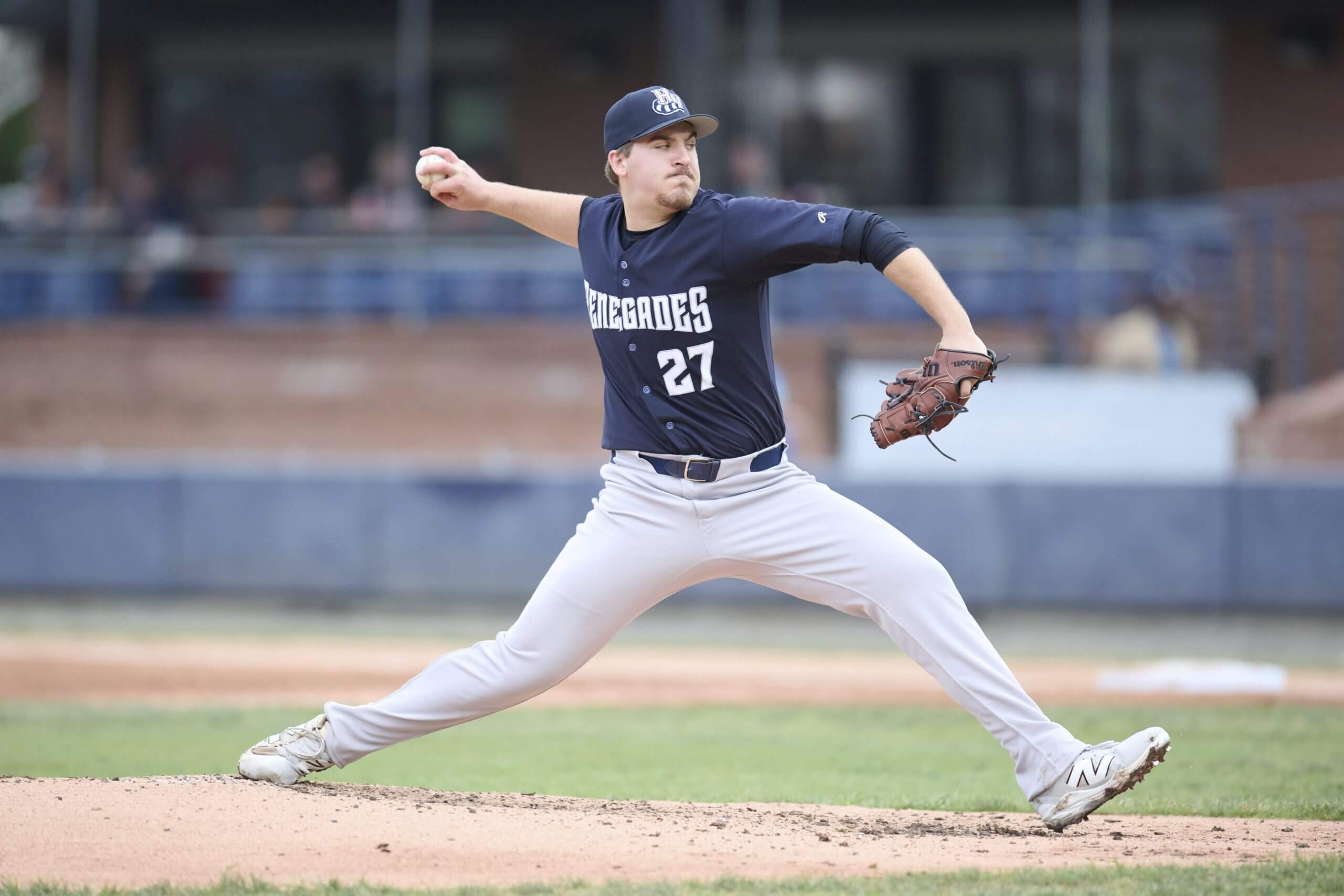
Ben Hess needs to throw his breaking balls harder to reach his ceiling. (Tony Farlow / Four Seam Images via Associated Press)
4. Ben Hess, RHPHeight: 6-5 | Weight: 255 | Bats: R | Throws: R | Age: 23
The Yankees’ first-round pick in 2024, Hess is a high-probability starter who’ll need another gear and/or a different fastball shape to profile as a mid-rotation guy or better. Right now, he’s typically 92-95 and gets good spin rates on a curveball and slider, both of which missed a ton of bats in High A and Double A but don’t project to do so at the higher levels because they’re slow — his slider is often down to 77-78, and there were no right-handed starters in the majors last year who lived in the upper 70s (or below) with their sliders. He has excellent feel to pitch, however, and goes right after hitters with all four weapons, including an average changeup. If the slider gets more power or he can get more ride on the four-seamer or he adds a harder mid-80s breaker, he could turn out to be an above-average starter. Even as he is now, however, I think he’s ready for someone’s rotation by July.
5. Bryce Cunningham, RHPHeight: 6-5 | Weight: 230 | Bats: R | Throws: R | Age: 23
Cunningham, the Yankees’ second-round pick in 2024, was rolling through High A to start the year, but his shoulder barked and the Yankees shut him down for over two months. He returned in August and threw in the Arizona Fall League, but his arm slot was lower and he didn’t have his previous command at all. He’s 91-96 when healthy with an above-average changeup and a fringe-average slider, mixing in an occasional curveball and sweeper, and throwing strikes with everything. He had his velocity again in the AFL, but not the command or control, barely missing bats and going heavy on the slider even over the fastball. I saw him before the injury, and he looked like a no-doubt starter with mid-rotation potential if any of the breaking pitches became at least a solid-average pitch.
6. Elmer Rodríguez, RHPHeight: 6-3 | Weight: 160 | Bats: L | Throws: R | Age: 22
Rodríguez, formerly known as Elmer Rodríguez-Cruz, came over to the Yankees in the December 2024 trade that sent Carlos Narváez to Boston. He took a big step forward last year in stuff and results, working now with a five-pitch mix that features a fastball at 93-96 with heavy arm-side run, a 55 split-change with good arm speed and three breaking pitches, all of which flashed average with good shape. He walked just under 10 percent of batters he faced last year across three levels (including one Triple-A start), but it’s about a grade more control than command. His delivery is tough to repeat, with a high elbow in back and very late pronation, which often gives pitchers trouble with breaking stuff. He has higher upside than Hess or Cunningham, probably No. 2 starter ceiling in the absolute best-case scenario, but much more relief risk from the delivery and lack of present command.
7. Spencer Jones, OFHeight: 6-7 | Weight: 240 | Bats: L | Throws: L | Age: 25
Jones has 80 power and strikes out too much for it to matter. He started last year in Double A after spending part of 2023 and all of 2024 at the level, hit well as a repeater, then went to Triple A where he got off to a great start until the league figured him out. He hit 11 homers in July, but after he missed a weekend at the end of the month with back spasms, he struck out 41.8 percent of the time the rest of the way. It is extremely hard, loud contact when he squares the ball up, with a max EV last year in Triple A of 114.4 (I may have seen that, as I saw him hit a mammoth homer at Lehigh Valley), with a hard-hit rate of 54.7 percent at the level.
He just doesn’t make enough contact, chasing stuff out of the zone, whiffing on a third of his swings in the zone and missing on 39 percent of fastballs he swings at. He’s 6-foot-7 and has a very hard time covering the entire strike zone, while frequent changes to his stance and setup haven’t helped matters — the last time I saw him live, he was mimicking Aaron Judge, which I sort of get in that they’re similar in size but also Aaron Judge is one of one. Jones is a good athlete with the arm for right field, but while he plays very hard in center, he doesn’t have the range for it. I could see him getting some MLB time as a platoon outfielder — he doesn’t hit lefties at all, but slugged .629 off righties even with all his strikeouts — and hitting some monster homers in the process.
8. Chase Hampton, RHPHeight: 6-2 | Weight: 220 | Bats: R | Throws: R | Age: 24
Hampton finally had Tommy John surgery last February after missing most of 2024 with elbow soreness, so he should be back at some point this spring. Before the injury, he would sit 94-95 with some ride and worked with a five-pitch mix, flashing plus on the slider and curveball. His landing was very stiff and he had a long arm action that wasn’t easy to repeat. He also needed to improve his changeup or try a different style to get lefties out. He’d be a back-end starter if he comes back as he was before the UCL tear.
9. Cade Smith, RHPHeight: 6-1 | Weight: 190 | Bats: L | Throws: R | Age: 24
Smith missed the end of 2024 and the beginning of 2025 with a shoulder ailment, improving as the season progressed, with two excellent starts in High A to end the regular season and a strong showing in the hitter-friendly Arizona Fall League. He’s a future reliever with multiple breaking pitches to get righties out, while the fastball is light, 91-93 as a starter without a ton of life or movement, and he’s already shown some platoon splits. I’d probably stick him in the Double-A bullpen and see if the velocity ticks up.
10. Kaeden Kent, SSHeight: 6-2 | Weight: 200 | Bats: L | Throws: R | Age: 22
Son of Hall of Famer Jeff Kent, Kaeden was the shortstop at Texas A&M last spring and went to the Yankees in the third round. He takes an enormous hack and tries to pull everything, rolling it over to the second baseman when he’s not whiffing entirely. He has enough raw power to get himself into trouble, as he’d probably be a more valuable player if he were willing to go the other way more and focused on contact first, while looking for the occasional pitch to lift and pull. The Yankees played him at shortstop and a little at third; he’s not a shortstop, with second base also a possible outcome. I think he’s a utility infielder in the end.
11. Brock Selvidge, LHPHeight: 6-3 | Weight: 205 | Bats: R | Throws: L | Age: 23
Selvidge throws breaking stuff for more than half of his pitches, leaning heavily on his slider and cutter, with a low-90s fastball that doesn’t miss bats. He returned last year from 2024 biceps surgery to repair a pinched nerve and had similar results in his second run through Double A, walking too many while getting just a 23 percent whiff rate. If he’s going to throw sliders and cutters all day long, fine, but that’s a reliever all the way.
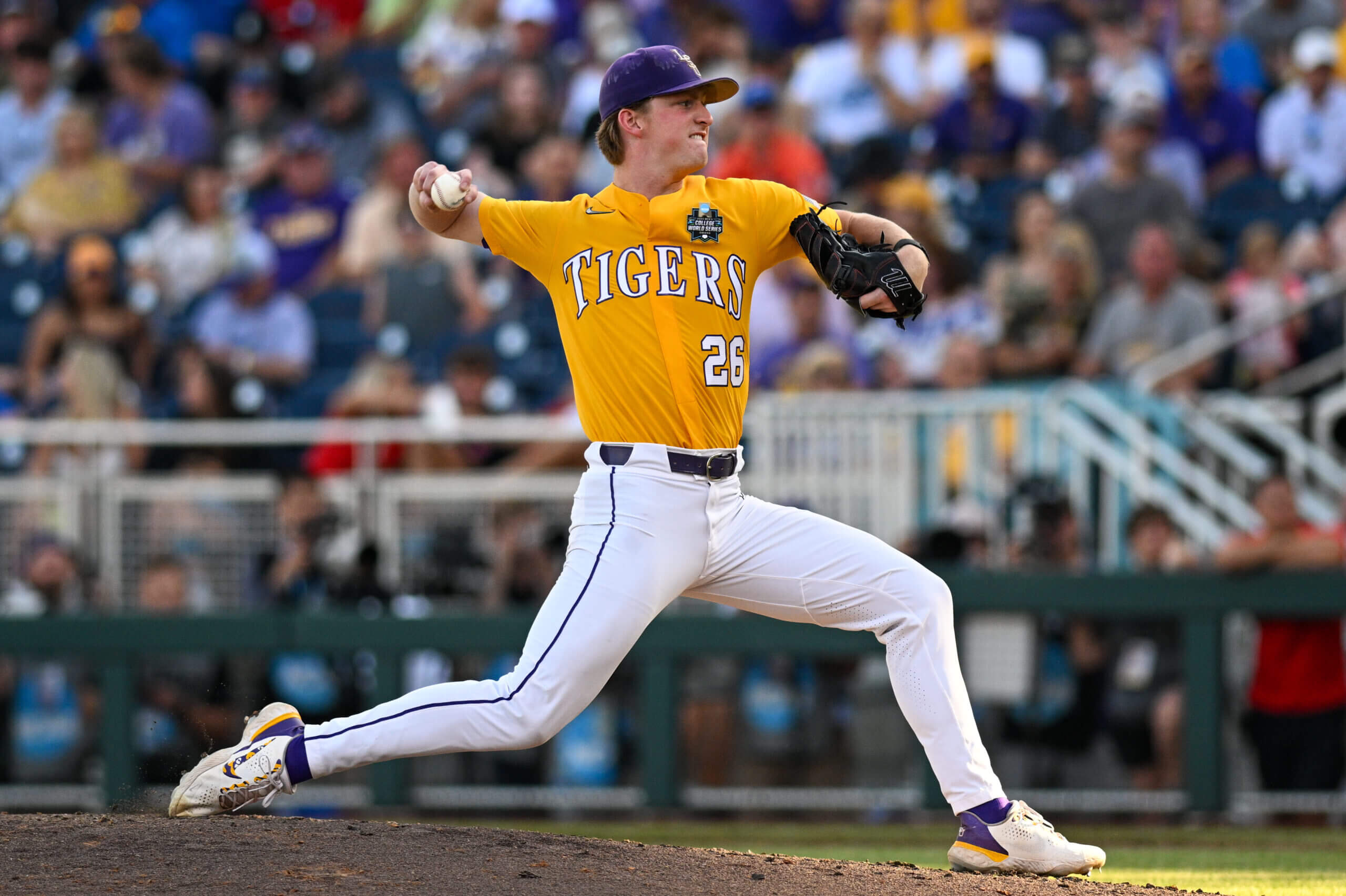
Thanks to elbow surgery, Thatcher Hurd has yet to pitch since being selected out of LSU in the 2024 MLB Draft. (Steven Branscombe / USA Today)
12. Thatcher Hurd, RHPHeight: 6-4 | Weight: 230 | Bats: R | Throws: R | Age: 23
Hurd was the Yankees’ third-round pick in 2024, coming off a spring where he lost his rotation spot at LSU while posting a 6.55 ERA, then had Tommy John surgery in February 2025, so he has yet to make his pro debut. Before the injury, he’d sit 94-97 with a tight slider up to 90 mph, and I thought for sure the Yankees would give him a sweeper as another or maybe superior breaking ball option, since he wasn’t great against same-side hitters in his junior year in Baton Rouge. He was a catcher in high school before moving to the mound, and that may be why he’s never settled on a consistent arm action, leading to below-average command outside of a few outings as a freshman at UCLA. He’s a perfect project for the Yankees’ pitching lab, as he’s big and strong and already has arm strength. They can rebuild his delivery; they have the technology.
13. Pico Kohn, LHPHeight: 6-4 | Weight: 200 | Bats: L | Throws: L | Age: 23
Kohn comes from a low three-quarters arm slot with a plus slider that’s very sharp, while his fastball is just average and got hit hard when he pitched at Mississippi State. His changeup is an average pitch and using it more might keep guys from sitting so much on the heater. He does throw strikes with average command and good feel, potentially a fifth starter if he can get a little more of anything to the fastball.
14. Brendan Beck, RHPHeight: 6-2 | Weight: 218 | Bats: R | Throws: R | Age: 27
Beck has missed two of the past four seasons with elbow surgeries, returning to throw a full season in 2025. He has above-average command of average or fringe-average stuff, sitting 90-92 without much life, with the slider maybe his one above-average pitch. He posted a 1.82 ERA in Double A to start the year, his first time at the level, but moved up to Triple A and gave up a lot of hard contact on all of his stuff, allowing 12 homers in 77 innings. I think he’s a swingman, or maybe a fifth starter on a non-contender because he throws so many strikes, but he’s going to get hit too hard to be more than that, even with his consistently low walk rates. He’s the younger brother of Tristan Beck.
15. Allen Facundo, LHPHeight: 6-0 | Weight: 171 | Bats: L | Throws: L | Age: 23
The Yankees didn’t protect Facundo from the Rule 5 draft this winter, and I think they got away with one here. He returned from an elbow injury midway through last season, sitting 94-96 with a plus slider in starts where he went 55-70 pitches, including five no-hit innings in his final outing. It’s not a pretty delivery; he has a massive pause over the rubber, with a short stride and some stiffness to his arm swing, coming at hitters from a low three-quarters arm slot. I’m sure the Yankees figured no one would take a now 23-year-old pitcher who has yet to throw a single inning above Low A, but this is big-league reliever stuff right now, and there were worse pitchers taken in this year’s Rule 5 draft over him.
16. Henry Lalane, LHPHeight: 6-7 | Weight: 211 | Bats: L | Throws: L | Age: 21
Lalane returned in August from offseason shoulder surgery, throwing 19 1/3 innings in the Florida Complex League and Low A, walking 14 and striking out 22. He was sitting 91-92, unfortunately, well down from his 95-plus before 2024, although he still showed a 55-60 changeup. The Yankees didn’t protect him this offseason and no one selected him in the Rule 5 draft.
17. Jose M. Rodriguez, RHPHeight: 5-11 | Weight: 160 | Bats: R | Throws: R | Age: 22
Rodriguez is 93-94 on both four- and two-seamers, topping out at 96.7 in Low A, and he can really spin the ball, getting up to 3,000 rpm on the curveball, with a fringe-average changeup. He was 21 in the FCL and Low A last year, having missed the 2024 season due to injury and only debuted in 2023 in the DSL. He’s probably a reliever, but maybe a three-pitch one who can go full innings or even handle long relief work.
18. Core Jackson, SSHeight: 6-2 | Weight: 190 | Bats: L | Throws: R | Age: 22
Jackson was the Yankees’ fifth-round pick last year out of the University of Utah, signing for well under slot as a senior because, while he was a freshman at the University of Nebraska, he drew a swastika on the door of a Jewish student. He told every team about it in 2024 and went undrafted, while the Yankees decided after some significant background work that they believed he’d grown up and understood the gravity of what he’d done. I can’t say I would have done the same as they did — I know many teams took him off their draft boards entirely and I probably would have done so, as well — but he is a prospect on the field. He’s pretty athletic and generates very high exit velocities, with a poor approach that is going to lead to contact issues at least by the time he reaches Double A, and he probably moves off shortstop to second base or maybe center field.
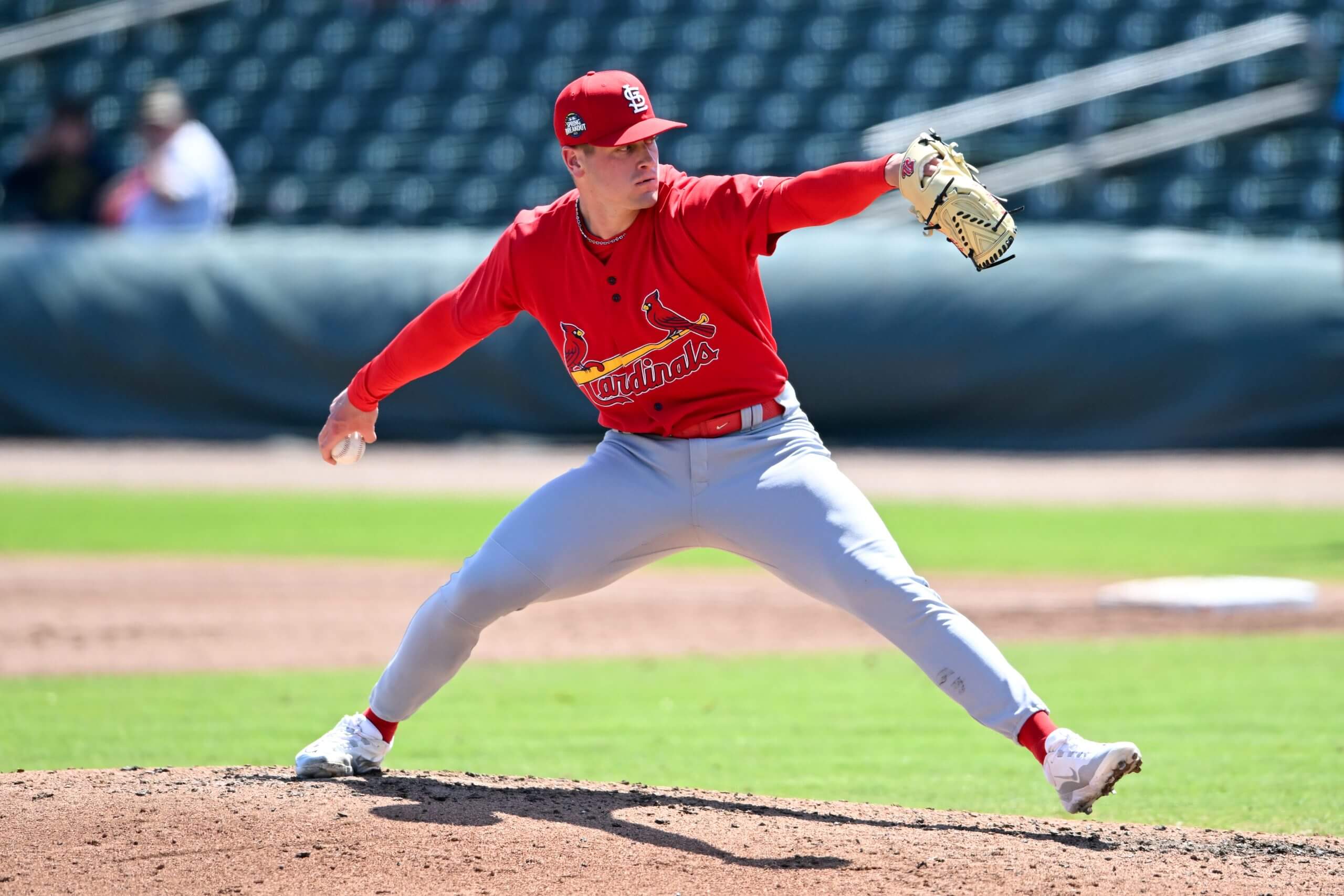
Cade Winquest could make franchise history as the Yankees’ first Rule 5 pick to make their Opening Day roster in more than 40 years. (Nick Cammett / Diamond Images via Getty Images)
19. Cade Winquest, RHPHeight: 6-2 | Weight: 205 | Bats: R | Throws: R | Age: 26
The Yankees selected Winquest from St. Louis in the Rule 5 draft; MLB.com wrote last week that the Yankees haven’t had a Rule 5 pick make their Opening Day roster since 1973. He worked as a starter last year in High A and Double A after missing most of the 2024 season due to a back injury, with solid results but probably too much hard contact to project him as a starter long-term. He crouches down in his delivery and gets out well over his front side, coming at hitters with 94-96 from a lower release height, pairing it with a plus curveball and a cutter that has some potential if he can locate it better. In a short relief role, which is where he’ll probably be as long as the Yankees retain him, he could be pretty effective.
20. Jace Avina, OFHeight: 5-11 | Weight: 180 | Bats: R | Throws: R | Age: 23
Avina came to the Yankees from Milwaukee in exchange for Jake Bauers in 2023, was not good in High A in 2024, then raked there as a repeater last year before moving up to Double A and scuffling again. He has plus power to his pull side and does know the strike zone, but so far he hasn’t shown he can hit decent velocity, feasting more on slower or weaker stuff in A-ball. He can handle all three outfield spots, so there’s a fourth-outfielder ceiling if he shows he can get to velocity.
2026 impact
Probably nobody, unless an injury in the rotation leads to one of their starter prospects getting the call early in the year.
The fallen
Roderick Arias looked like he was going to be a star after his time in the FCL in 2023, even making the very back of my top 100 going into 2024, but he’s spent two years in Low A now and has looked lost at the plate, hitting worse the second time around with a .208/.325/.315 line. He’ll flash some hard contact now and then, but hasn’t even squared up fastballs enough to see him as a prospect anymore.
Sleeper
Kilby is on the just-missed list, but he’s also the guy here most likely to leap onto the 100 next offseason, assuming he carries what he did in his scant pro debut over to a full season. After him, the guy with the next-best chance to turn into a GUY is Hurd, assuming he comes back healthy.