
As President’s Day approaches, it’s the perfect opportunity to delve into the rich history of American presidents with ties to Upstate New York.
Several presidents were born, lived, or are buried here, leaving significant historical imprints on the region. Discover the fascinating journeys of these leaders from Upstate New York to the White House.
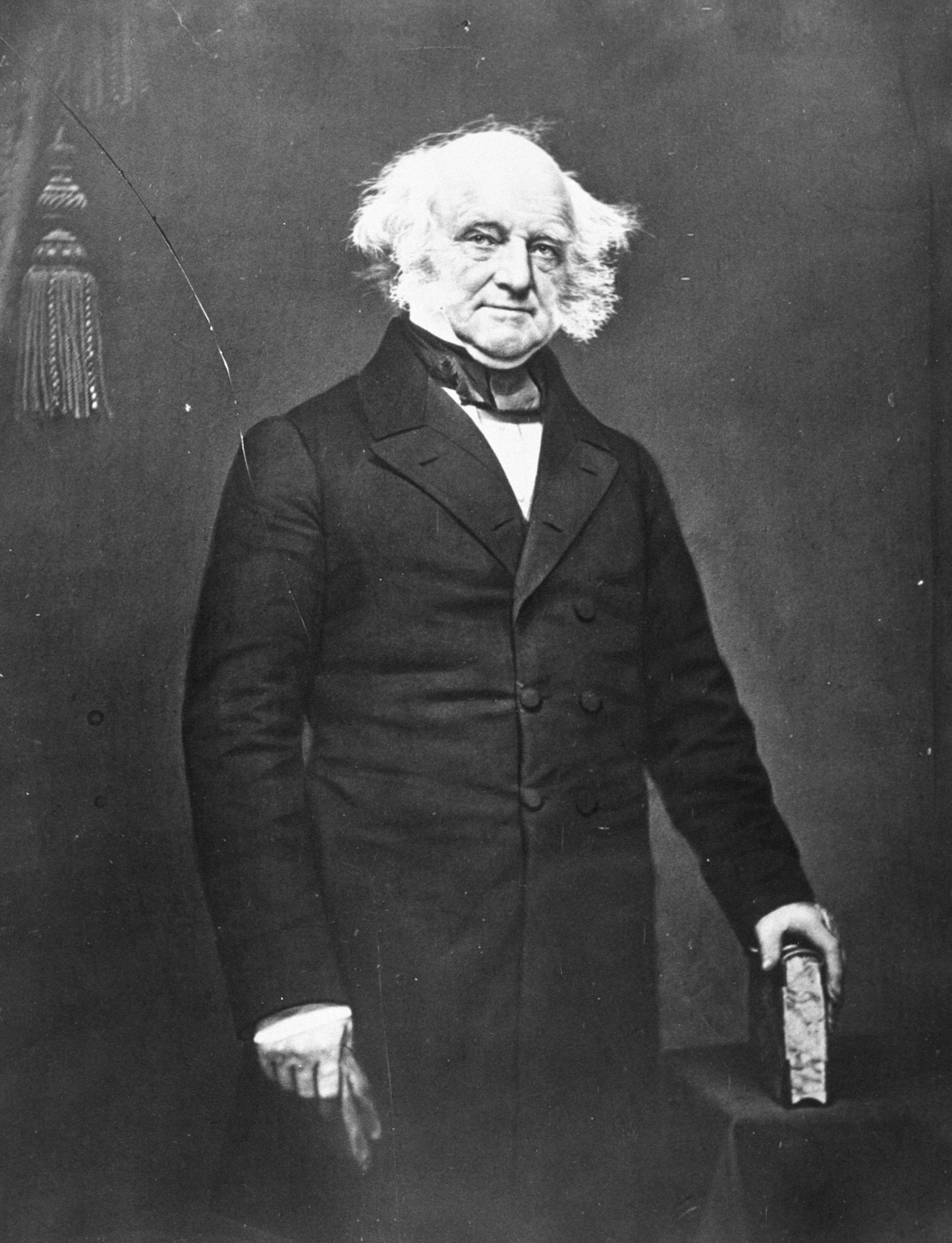 Portrait of 8th United States President Martin Van Buren. (1837-1841) Courtesy of the National Archives/Newsmakers | Getty ImagesCourtesy of the National Archives/Newsmakers | Getty ImagesMartin Van Buren (8th U.S. president)
Van Buren’s nickname, “Old Kinderhook,” reflects on this important politician’s roots in the Hudson Valley, in Kinderhook. He was born and is buried there. Van Buren served as New York State attorney general, U.S. senator, and as the ninth governor of the state. He also served as President Andrew Jackson’s vice president. His longtime estate, Lindenwald, is now a popular tourist spot in Kinderhook, Columbia County, as is his gravesite in the Reformed Church Cemetery in the village. Be sure to look for a remarkable life-size bronze statue of the president at the main road intersection across from his home.
Presidential factoid: Van Buren was the only U.S. president to whom English was a second language. Growing up, he spoke only Dutch.
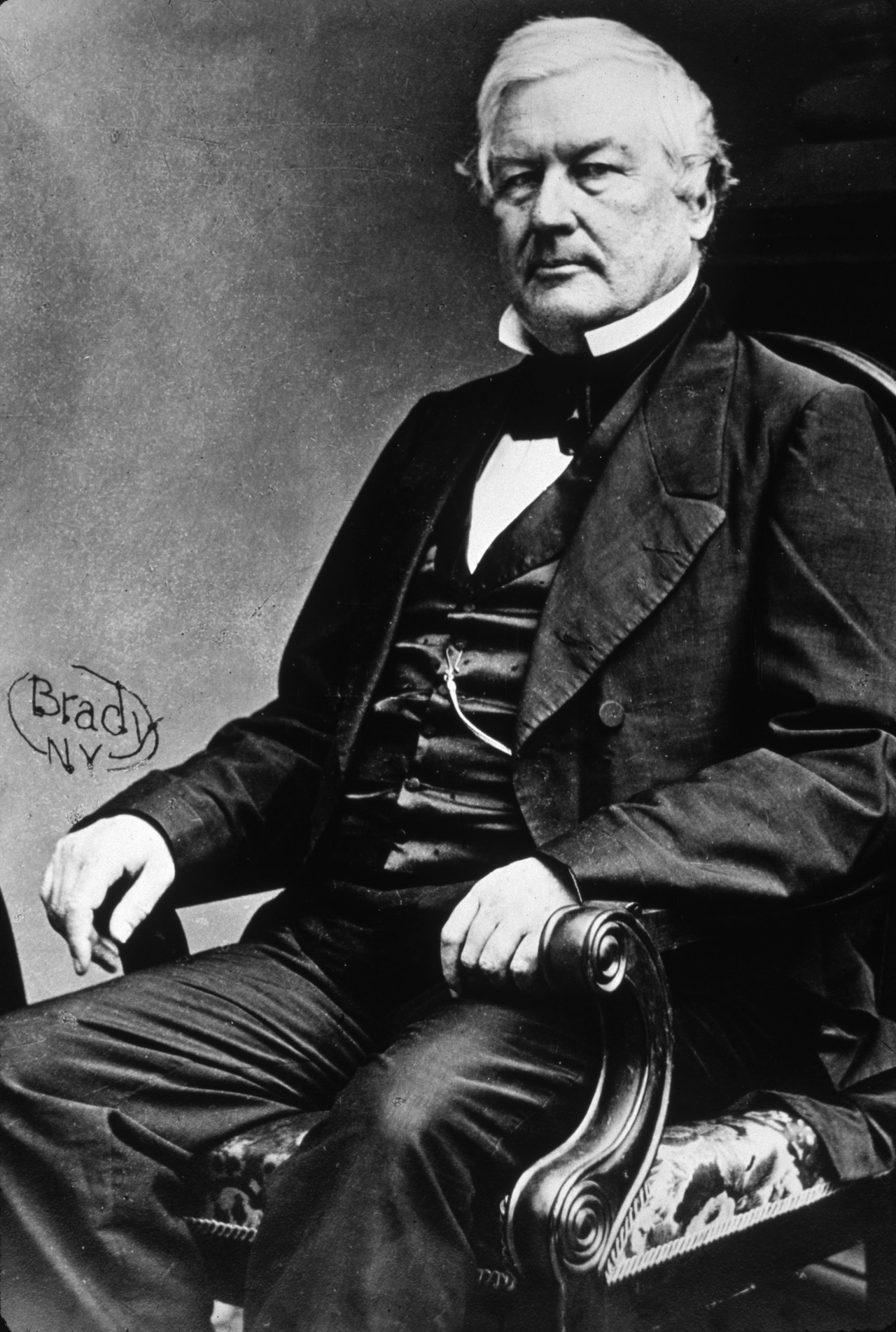 circa 1850: Millard Fillmore (1800 – 1874), the 13th president of the United States as leader of the Whig Party. Photo by Mathew Brady/MPI/Getty ImagesPhoto by Mathew Brady/MPI/Getty ImagesMillard Fillmore (13th U.S. president)
Fillmore was a true son of Western New York. Born in a log cabin in Moravia, Cayuga County, he served in several political positions in state government. He was the 12th U.S. vice president and the 13th U.S. president, taking office upon the death of President Zachary Taylor. Despite a desperate upbringing in extremely poor conditions, he later served in the U.S. Congress.
Fillmore became a towering figure in the history of the then-growing city of Buffalo, serving as a prominent attorney and civic leader. Although he was largely unschooled as a child, he was instrumental in founding the University of Buffalo and served as its chancellor from 1846 to 1874. In 1923, the city’s largest hospital was named in his honor as the Millard Fillmore Hospital. A life-size statue of Fillmore stands in downtown Buffalo at City Hall.
He and his family lived for four years in East Aurora, where visitors today can tour the Millard Fillmore Presidential Historic Site. He is buried in one of the largest family plots in historic Forest Lawn Cemetery in Buffalo.
Presidential factoid: Fillmore was the last person elected U.S. president who was not a member of the Democratic or Republican party. He ran and won as a candidate from the Whig Party.
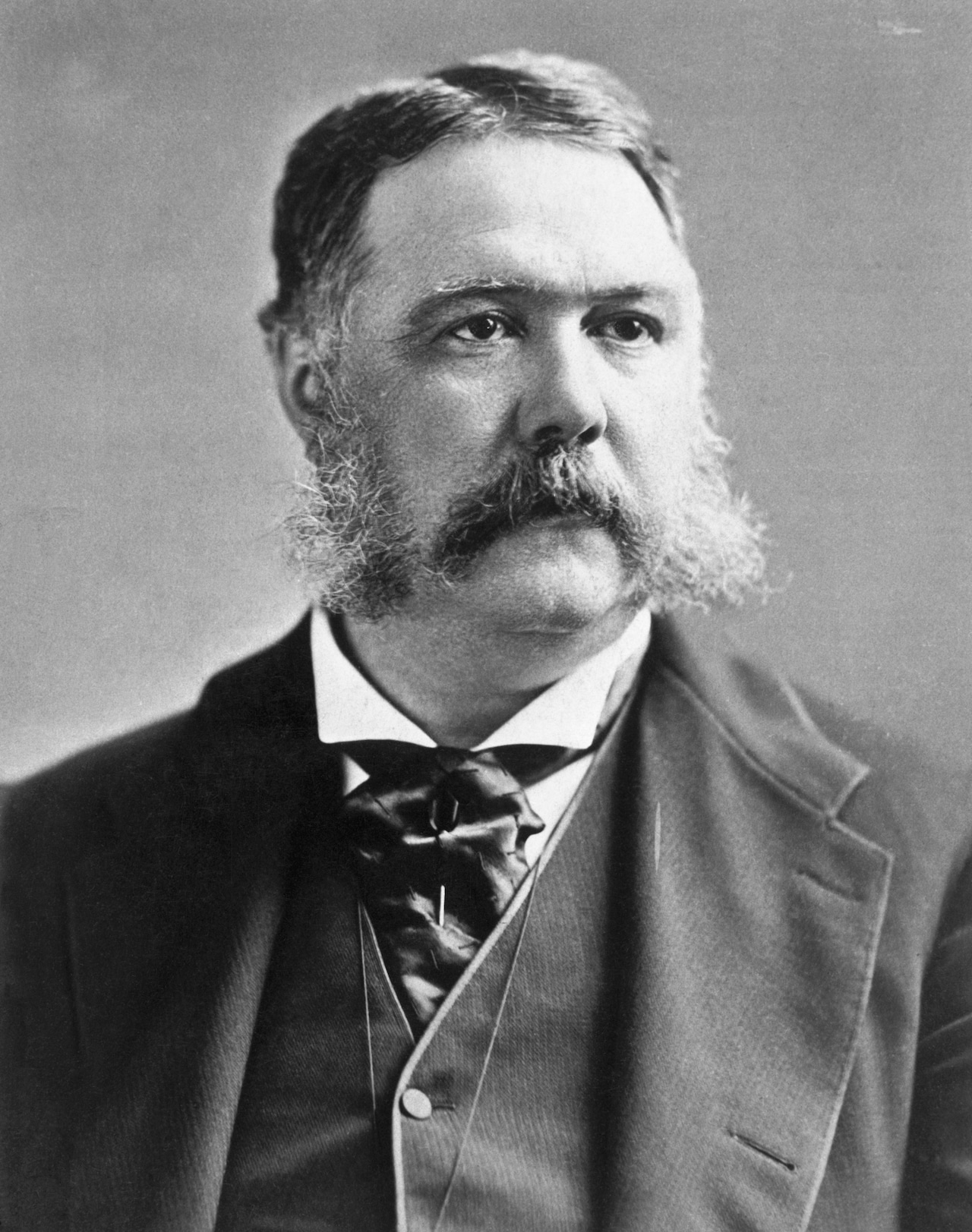 Chester A. Arthur, (1829-1886), the twenty-first President of the United States. Bettmann Archive | Getty ImagesBettmann Archive | Getty ImagesChester A. Arthur (21st U.S. president)
Arthur was President James A. Garfield’s vice president and ascended to the Oval Office upon Garfield’s assassination. Born in Fairfield, Vermont, Arthur had a long political career in New York. He moved here from Vermont as a child and spent much of his boyhood years in and around the Capital Region. He graduated from Union College in Schenectady.
During the Civil War, Arthur served as quartermaster of the New York State Militia, later known as the National Guard. He oversaw the enlistment, training, and equipping of more than 125,000 Union soldiers. Arthur died on Nov. 18, 1886, and is buried in a massive, ornate gravesite in Albany Rural Cemetery, just north of the city. Each year, members of the New York State National Guard commemorate his birthday, Oct. 5, with a military presentation at his grave.
Presidential factoid: Only four U.S. presidents had a shorter lifespan than Arthur. He died at age 57. His predecessor in the White House, James A. Garfield, was 49 at the time of his assassination. The other three youngest to die were James K. Polk (age 53), Abraham Lincoln (age 56) and John F. Kennedy (age 46).
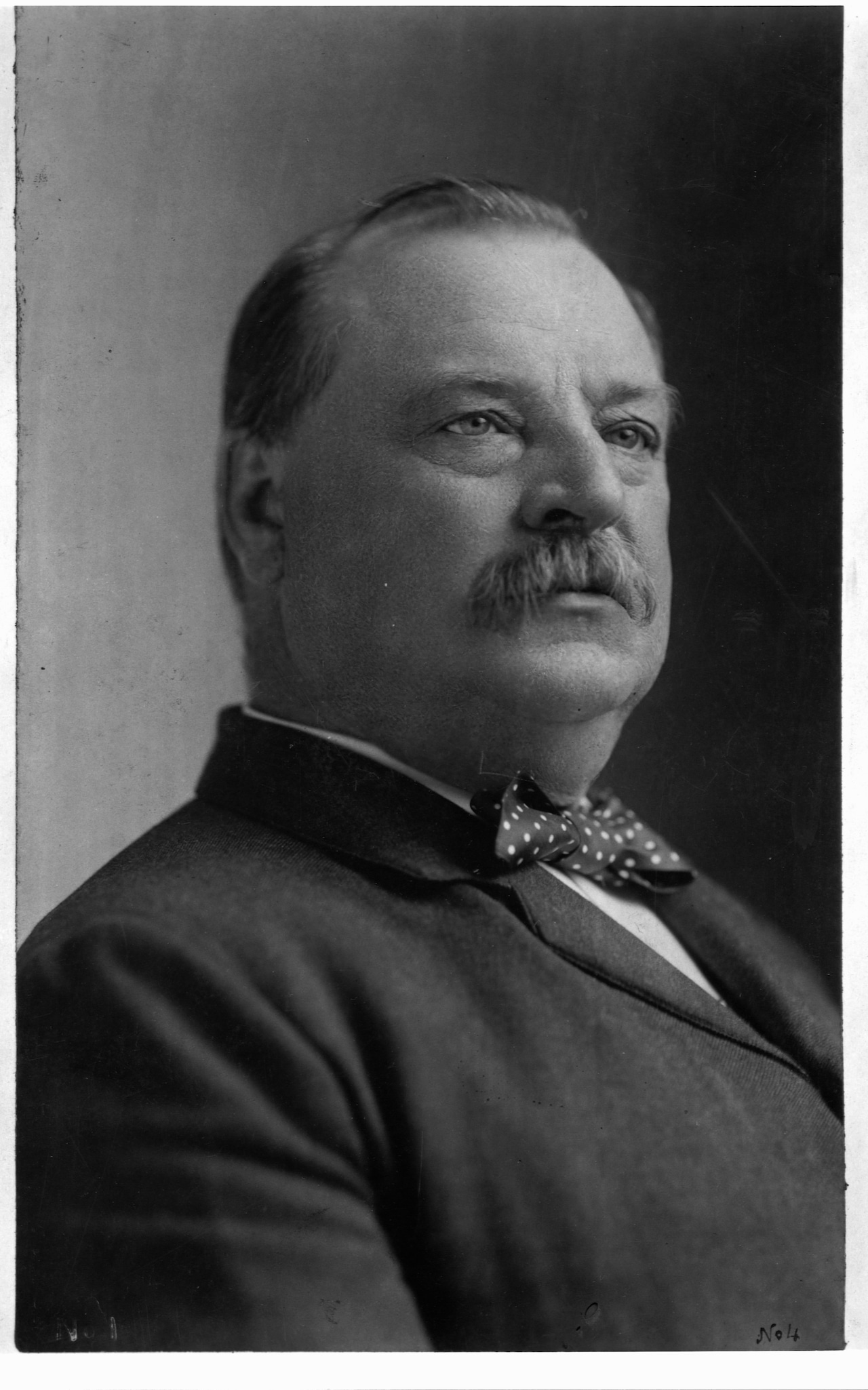 Grover Cleveland. Photo by Library of Congress/Corbis/VCG via Getty ImagesPhoto by Library of Congress/Corbis/VCG via Getty ImagesGrover Cleveland (22nd and 24th U.S. president)
Although Cleveland was neither born in New York state nor buried here, he had a significant political career based in Western New York, much like Millard Fillmore. After passing the bar in 1859, Cleveland served as assistant district attorney of Erie County, sheriff of Erie County, became the 35th mayor of Buffalo, and then served as the 28th governor of the state.
He was born in Caldwell, New Jersey, in 1837, and died on June 24, 1908, at his home in Princeton, New Jersey, where he is also buried. After leaving the White House, he served as a trustee of Princeton University.
When visiting Buffalo, you can check off two presidential sites for the price of one. At Buffalo City Hall, there is a large statue of Mayor and President Grover Cleveland on the north side of the building. President Fillmore’s statue is on the south side of the same building. Each was sculpted by artist Bryant Baker, and both were dedicated simultaneously in 1932.
Presidential factoid: Although Cleveland was a bachelor when he entered the White House, that status lasted only 15 months. He married Frances Folsom on June 2, 1886. His new bride became the youngest first lady of the United States at age 21.
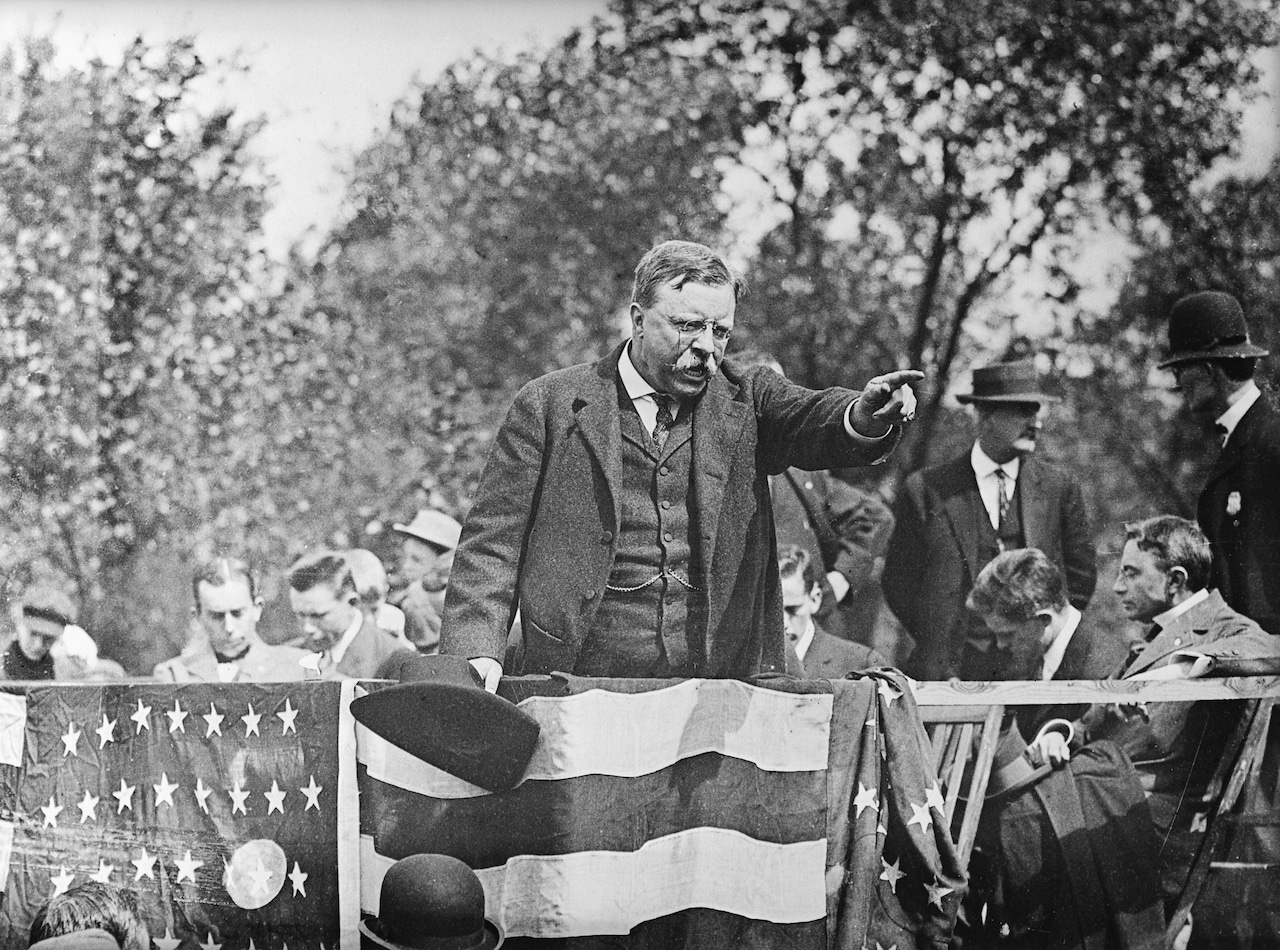 Theodore Roosevelt standing on a podium pointing into the crowd during a campaign rally speech. Ca. 1900s.Bettmann ArchiveTheodore Roosevelt (26th U.S. president)
Theodore Roosevelt was born in New York City and is buried on Long Island, but a significant chapter in American history connects him with the Adirondack Mountains of Upstate New York. In 1901, while serving as vice president under President William McKinley, Roosevelt was vacationing in the High Peaks region.
On Sept. 6, 1901, McKinley was shot while visiting the Pan-American Exposition in Buffalo. By the time word reached Roosevelt, some 300 miles away in the mountains, McKinley, though gravely wounded, was still alive. The president lingered for several days before succumbing to his gunshot wounds on Sept. 14. As McKinley’s death became imminent, Roosevelt left his camp and embarked on a harrowing dash through the mountains in a wagon to reach the nearest train station. He eventually arrived at the small train depot in North Creek. There, while boarding the train to Buffalo, he was informed that McKinley had died and that he, Theodore Roosevelt, was now president of the United States.
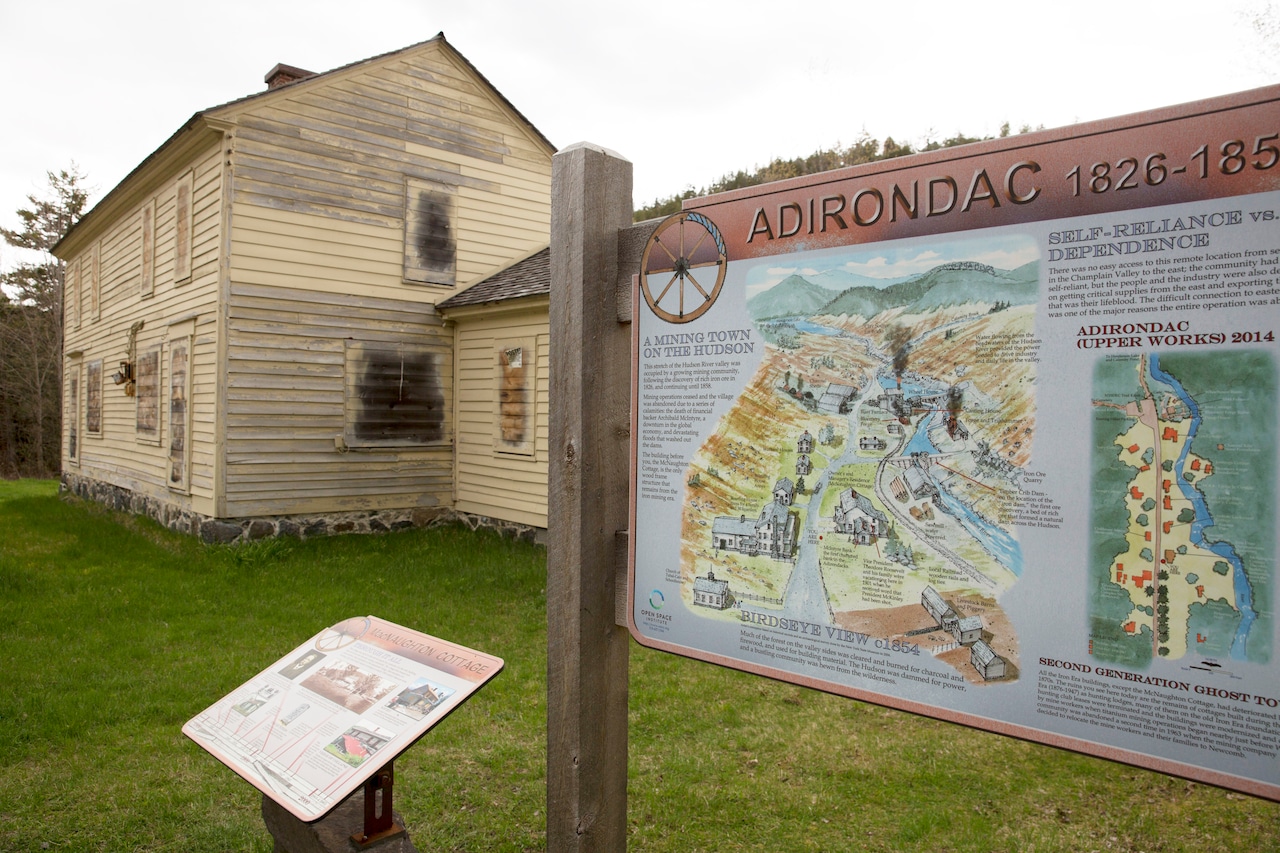 The McNaughton Cottage in the ghost town of Tahawus (also known as Adirondac) is where Vice-President Theodore Roosevelt was staying in 1901 when he received word President William McKinley was dying. Mike Lynch | nyup.comMike Lynch | nyup.com
This dramatic story is detailed at the North Creek train station, which still operates and hosts the North Creek Depot Museum. Visitors can learn about this exciting chapter of American history through artifacts, photographs, and video presentations.
Presidential factoid: When Roosevelt arrived in Buffalo, he went straight to a private home, the Ansley Wilcox House, where he took the presidential oath before a small audience of fewer than 50 people. There is no photographic record of this important event. A life-size statue of Theodore Roosevelt stands in the front yard of the house, now a museum known as the Theodore Roosevelt Inauguration Historic Site, which is open to the public.
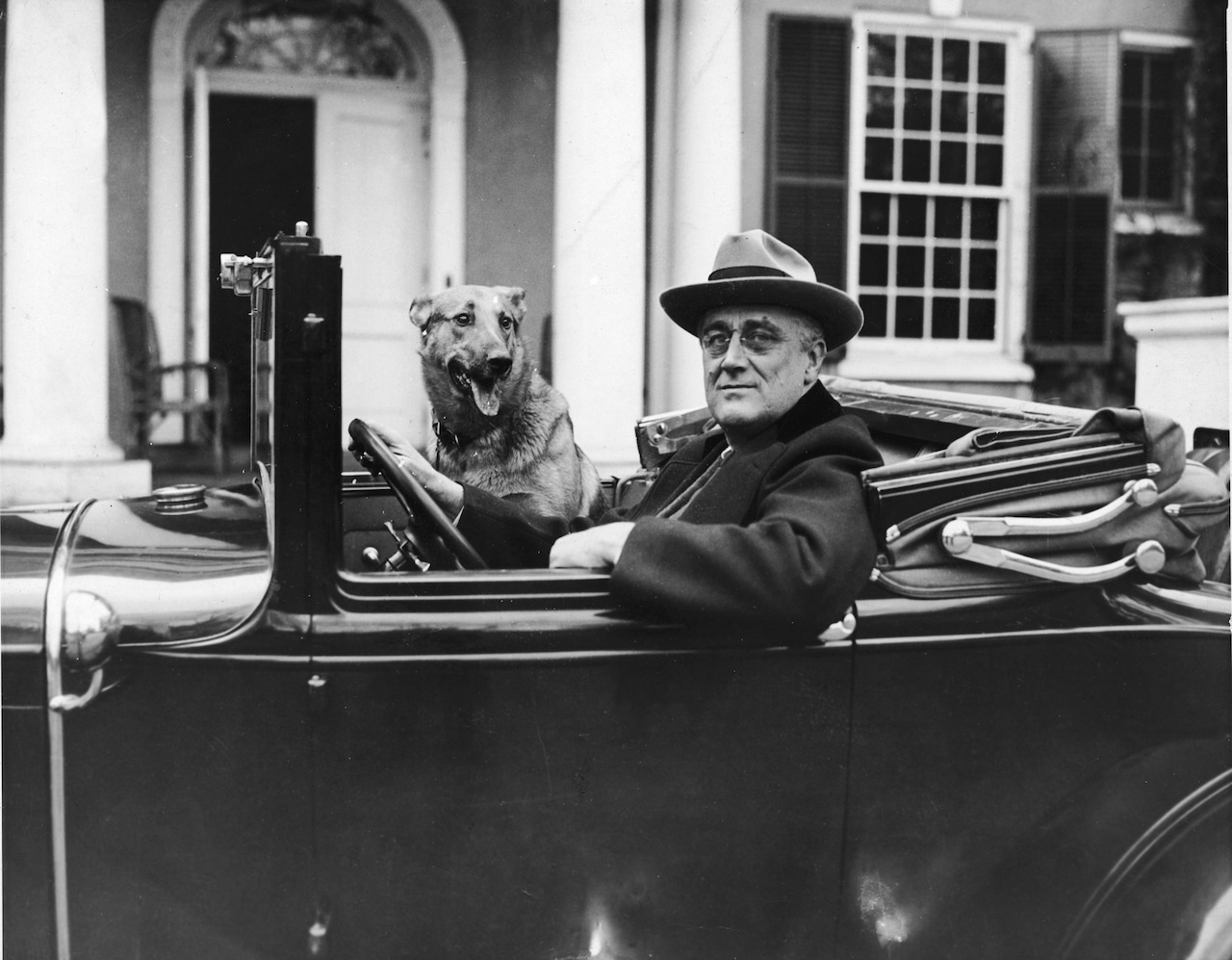 Portrait of American President Franklin Delano Roosevelt (1882 – 1945) as he sits behind the wheel of his car outside of his home in Hyde Park, New York, mid 1930s. Photo by FPG/Getty ImagesPhoto by FPG/Getty ImagesFranklin D. Roosevelt (32nd U.S. president)
Probably more has been written about Franklin D. Roosevelt than any other president. He was elected to the presidency four times (1932, 1936, 1940, 1944), serving from 1933 until his death in 1945. His sprawling birthplace, actually his mother’s 16-acre estate, is officially known as Springwood and is situated along the banks of the Hudson River in Hyde Park. On average, about 225,000 visitors make their way to this small locale on the eastern shore of the Hudson each year. The president called this his home throughout his life.
The museum here has an extensive collection of FDR memorabilia and hosts several large public events each year, including author presentations, cultural performances, and musical presentations. Tours are available. Franklin Roosevelt is buried in the center of the home’s rose garden, alongside his wife, Eleanor, who died in 1962.
While all presidents now have a public library to hold their papers and presidential material, FDR’s was the first, dedicated by the president himself on June 30, 1941.
Presidential factoid: President Roosevelt had perhaps the most famous presidential pet. Fala, a small Scottish Terrier, received much press and was popular with the American public. Fala died on April 5, 1952, and is buried next to his master’s grave in the rose garden, with his own small grave marker.