
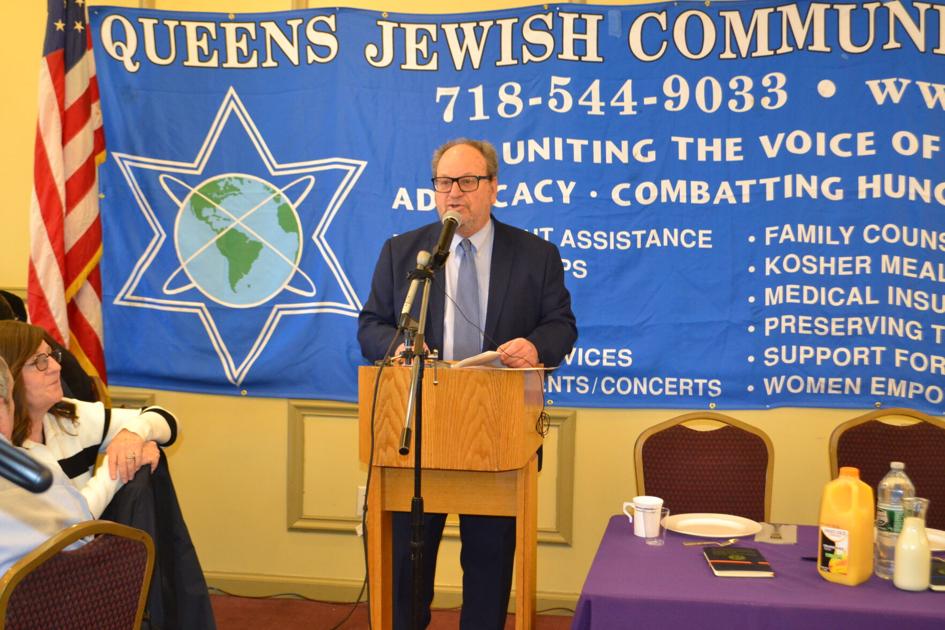
Barry Grodenchik, president of the Queens Jewish Community Council, was uncharacteristically somber Sunday morning at the group’s annual legislative breakfast.
“If I do not start off with the usual pleasantries, I hope that you will understand,” the former councilman said to a group of more than 200 at the Young Israel of Jamaica Estates synagogue.
The annual event, as usual, brought out government dignitaries including state Attorney General Letitia James, U.S. Reps Grace Meng (D-Flushing) and Tom Suozzi (D-Nassau-Queens), the city and state comptrollers, Council Speaker Julie Menin (D-Manhattan) and a vast array of elected officials from Queens.
But this year, with the single-digit temperature outside a distant second, the speakers were very focused on recent antisemitic incidents including a pro-Hamas rally outside of a Kew Gardens Hills synagogue back in December; the Jan. 27 assault of a rabbi in Forest Hills; the vehicular attack at Chabad Lubavitch World Headquarters in Crown Heights in Brooklyn a day later; and other acts of violence and vandalism.
“We are definitely not living in normal times,” Grodenchik said. “The Jewish community is in a place in New York City that many people in this room have never known. We need armed guards in our synagogues and schools. And, regrettably, it is necessary that we have police patrols as well.”
But Grodenchik and others also thanked those gathered for always supporting them and the Jewish community. Talking near the end of the program, Queens District Attorney Melinda Katz spoke of greeting guests from outside the Jewish community and thanking them for their support.
“They said, ‘We were always here.’ I said, ‘But you still are,’” Katz explained.
Rabbi Meyer Waxman, executive director of the QJCC, briefly touched on recent events in his talk before returning to the topic of the religious, cultural, food assistance and community services the group continues to provide.
“I want to make it clear that QJCC it at all all about antisemitism,” Waxman said. “While of late we are seeing that the world has too many evil people … these people do not define us.”
Menin, the daughter and granddaughter of Holocaust survivors from Budapest in Hungary, took the opportunity to discuss her five-point plan to combat antisemitism with a series of bills introduced on Jan. 29.
They include security buffers around entrances to houses of worship, security provisions and private schools and Holocaust education programs in schools.
“It is an everyday challenge,” Menin said. Unfortunately it is not a new challenge.” She reiterated that buffer zones would not infringe on legitimate rights to peaceful protest.
“Children have the right to enter their schools without threats and intimidation,” the speaker said. “… The right to peaceful protest is sacrosanct. What is not sacrosanct is intimidation and harassment.”
Former Flushing Assemblyman Daniel Rosenthal, now vice president of government relations with the UJA-Federation, also spoke briefly of services provided and his gratitude for community support. James, during her talk, referenced the social service programs run by the QJCC and other agencies that have faced threats of or actual cuts in federal funding from Washington, DC.
“There have been efforts to stop a lot of these services,” James said. “And when we received an executive order that seemed intended to cut a lot of these programs, it was my office that stepped in, filed an action and stopped them.”
State Comptroller Tom DiNapoli was unequivocally clear on his office’s continued investments of state pension funds in State of Israel bonds, saying the Empire State is the largest state investor in Israel, despite many parties who protest the transactions.
“And soon again [will be] New York City,” called out new city Comptroller Mark Levine.
“It makes sense,” DiNapoli said. “It will be a good move for New York City. We get a good return.”
On the flip side, DiNapoli reiterated state policy of not doing business with companies that boycott Israel.