
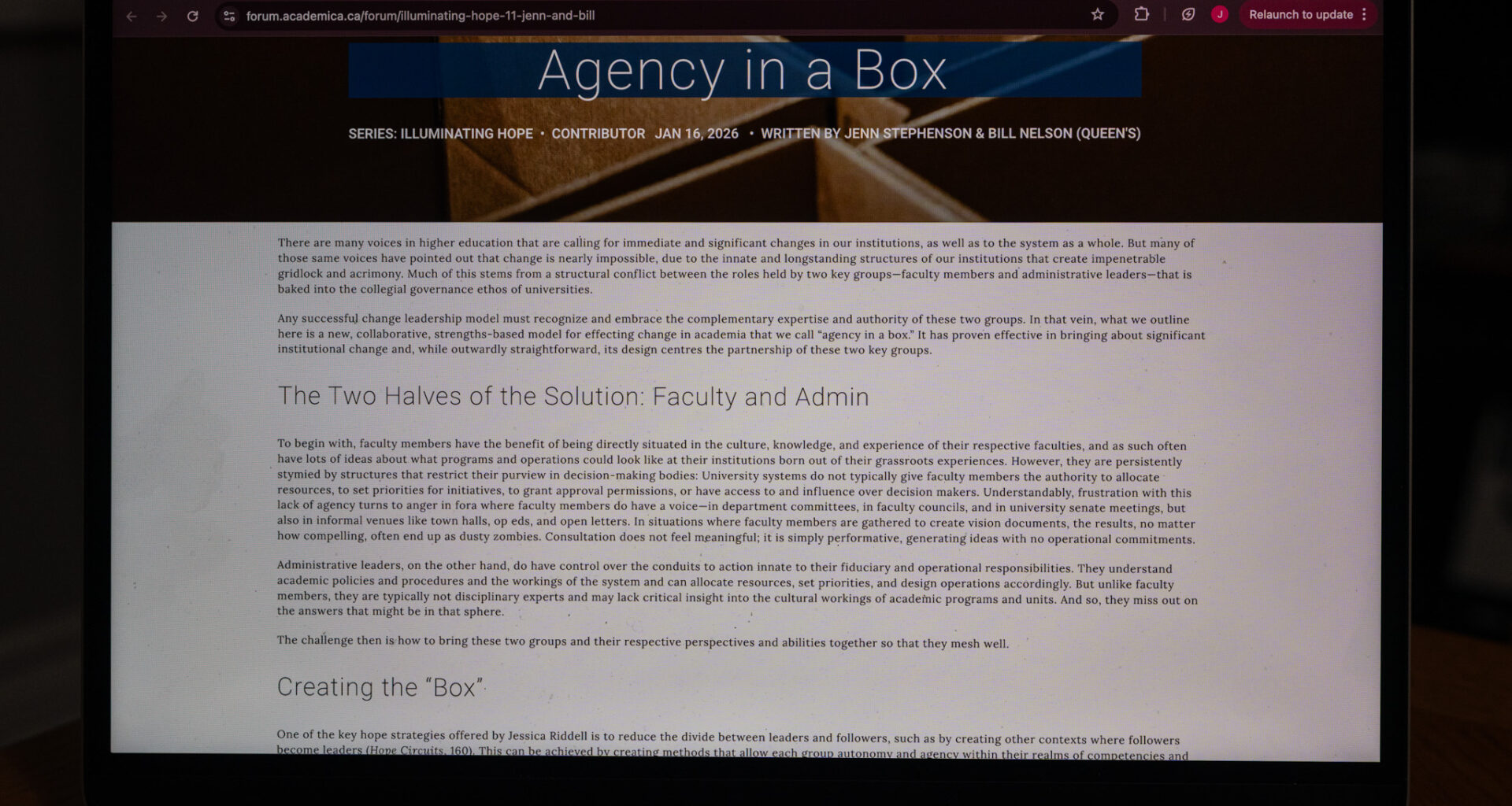
Despite online backlash, Queen’s administrators who authored “Agency in a Box” argue the model’s meant to promote collaboration among University administration and faculty.
Bill Nelson, ArtSci associate dean (teaching and learning), and Jenn Stephenson, former ArtSci associate dean (studies) until June 2025 and current professor in the Dan School of Drama and Music, have published two articles in the Academica Forum as part of the Illuminating Hope in Higher Ed initiative. The articles outline a framework they call “Agency in a Box,” a framework for academic change in which administrators set broad constraints while faculty develop collaborative, implementable solutions within existing governance structures.
This model unfolds in three stages: First, “creating the box,” where leaders outline the core requirements and constraints of a solution; second, “kicking the box,” where faculty and staff test and agree on the parameters; and third, “development in the box,” where faculty build tailored solutions with administrative promise that if the solution follows the guidelines set, it will be supported.
In an interview with The Journal, Nelson and Stephenson stated that the model can be applied to university issues, such as program redevelopment, as well as to recurring academic challenges and situations shaped by external constraints, including funding pressures.
The articles and framework, though, have sparked online discourse on Reddit, where one user characterized the work as policy writing for academic consulting firms and as limiting faculty autonomy.
In response, Nelson and Stephenson said their work isn’t policy writing or consulting and isn’t being done on behalf of Queen’s University.
Instead, Nelson explained that the model emerged from his and Stephenson’s experience working within university governance structures, where ideas for change were frequently generated but rarely implemented.
According to Nelson, faculty, staff, and administrators frequently bring forward ideas, but institutional systems were poorly designed and “articulated,” which is why they have created the new Agency in a Box model.
“What we realized is that the system that we’re using to work together was not really well built […] And so the agency in a box is a way for groups of people in the University to work together. It’s a collaboration model,” Nelson said.
Stephenson described the “Agency in a Box” work as a “scholarship of leadership,” an academic approach that studies leadership practice within universities. Modeled on the scholarship of teaching and learning, their research aims to examine how collaboration functions within collegial governance, using case studies from Queen’s and other Canadian institutions.
“Very often professors will engage in scholarship around what’s happening in their classes. And so they might ask a research question about their teaching and then, through their classroom experience, do some studies on it and then write about it, publish and share their results. […] We’re taking a similar approach to think about scholarship of leadership.”
Similarly, Stephenson explained that after years of engaging in leadership work, they’re now critically examining that experience to understand what was effective, what wasn’t, and what lessons were learned.
Nelson said the “box” refers to “a set of constraints,” but “also a promise” that solutions built within the constraints will be implemented. According to Nelson, the framework is designed to prevent project stalling by ensuring that solutions developed within established constraints proceed.
Additionally, he said the model’s designed to avoid limiting faculty voices by ensuring the “box” remains broad enough for meaningful academic design. He explained that while the framework sets “hard operational constraints,” it must not prescribe outcomes.
“That box has to be really wide. It […] can’t be prescriptive because faculty members, if they don’t see themselves in it and they can’t create their discipline and the culture within it, they’re never going to have agency,” he explained.
To include student voices, according to Stephenson and Nelson, the model is intended to follow existing university governance structures, meaning student representatives and leaders will collaborate through channels such as the Senate and Faculty Board.
Looking ahead, they plan to expand their research by collecting case studies from other universities, tracking how participants experience collaboration over time, and applying for external funding to support the work.
Tags
Administration, Agency in a Box, faculty
All final editorial decisions are made by the Editor(s) in Chief and/or the Managing Editor. Authors should not be contacted, targeted, or harassed under any circumstances. If you have any grievances with this article, please direct your comments to journal_editors@ams.queensu.ca.