
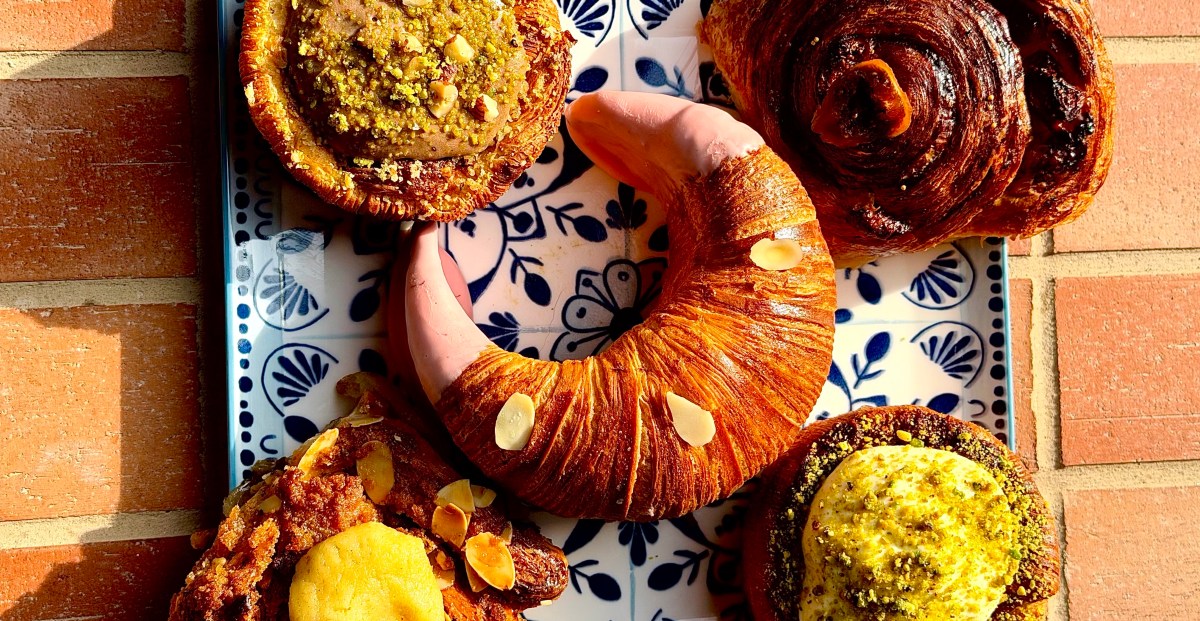
Nestled out in Brooklyn Heights since December, tiny bakery Diljān has been selling out of its Afghan baked goods and breads. Co-owners Ali Zaman and Mohamed Ghiasi (of Astoria’s Little Flower Cafe) wanted to bring the traditional breads that the Afghan Americans grew up eating, with the help of skilled co-owner, baker, and friend Bryan Ford.
Here, Eater NY takes a closer look at the baked goods that are defining Diljān, from the best-selling saffron shah to halwa sticky bun to the giant Afghan naans.

The saffron shah at Diljān. Diljān/Official
A crescent-shaped pastry stuffed with saffron pastry cream dipped in saffron-laced chocolate
Ali Zaman: Everyone’s done rose water and cardamom, but I was like, ‘Let’s just try to see what we could do with saffron.’ [Ford] made these beautiful crescents — the Islamic symbol.
Bryan Ford: I made a pastry cream with saffron, and bloomed it in the milk for the pastry cream — no vanilla, because we really want the saffron to shine brightly. I decided to make white chocolate tempered with saffron, which I blended and dipped the pastry into, which creates that nice little crunch. It’s very saffron-forward, but the white chocolate helps break it up.

The halwa sticky bun at Diljān. Diljān/Official
A sweet roll topped with scattered blocks of semolina pudding
Zaman: Bryan was really smart to say, “Why don’t we take that same concept, but put it in a sticky bun?” It’s very ooey-gooey, like a cinnamon bun.
Ford: Halwa would be really cool in a sticky bun with gur [jaggery], butter, all the nuts — almonds, walnuts, pistachio — and we just made a badass sticky bun. I put chunks of halwa on the pan, and then I put the dough, so when I invert it, the halwa is crispy right on top. It’s got a little toastiness.

The sheer pira at Diljān. Diljān/Official
A round pastry filled with the Afghan milk fudge
Ford: Some flaky dough, put a layer of pistachio frangipane, bake it, and then I shove the milk fudge into it, and top it with a vanilla diplomat cream, which just gives it a lot of different textures and a little bit of lightness to cut the milk fudge because it’s so rich. It’s dense but light, it’s got cardamom, rose water, sugar syrup, and milk powder. You can fold nuts into it; we do pistachio.

The panja and roghani at Diljān. Diljān/Official
Afghan naan e panja and roghani
Ford: I gathered information from Ali, Mohamed, and the parents — they’ve eaten the bread the way it’s supposed to taste, so I drew on their flavor, aesthetic, and smell notes.
Zaman: The panja is more of a flat traditional bread. The reason why it’s so special to me is that you literally see Bryan’s fingerprints in every single piece of bread that comes out. It’s such a personal, intimate bread. It has to have just enough fluff, but it also has to have a nice crispy bottom, and the indentation with your fingers has to be in this sort of way.
Ford: The panja’s got to have a decent amount of whole wheat, so I sourced stone-ground flours that could emulate that: Cairnsprings Mills [in Washington state] and Brooklyn Granary.
Zaman: The sourdough gave it this nice little tang, which I wasn’t fully used to, but it was such a perfect addition.
Zaman: “Roghan” in Farsi is “oil;” “roghani” is something that is oily, so it’s bread with more oil. We found the sweet spot with 18 percent more olive oil.
This interview has been edited and condensed for clarity.