

Last week, you might have seen that Manhattan Associates, Inc. (NASDAQ:MANH) released its yearly result to the market. The early response was not positive, with shares down 3.9% to US$145 in the past week. Manhattan Associates reported US$1.1b in revenue, roughly in line with analyst forecasts, although statutory earnings per share (EPS) of US$3.60 beat expectations, being 4.5% higher than what the analysts expected. Earnings are an important time for investors, as they can track a company’s performance, look at what the analysts are forecasting for next year, and see if there’s been a change in sentiment towards the company. So we collected the latest post-earnings statutory consensus estimates to see what could be in store for next year.
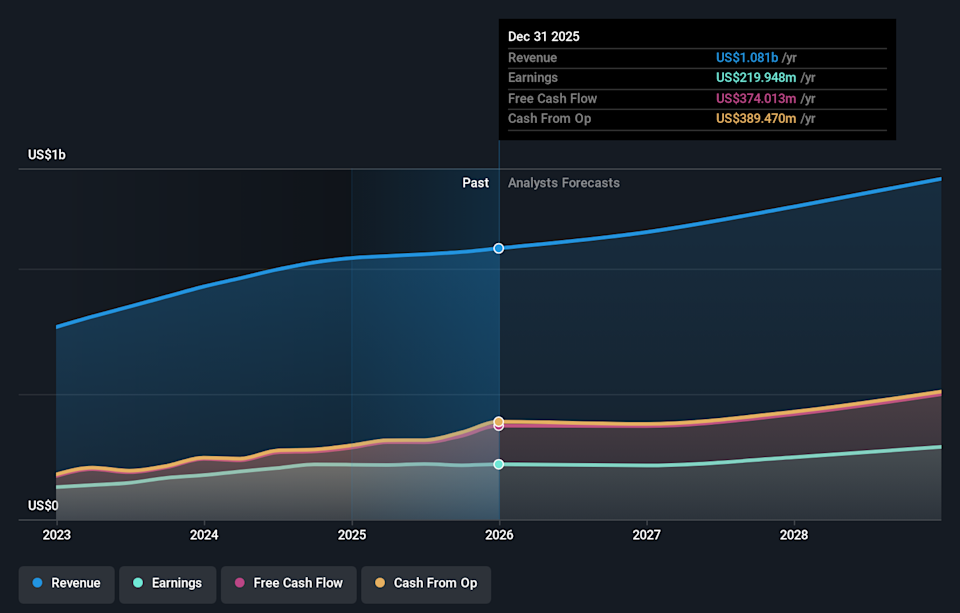 NasdaqGS:MANH Earnings and Revenue Growth February 8th 2026
After the latest results, the eleven analysts covering Manhattan Associates are now predicting revenues of US$1.15b in 2026. If met, this would reflect an okay 6.0% improvement in revenue compared to the last 12 months. Statutory earnings per share are forecast to reduce 3.9% to US$3.53 in the same period. Before this earnings report, the analysts had been forecasting revenues of US$1.15b and earnings per share (EPS) of US$3.67 in 2026. The analysts seem to have become a little more negative on the business after the latest results, given the small dip in their earnings per share numbers for next year.
Check out our latest analysis for Manhattan Associates
The consensus price target held steady at US$213, with the analysts seemingly voting that their lower forecast earnings are not expected to lead to a lower stock price in the foreseeable future. The consensus price target is just an average of individual analyst targets, so – it could be handy to see how wide the range of underlying estimates is. The most optimistic Manhattan Associates analyst has a price target of US$240 per share, while the most pessimistic values it at US$160. There are definitely some different views on the stock, but the range of estimates is not wide enough as to imply that the situation is unforecastable, in our view.
One way to get more context on these forecasts is to look at how they compare to both past performance, and how other companies in the same industry are performing. We would highlight that Manhattan Associates’ revenue growth is expected to slow, with the forecast 6.0% annualised growth rate until the end of 2026 being well below the historical 13% p.a. growth over the last five years. By way of comparison, the other companies in this industry with analyst coverage are forecast to grow their revenue at 15% per year. So it’s pretty clear that, while revenue growth is expected to slow down, the wider industry is also expected to grow faster than Manhattan Associates.
The biggest concern is that the analysts reduced their earnings per share estimates, suggesting business headwinds could lay ahead for Manhattan Associates. Fortunately, the analysts also reconfirmed their revenue estimates, suggesting that it’s tracking in line with expectations. Although our data does suggest that Manhattan Associates’ revenue is expected to perform worse than the wider industry. There was no real change to the consensus price target, suggesting that the intrinsic value of the business has not undergone any major changes with the latest estimates.
With that in mind, we wouldn’t be too quick to come to a conclusion on Manhattan Associates. Long-term earnings power is much more important than next year’s profits. We have forecasts for Manhattan Associates going out to 2028, and you can see them free on our platform here.
Another thing to consider is whether management and directors have been buying or selling stock recently. We provide an overview of all open market stock trades for the last twelve months on our platform, here.
Have feedback on this article? Concerned about the content? Get in touch with us directly. Alternatively, email editorial-team (at) simplywallst.com.
This article by Simply Wall St is general in nature. We provide commentary based on historical data and analyst forecasts only using an unbiased methodology and our articles are not intended to be financial advice. It does not constitute a recommendation to buy or sell any stock, and does not take account of your objectives, or your financial situation. We aim to bring you long-term focused analysis driven by fundamental data. Note that our analysis may not factor in the latest price-sensitive company announcements or qualitative material. Simply Wall St has no position in any stocks mentioned.