
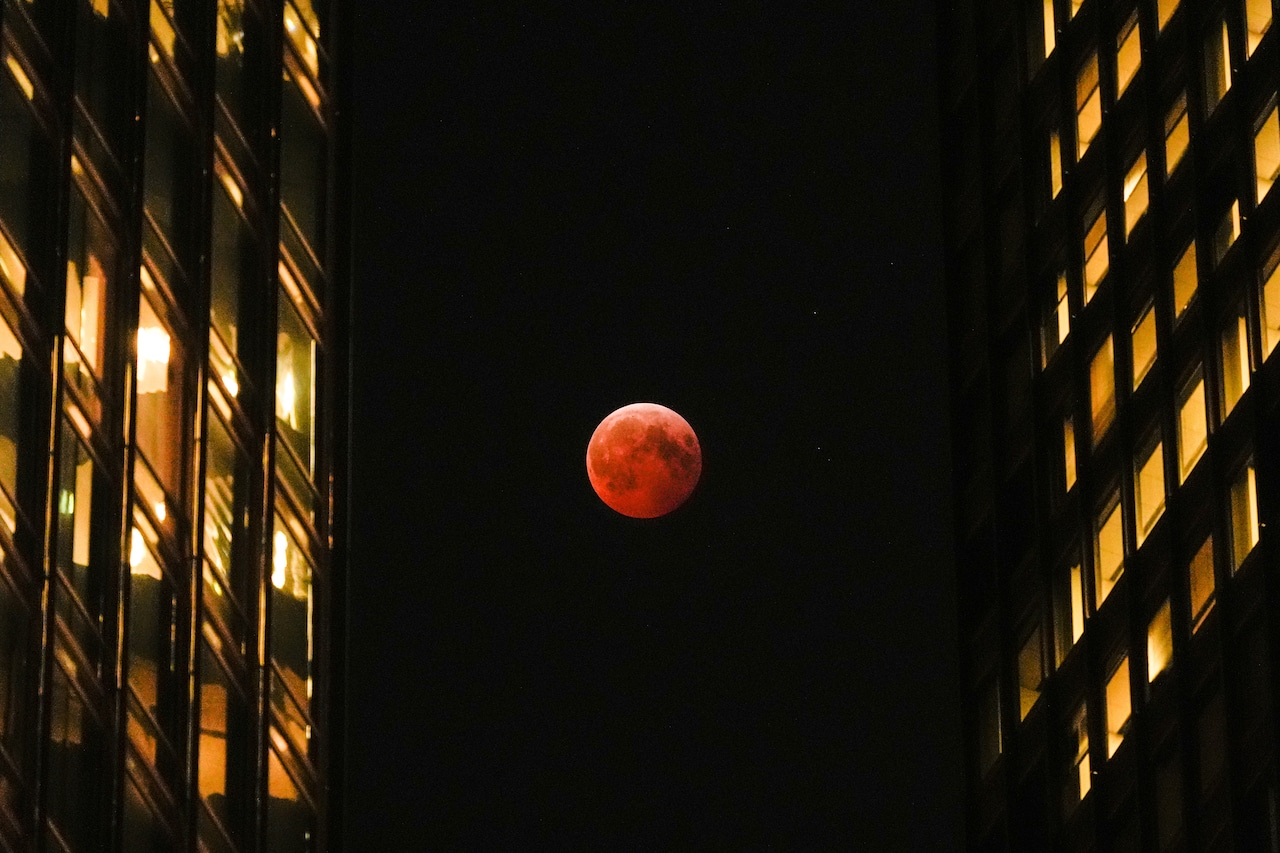
Get ready stargazers. A total lunar eclipse — commonly called a “blood moon” — will occur on Tuesday, March 3, and New Yorkers will be well-positioned to see it in its entirety.
According to the Old Farmer’s Almanac, the most dramatic part of the eclipse — when the moon appears darkest and takes on its deepest reddish color — will occur between 6:04 and 7:03 a.m. During this time, the moon should take on a coppery or orange-red appearance before it slowly brightens and returns to normal by 9:23 a.m.
It’s the only total lunar eclipse of the year — and the last one anywhere on Earth until Dec. 31, 2028.
“A lunar eclipse occurs when Earth passes directly between the sun and moon, casting a gigantic shadow across the lunar surface and turning the moon a deep reddish-orange,” according to NASA.
All lunar eclipses are completely safe to view with the naked eye. You can observe a lunar eclipse without any special equipment, but for a more dramatic observing experience, seek a dark environment away from bright lights. Binoculars or a telescope can also enhance your view.