
Mother Island: Act I
A.I.R. Gallery
January 10–February 8, 2026
Brooklyn
There’s a dizzying dissociative quality to Rebecca Weisman’s exhibit Mother Island: Act I, showing now through February 8 at Brooklyn’s A.I.R. Gallery. Weisman says it’s a “distillation” of a fuller work exhibited this past summer upstate, at the cavernous Wassaic Project. Taking up a chunk of the fourth floor, her interactive video and sculptural installation there also evoked wonder. These two qualities of Mother Island: Act I, dissociation and wonder, describe an artwork that captures the lovely madness of making art, playing, and raising kids, and making a life out of making art and playing and raising kids.
Conceptually, Mother Island is a set of concentric circles, each describing a world. At the core are six children who for fifteen months in 1965 were castaways on the tiny island of ‘Ata in the Tongan archipelago. Next, is the short broadcast film recreating and documenting the boy’s survival and rescue, completed in 1966 by an Australian TV crew. Then there’s Weisman herself: an artist, her partner, and their two kids living together in Vermont. They are followed by an impossibly huge ring trailed by an infinitesimally smaller one: the COVID pandemic’s quarantining lockdown, its isolating effects on all who were subject to it, and a play-activity Weisman initiated with her kids, then three and five, while sequestered together in Vermont during the pandemic. The activity was making an art project together by recreating the stranding, isolation, and rescue of the six boys. The next circle is the finished artwork now on display in Brooklyn, earlier in Wassaic, articulated as a video and sculpture installation. The final ring of course is the world Weisman’s Mother Island now inhabits.
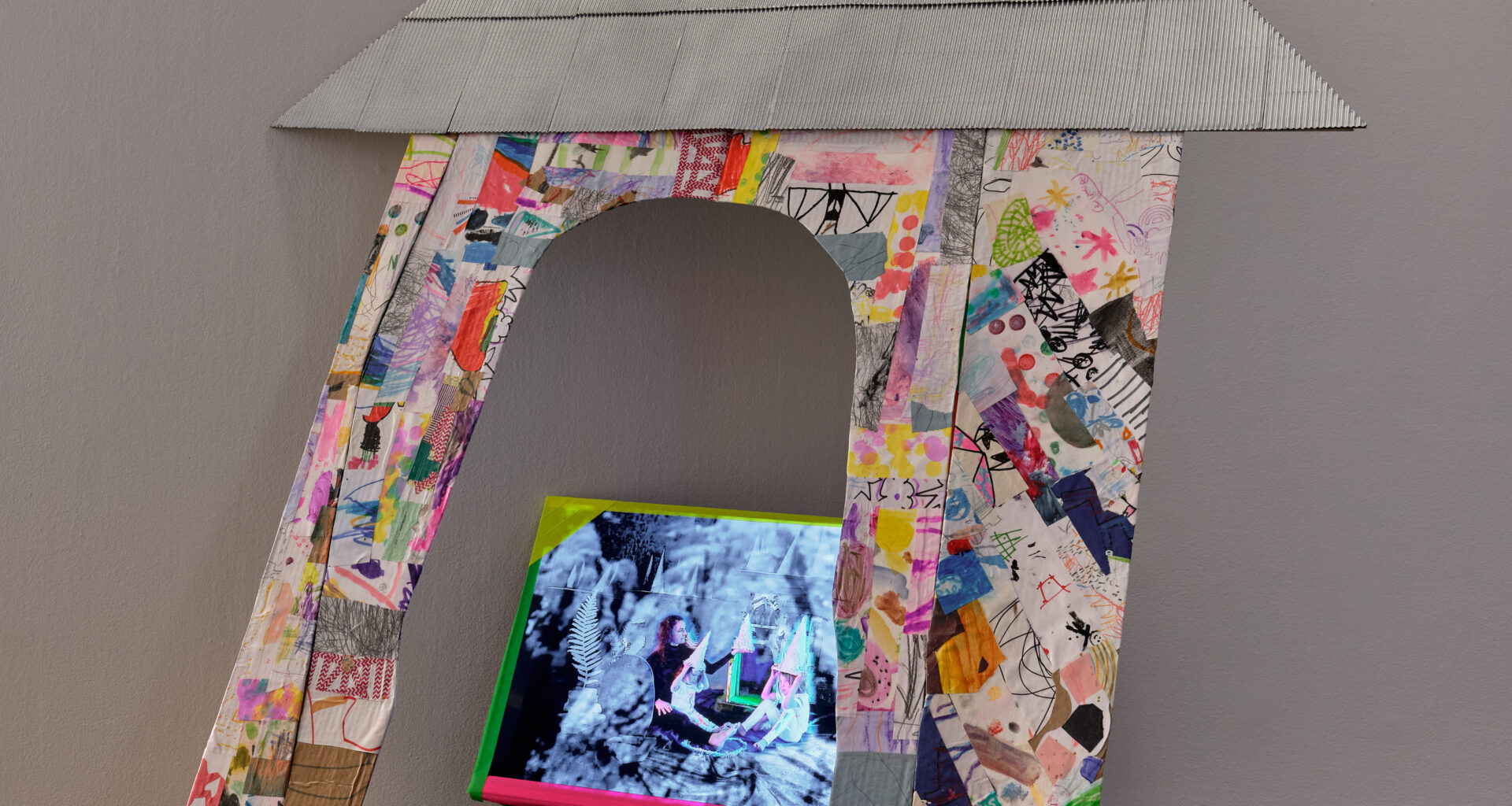
Physically, the work at A.I.R. is a mix of sculpted cone forms, two video screens embedded within made objects, one video projected on a prepared screen through a banner and reflective hanging glass, and a wall text. The text explains some of the work’s story, and may not be required, but is helpful. The cone-forms were initiated by Weisman’s kids as a way for them to represent islands in their recreation. One screen is inserted into the deck of a small, roughly built yet sturdy-looking wooden sailboat. The other screen is mounted in a barely three-dimensional form parroting a house, whose exterior is decorated by a collage of what appear to be fragments of kids’ drawings. The videos projected and displayed on the screens are each three-segments of one edited video. They document the kids and Weisman’s non-linear recreation of the castaways’ island survival. The video involves a lot of scenes of Weissman and her children scuttling and playing about forms like the sailboat, the dwelling, the cones, and plant-like objects. The environments on the screen involve green-screened imagery; often water serves as the ground. Throughout the footage, images of ‘Ata from the TV crew’s 1966 film are collaged into the background: the only remnant of the originating core within the visuals of the artwork. As a result of the collages and the swirl of hanging mirrors onto which the video is projected, the installation reinforces the sense of being adrift.