
Bonded by the Spirit of Doubt
15 Orient
January 10–February 14, 2026
New York
As we find ourselves mired in the boundless proliferation of images (human-made or otherwise), our collective relationship with visual certainty is so scrambled and hazardous that the term is beat into near-extinction. When the stakes are as high as environmental, social, and political catastrophe, artmaking today occupies a dire role in navigating newfound sensitivities to visual information that contend with human perception, specificity, and veracity. Drawing conclusions and making generalizations demand more self-scrutiny than ever. In Bonded by the Spirit of Doubt, Mitchell Kehe presents work that brings attention to the upended internal logic of abstraction—to abstract meaning in the age of post-objectivity is an overpromise. Swept up by the relentless billows of imagery, the proverbial ship has turned turtle.
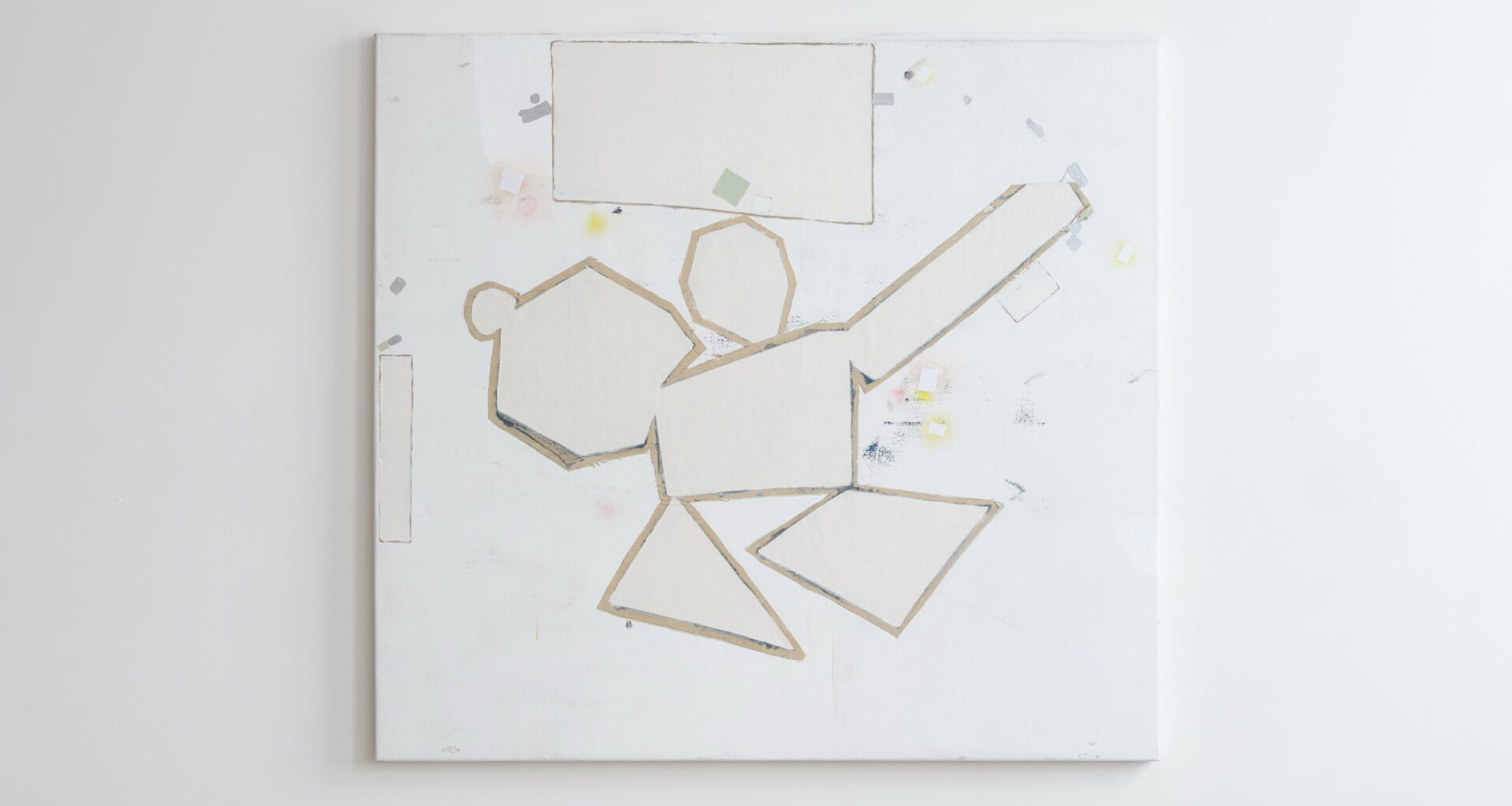
Shapes seem to naturally accumulate and swell in Kehe’s paintings. Their near-geometric visual vocabulary gives you a sense of color field paintings from the 1950s before breaking entirely from the tradition. His layered application of sewn fabrics, enamel, and flocking ultimately privileges form and texture over hue.
Untitled 14 (2025) registers a crudely assembled figure with unbalanced limbs and proportions. Outlined in tan, the body becomes weightier but remains flat against the surface. Kehe alludes to dimension through oblique quadrilateral absences and additions that introduce color and gradients of white. This painting, aptly positioned closest to the entrance, primes visitors for Kehe’s arrhythmic mark-making and instinctive approach to intimating engrossing forms.
As the Berlin-based artist was working (and sleeping for a time) in situ in preparation for this show, he made use of what he could find in the gallery to finish the paintings and compile his sculptures. In some instances, he revisited works of his own that he discovered in storage. Such is the case with Untitled 12 (2021–26), where flocked vertical stripes sit in the foreground. Behind these bars, a black oval teems with rounded, irregular shapes. A cast-iron radiator sits just feet away, its repeating columns rhyming with the painting’s. This may be the most blatant example of Kehe’s sensitivity, but I don’t mean to suggest heavy handedness. Kehe’s approach belongs to an intrinsic processing that is opaque insomuch as it doesn’t bother explaining itself. This series denies any clear understanding, offering doubt, as is suggested by the title, as a collectivizing effect.
Kehe apprehends austere geometries and inflates them in Untitled 7 (2025) and Untitled 4 (2026). In Untitled 7, a bold red, multilobed shape, detailed in metal enamel, is collaged onto an asymmetrical frame. Untitled 4 inverts a similar shape, this time in an off-white color. There is no moving image in either, but the segments attached to each stem appear to be ballooning like bubble letters. Taking these forms as fossilized imprints of bloated gingko leaves or overgrown microbial cultures is reasonable. Understood in this way, containment, be it geologic processes of preservation or careful methods of inoculation, becomes a persistent inquiry.