
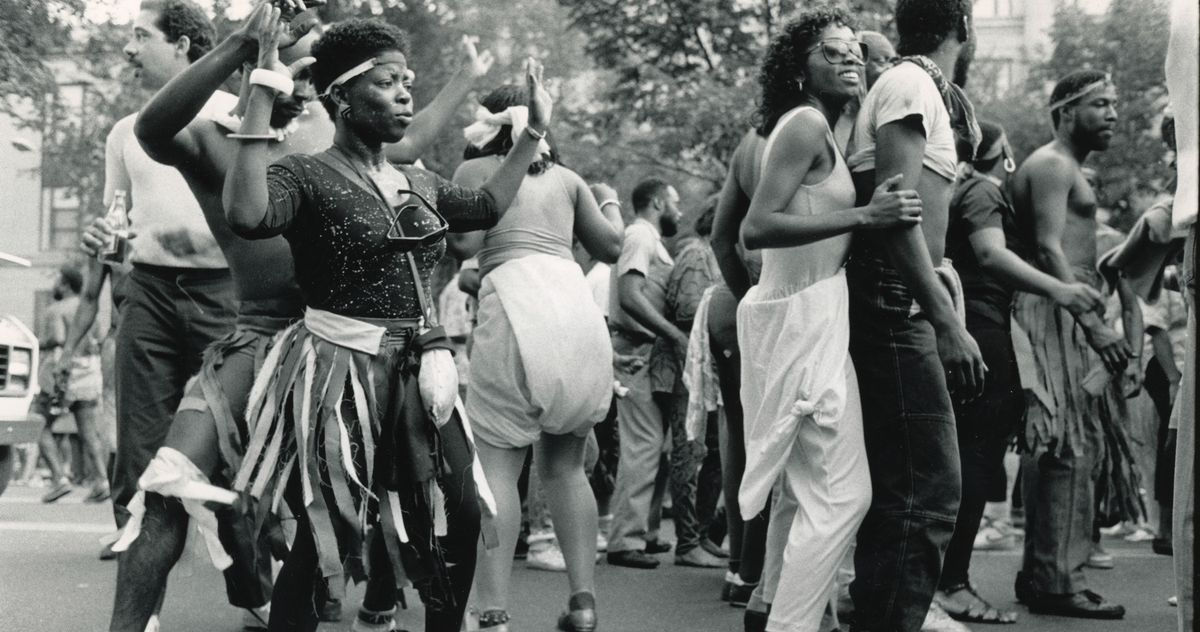
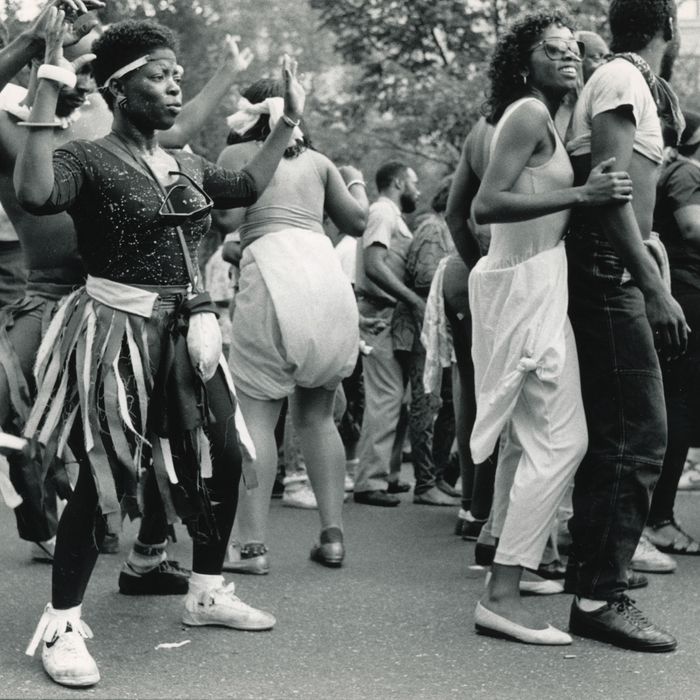
West Indian Day Parade in Crown Heights in 1986.
Photo: © 2026 Marilyn Nance / Artists Rights Society (ARS), New York
I once lived in a Black mecca. But by the summer of 2022, my toddler son and I were often the only Black folks on the playground in Bedford-Stuyvesant, a fact that felt both alienating and surreal. We moved to Bed-Stuy that summer to be close to my sister and her family. Reeling from a recent separation and scrambling for child care in a different neighborhood, I often found myself on the playground, trying to make sense of both our new life and this new community. In the heat of summer afternoons, I sweated and watched with morbid curiosity as my child played with a gaggle of white and mixed-race children. When we met the rare Black family, I was too eager to speak to them, a moth to a proverbial flame of racial solidarity.
One sweltering day, my son was riding his scooter on the playground when a white nanny came by with her charge, a mixed-race girl who was roughly the same age as him. After hearing my son speak hesitantly to the little girl she was minding, the nanny said that my child, then nearly 3 years old, would make a good athlete but might struggle with academics. I told her that seemed unlikely, given that he’d started walking at 17 months old and seemed to have inherited my lack of athletic prowess. Undeterred, she went on with her inane theory; I tuned her out and spent the rest of the summer carefully avoiding her. When I saw this child’s Black father on the playground the next weekend, I contemplated telling him about his employee’s behavior, but I decided to just let it go.
I was offended, shocked that this woman would use her “expertise” to opine on my child’s academic potential. Bed-Stuy was the last place where I thought we’d be the target of racist microaggressions. But the predominantly Black neighborhood, where I once visited my great-grandmother’s brownstone and where my sister had lived for the better part of 20 years, had turned into something unrecognizable. Few and far between were the Black elders who would greet you and expect a greeting in return, replaced by young white professionals and families who offered awkward smiles and occasional small talk when forced into proximity. For the past two decades, I have found myself witness to what feels like a slow, deliberate death of the strong Black communities that produced and enveloped me, an extension of the Caribbean, which my parents left for New York in the late 1970s. Far from an inconsequential transformation or a sign of the times, these changes have left me feeling disoriented and seeking a new place to call home.
The numbers bear out this erasure. Over two decades, from 2000 to 2020, New York City lost nearly 200,000 Black folks, or about 9 percent of its Black residents. These losses have been particularly notable in historically Black strongholds like Bedford-Stuyvesant and Harlem. New York University’s Furman Center data shows that in 2000, Black residents made up approximately 75 percent of Bed-Stuy’s population, and that number dropped to about 40 percent between 2019 and 2023 with the white population increasing more than tenfold.
I was born in Crown Heights in 1980 to parents from the Caribbean — Barbados and Antigua specifically — part of a tidal wave of late-20th-century West Indian and African emigration that changed the face of Black New York. My Brooklyn childhood was marked by three distinct periods: There were the early years my sister and I spent in a co-op apartment my mother bought in Crown Heights. Later, we lived in a Flatbush apartment with my father, stepmother, stepbrother, and a rotating cast of extended family. By the time I was 16 years old, my father and stepmother finally fulfilled their dream of buying a home in Old Mill Basin and our lives became starkly different.
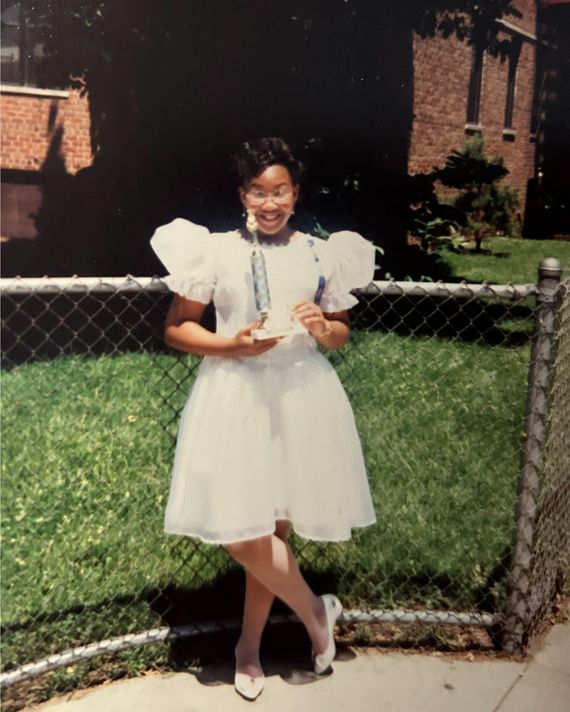
The author after her elementary-school graduation in 1991.
Photo: Courtesy of the author
My formative years were in Flatbush, which is called “Little Caribbean” even though it becomes less and less Caribbean each day as new Asian, Latino, African, and African American residents move in, making the communities where I grew up feel both less familiar and more diverse. Even the name Little Caribbean, as effective and important as it is as a marketing tool, makes me mildly nauseous each time I encounter it on a lamppost or a street sign; it seems to commemorate a community that doesn’t quite exist anymore.
In that Brooklyn, in the late 1980s, all the kids were, like me, the children of Caribbean immigrants. One would still occasionally see a Black Pentecostal church parade on a Sunday afternoon — white-turbaned women, drums and a horn section playing loud gospel music. In that Brooklyn, I squirmed as my stepmother stopped on nearly every block to greet a neighbor; on Saturdays, when our family’s kitchen was closed, we ordered jerk chicken and festival from the now-defunct Danny and Pepper’s or boiled crab and corn from Mr. Chin, the Chinese Jamaican man who cooked his victuals in a Dutch pot on Rogers Avenue and surprised me when he spoke in patois one day.
I still remember roaming Nostrand Avenue with a pack of kids from my junior high school in the bright-red cardigans and gray plaid uniform skirts that marked us as students at a Bushwick magnet school. After school, we split one order of chicken wings and French fries from the Chinese greasy spoon, all that we could collectively afford on our meager allowances. We tied our sweaters around our waists and washed down our food with quarter waters scored at the Puerto Rican–run bodegas while we debated the viral-before-virality-existed conspiracy theory that Tropical Fantasy was a drink designed to sterilize Black boys and men. We celebrated like it was Christmas when the West Indian Day Parade came around each Labor Day, making the pilgrimage to watch the masqueraders in their elaborate costumes and waiting patiently until my favorite band, Burning Flames, exploded onto Eastern Parkway with a mass of Antiguan revelers behind them. None of us thought of the parade as a reason to file a noise complaint; the sounds of the weekend-long party proved that our families had made their mark on the city where we lived. We were the fledgling hopes of our parents’ lives in the U.S. and shone proudly.
The Brooklyn of my childhood was not all idyllic. The threats of gun violence and sexual assault were omnipresent. My father was nearly hit by a stray bullet that entered our apartment from the apartment next door while he was napping on the couch. My sister and I watched a neighbor bleed after he was shot on his bicycle in a drive-by. And to be a girl with a pubescent body meant being subject to rude comments and propositions from boys and men that rained down on you like so much hard hail, while stories about the rape of girls and women, forced to the roofs and abandoned in stinky stairwells of apartment buildings, were cautionary tales.
I was a junior in high school when we moved to Old Mill Basin, an area just off the Belt Parkway marked by rows of two-story attached homes once inhabited by Jewish, Italian, and Irish folks before white flight and retirement spirited them to places like New Jersey, Long Island, and Florida. We were one of the first Black families on our block in the late 1990s; I soon came to know that the Yiddish word schvartze meant “Black” when a fellow passenger lamented that the bus was full of “schvartzes.” My entire body blushed then — the feeling of virulent racism was an unfamiliar, uncomfortable sensation that traveled like lightning from head to toe. A decade later, there were only a few white families left on our block, replaced slowly but surely by Black, mostly Caribbean and African, families.
After college, I struck out on my own, determined to find an affordable apartment to purchase; I knew that escaping the vagaries of rent increases would be the key to surviving New York City as a single adult. My real-estate search led me back to the neighborhood where I’d grown up — to the same subway station, to be precise. In 2006, I convinced my dad, who helped me by paying for my home inspection, that buying property in Prospect–Lefferts Gardens (while this has been a historic district since 1979, when I was growing up, I thought it was part of Flatbush) was a smart idea. At the time, I was 25 years old and scraping together a down payment on a modest studio apartment through a combination of savings and first-time-homebuyer grants. The neighborhood was already transforming; there was a new coffee shop and more white residents. Back then, the abbreviation PLG felt like a harbinger of gentrification that would protect my property value. Now, it feels more like a death knell for the childhood I remember.
Photographer Dinanda Nooney documented Bedford-Stuyvesant residences and their occupants in 1978. Clockwise from top left: Lisa and Dorothy, 579 Putnam Ave. Vonceil and Robert, 254 Hancock St. Jonathan and Dorothy, 897 Sterling Pl. Howard and Louis, 624 Macon St. Photo: Dinanda H. Nooney, Courtesy The Miriam and Ira D. Wallach Division of Art, Prints and Photographs: Photography Collection, The New York Public Library.
Photographer Dinanda Nooney documented Bedford-Stuyvesant residences and their occupants in 1978. Clockwise from top left: Lisa and Dorothy, 579 Putna… more
Photographer Dinanda Nooney documented Bedford-Stuyvesant residences and their occupants in 1978. Clockwise from top left: Lisa and Dorothy, 579 Putnam Ave. Vonceil and Robert, 254 Hancock St. Jonathan and Dorothy, 897 Sterling Pl. Howard and Louis, 624 Macon St. Photo: Dinanda H. Nooney, Courtesy The Miriam and Ira D. Wallach Division of Art, Prints and Photographs: Photography Collection, The New York Public Library.
Sarah Schulman’s The Gentrification of the Mind: Witness to a Lost Imagination illustrates how gentrification transforms cities by profoundly restricting the possibilities of what art and ideas are made within them, blocking the creation of “a true avant-garde, a large, vibrant community of people willing to think, fuck, love, live, and create oppositionally.” What is lost in the process of gentrification is not just a Black population but Black culture, communities, institutions, and political power. There are novels that will never be written, music that will never be recorded, innovative ideas that will never be imagined or executed, relationships that will never take flight, policies that will never see the light of day, because these neighborhoods no longer exist. The listening rooms, salons, murals that may have once bloomed in Brooklyn will likely find their roots in other, more affordable cities.
On the corner of Sullivan Place and Nostrand Avenue, for more than 40 years, there was a shoe store where I think my mother once bought my sister or me or both of us shoes that shuttered recently. It’s now a nail salon where I got a gel mani and pedi complete with nail art — hilarious upside-down balloons that looked suspiciously like sperm — for my son’s 5th-birthday party. There are some stalwart holdouts, notably Culpepper’s, a Bajan bakery where I ordered the fish cakes I never had a chance to taste for my first book launch in 2015. And there’s the Trinidadian Allan’s Bakery, known for its famous currant rolls, though my favorite has always been the strawberry-cream Danish, partly because the countergirl always gave one extra when my father ordered because she had a crush on him.
The changes are a source of both lament and ambivalence. I love some of the new coffee shops that have popped up, allowing me the indulgence of my favorite lavender oat latte. I appreciate the new crop of Black-owned businesses in Brooklyn like Miss Barb’s coffee shop and wine bar and Pearl Lee’s Washtub, a jazzy laundromat that also serves beer and wine and has live music twice a month. The Brooklyn Public Library branch where my public school checked out books and once took a class trip to be fingerprinted (it was the 1980s, and we were told that our fingerprints would be held at the local police station to aid in the unfortunate event that one of us went missing) is now a sunlit and airy space populated by a diverse array of constituents. There is less crime, but there’s also more surveillance. The cameras and bright lights that sit on certain blocks in Crown Heights and Flatbush make me feel less safe than watched, ensnared by a modern panopticon.
At the local library last spring, I started taking an afternoon art class with a group of guarded but creative seniors, mostly retired West Indian women who read me, I think, as an interloper even though I could just as easily be one of their children or grandchildren. During a long sabbatical from my teaching job, when I wasn’t working on my book, I felt acutely lonely, and these afternoons were a lifeline to adult company. I tried to spur conversation with these women, many of them retired health-care workers, as we made Easter cards and collages, but they were tight-lipped beyond polite greetings. I settled for the gift of being in community with my hands occupied, understanding that friendship or meaningful connection wasn’t on offer. Attending a mostly white prep school and college has practically erased my Black Brooklyn accent, though it rears its head when I’m tired or irate or both. I’ve been mistaken for a Midwesterner and a Californian, and these misinterpretations do smart — I know that sounding “white” means that I no longer read as if I’m from the hoods that raised me. I wonder if those women would have welcomed me if I were older or if the neighborhood around us hadn’t morphed into something unrecognizable from what it used to be.
Even as I rue the losses, like Mr. Chin and his Dutch pot and the penny-candy store that used to sit on the corner of my elementary school’s block, I’m grateful that the new Brooklyn has more space for my quirky, queer multiplicity and my son, a Black nerd-in-training, than the one that preceded it. There’s a Black lesbian-owned bookstore and wine bar in Bed-Stuy, Gladys Books & Wine, that would have been a godsend for me as a teen, when casual homophobia was so prevalent. The city can still be a sanctuary for Black creative folks and queer people who find building community, making a living, and feeling safe difficult, if not impossible, elsewhere.
The past five years of my life have been shaped by loss and change — a separation and then divorce from my husband, the deaths of my beloved grandmother and father, and four moves. These transitions have wrought a new relationship to impermanence, and to the meaning of both family and home, installing grief as a permanent fixture in my life and making even my parents’ home feel slightly foreign now that my father no longer lives there.
I am now on the hunt for a new place for me and my son. In my 20s, I bounced around Harlem, Crown Heights, and Bed-Stuy as well as the South and North Bronx. I still have the studio apartment I bought when I was 25, even though my family’s needs have long since outgrown the space. Ideally, I’d like to purchase a two-bedroom apartment in a safe neighborhood within reasonable commuting distance of my child’s school in Manhattan (we currently travel an hour by bus and subway from Brooklyn), but even selling the studio would not necessarily put me in a position to own a home that could accommodate us because of the high cost of buying property in the city. And I am holding on to the hope that I might one day pass it on to my child, building the generational wealth that my parents immigrated to this country to give us. I recognize the privilege of my position, how owning property affords me choices unavailable to most New Yorkers. A person can still see gentrification as a nuisance even as they benefit from it.
When I was married, my husband and I bought a house in the Bronx, which I retained as part of the divorce settlement. It has three floors and as many bedrooms, and it is both too large and too expensive for me to comfortably afford and maintain. The cost of mortgage payments and repairs exceeds the rental income, and its value has not increased considerably, which means I’m likely to lose money on its sale. The math of owning this property just barely computes, and the borough holds painful memories. For now, like many New Yorkers, I’m paying more than 35 percent of my monthly take-home pay on rent and hoping that I’ll figure out a sustainable solution to this vexing problem of where to live comfortably and affordably.
As time passes, it’s become clear that having the home I want probably means leaving New York. The inevitable question that arises: If not Brooklyn, then where?
My childhood best friend who grew up in Flatbush like me bought a house with a white picket fence, a driveway, a patio, and a backyard on Long Island with her husband in 2021. Their daughters have thrived, taking advantage of excellent public schools. “My husband and I took pride in surviving city life, but parenthood forced us to see success differently,” she tells me. I’ve spoken to a few artists who have left Brownstone Brooklyn for Baltimore, a port city immortalized in The Wire and experiencing a melanin-fueled renaissance after years of redlining and disinvestment. Pierre and Jamyla Bennu, the husband-and-wife team behind Oyin Handmade, a natural-hair-care brand, spent four years in Black Brownstone Brooklyn in the late ’90s before ultimately landing in Baltimore in 2005. “There was no guarantee that what we wanted to do would turn out to be super-lucrative. We wanted to be able to figure it out. Reducing our cost of living was one way to do it,” Jamyla says. The Baltimore that they encountered felt like a warm, brown embrace, a place where they could experience what artist Elissa Blount Moorhead describes as “unmolested Blackness,” a home where, Jamyla says, “we felt we could experiment, we could play, we could live well.”
Before decamping for Baltimore, Blount Moorhead had, in theory, all the things that make living in Brooklyn beautiful — a brownstone in Bed-Stuy; a strong, tight-knit Black community; and progressive private schools for her children. Friends would tell her, “That’s the dream.” Her response was, “Whose dream? My dream is that my kids go to a strong public school, not a private school that costs $60,000. The dream is that they sit next to teachers’ kids and professors’ kids and the children of artists and writers.” Blount Moorhead eventually moved to a Baltimore neighborhood populated by both natives and friends who had also moved from Brooklyn, contributing to and experiencing a “critical mass of Blackness” that was slipping away from historically Black neighborhoods like Bed-Stuy. Blount Moorhead describes a “generosity of spirit and time” that’s available when the “industry and hustle” of doing business and making rent in New York are taken off the table.
Some Black native New Yorkers have chosen to move not just outside the city but out of the country altogether. Ryan Norville, a florist, grew up in the Bronx and Harlem while her husband, Kyle, was raised between Flatbush and Bed-Stuy. They moved to Paris in 2023 with their two small children. Ryan says that having children was “the deciding factor” in their move. New York City has an affordability problem regarding housing and child care to which I can attest (I once paid more than $25,000 for a year of preschool and child care for my son).
Beyond the money, though, there’s a question of culture — specifically the disappearance of Black culture and predominantly Black neighborhoods — that factored into the Norvilles’ decision as well. “I realized that my children would never have the childhood that I had. In some ways, that’s a positive in terms of danger,” says Norville. “But at the same time, the kind of culture we grew up with, in terms of very familial neighborhoods where everyone knew each other, where neighbors were looking out for their children, or going to Grandma’s house after school, just that very family, close-knit New York, is not always available to us anymore.” Many of her husband’s family members have moved back to the Caribbean, and she says that watching the city change so drastically has given her a kind of “emotional detachment.” What keeps me here is the fact that my immediate family remains, in no small part because they’ve been able to purchase and hold on to their homes.
After a long apartment search last summer that included stops in Harlem, Jersey City, the East Village, and the Lower East Side, I finally found an affordable place in Bed-Stuy through a friend. The clock ticks loudly in my subconscious until our sublease ends in June.
The whole-cloth erasure and erosion of Black communities will not be undone quickly or perhaps ever. I blame these problems on a capitalist free-for-all, and specific city and state policies around housing and real-estate development, which have made poor and middle-class Black people strangers in and pushed out from their own communities. Resurrecting the vibrant neighborhoods that nurtured me would mean implementing public policies that make the city truly affordable and accessible for Black folks and poor and middle-class New Yorkers of all races. Even with a new administration and its promises, I fear that the Brooklyn I knew and loved is long gone, never to return again. Still, I take solace in this quote from Schulman’s book: “Anything that humans construct, humans can transform.” For now, I count the days until we move again, committed to savoring the best of what may very well be our last days here. What I want, truly, is a return to the Black Brooklyn that raised me, but there’s no way to revisit a time and place that no longer exists. And so I’ve resigned myself to being open to making home elsewhere, setting down roots in a new place that we can afford and where we can be both happy and free.
Thank you for subscribing and supporting our journalism.
If you prefer to read in print, you can also find this article in the , issue of
New York Magazine.
Want more stories like this one? Subscribe now
to support our journalism and get unlimited access to our coverage.
If you prefer to read in print, you can also find this article in the , issue of
New York Magazine.
One Great Story: A Nightly Newsletter for the Best of New York
The one story you shouldn’t miss today, selected by New York’s editors.
Vox Media, LLC Terms and Privacy Notice