
Jane Addams Hull-House Museum
November 14, 2025
Chicago
MAS Context
March 2026
Chicago
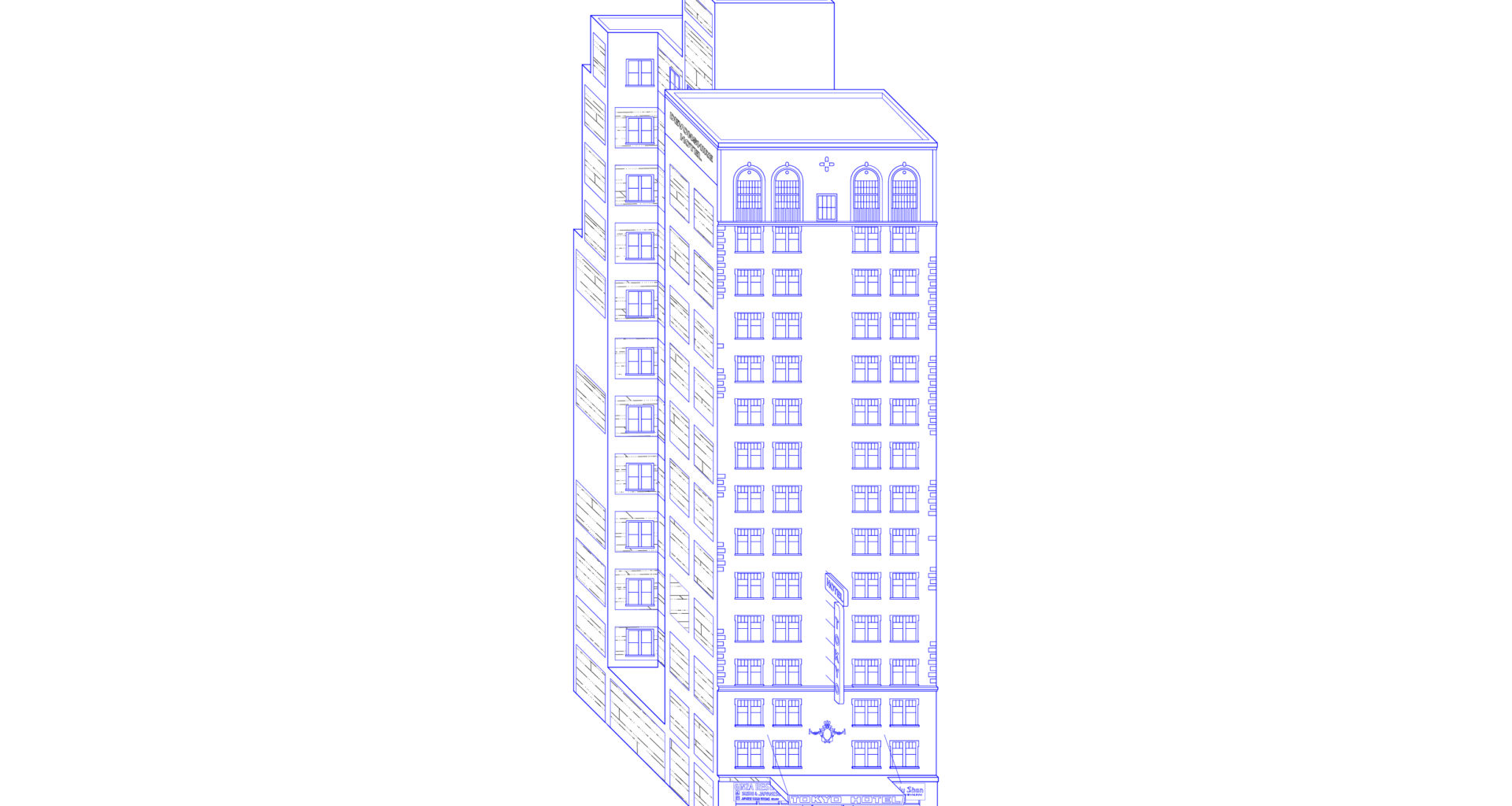
Developed from a theory seminar and a design research studio at the UIC School of Architecture, All Magnificent and Wild: Notes on Chicago Residential Hotels reconstructs the controversial history of Chicago’s residential hotels through forty case studies, each redrawn in plan and cabinet axonometric and correlated with archival material, texts, and historical maps.1
Residential hotels are a hybrid species. They emerged at the turn of the twentieth century, when Chicago consolidated its economies of scale—lumber, meat, grain, steel—and cemented itself as the nation’s principal wholesale market and railway hub, binding East and West. Although the city was built and powered largely by migrant labor, Chicago was not prepared to accommodate the workers arriving from across the continent and overseas. And so, below the glowing office towers, warehouses, and wholesale stores—buildings designed to stock the growing accumulation of commodities—the city developed a second, more generic inventory of buildings for housing low-income, transient workers: a nomadic architecture that could inhabit different forms.
Their names alone evoke a catalog of euphemisms: boarding and rooming houses, welfare palaces, palace hotels, women’s home clubs, workingmen’s hotels, single-room-occupancy hotels, missions, charitable institutions like YMCAs and YWCAs, municipal lodgings, barrelhouses and flophouses offering lodging for short- or long-term rental. Accommodation came in gradations of affordability, ranging from rooms with a private sink and alcove in a brownstone house, to wooden cubicles with nothing but a bed and a chair, topped with wire mesh or, in some cases, to bunk beds and benches in an industrial warehouse.
The transient lives of their guests—working intermittently, traveling frequently—reshaped the nature of habitation itself, pushing traditional patterns of domestic life to their practical and social limits, blurring the lines between familiarity and estrangement, individuality and commonality, permanence and flexibility, asceticism and luxury, heteronormativity and queerness, and interior and city. The residential hotel expanded conventional ideas about collective housing, family, ownership, and the existenzminimum (sustenance level), replacing the commodified “house” understood as an assemblage of possessions and privatized rooms, with a collection of spaces to be used without being owned. The emphasis shifts from housing to dwelling. No longer a container of units but a sequence of practices—inhabiting as action. Home, in turn, is less a Heideggerian place to settle down than a site of provisional kinship—a way of staying and living with strangers. Proximity imposed by necessity produced, in many cases, dense social worlds and informal economies, characterized by exchange, mutual surveillance, care, and solidarity.
In this context, All Magnificent and Wild conjectures a ‘retroactive manifesto’ of the domestic hotel or, perhaps, an elegy for a somewhat elusive, vernacular, underground, subtle but impudent, and almost extinct urban type. At a moment when work has become more nomadic and precarious across fields of production and when US cities face a deepening housing crisis, rising homelessness, laws criminalizing unsheltered people, and speculative development, re-examining the stigmatized infrastructure of residential hotels is not an exercise in nostalgia. It is a way to reframe how the housing question is posed and to imagine other ways of dwelling together.
Among the examined case studies, the single-room-occupancy (SRO) hotel seems to best crystallize the nomadic character of residential hotels in its most classical and controversial form—defined by the Chicago code as a building in which at least 90 percent of the units are single-room occupancies. Their spartan architecture and cryptic names, their modest appearance, mid-size scale, and structural and formal organization were flexible enough to allow for easy modifications and appropriations, enabling not just the accommodation of the highest diversity (of guests, of necessities, of programs and desires) but also avoiding the paternalism typical of larger-scale social housing, philanthropic complexes, missions, or municipal lodgings.