
Five Easy Pieces
Tanya Bonakdar Gallery
January 8–February 12, 2026
New York
Though images hold the capacity to shape sight, language contains the codifying power of definition. Some people have a knack for wielding language deliberately and some people don’t. Those who can direct language, in theory, exert control over the historical record. Just like everyone else, critics see through the lens of ourselves. It is impossible to separate perception from experience and identity. Subconscious optical and emotional analysis is a precursor to active criticism: it’s our background processing, happening all the time regardless of how we direct ourselves.
In the wake of the 1986 book Endgame: Reference and Simulation in Recent Painting and Sculpture, which served as a generational framing text solidifying the ranks of the “commodity artists” and crystallizing the supposed “endgame” playing out in contemporary art, the authors of Art Since 1900: Modernism, Antimodernism, Postmodernism erroneously interpreted Haim Steinbach’s related and different (1985/2025) as plastic goblets representing the Holy Grail while neglecting to provide a reference image. Steinbach’s related and different offers up an edition of that piece, which originally appeared as five Indian brass candlesticks placed beside a multicolored pair of Nike basketball shoes on two distinct shelves. Since then, the arrangement has evolved crucially but slightly: the shelf has been unified in white laminate, the shoes are now all-white (as per the dominant style of our time) and, to my eye, the candles upon their pedestals suggest a hybridized and truncated menorah.
Are these the “five easy pieces” to which the exhibition title (a reference to the 1917/1918 Igor Stravinsky composition and 1970 Bob Rafelson film) gestures? Perhaps they are not so easy after all. On a specifically angled and colored shelf in this particular visual and historical context, they come to mean something—about memory, culture, archives, assumptions, and expressions of displacement via placement—as, simultaneously, they simply exist.
Steinbach’s work is not so much about the nature of commodity as it is about nonhierarchical seeing (vs. hierarchical reading) in our contemporary economy of objects. It reflects the texture of our lives: mercantile, commercial. More than anything else it is about semiotics. Though Steinbach has always explored Saussurian linguistics, this new show clarifies and extends his theoretical fixations.
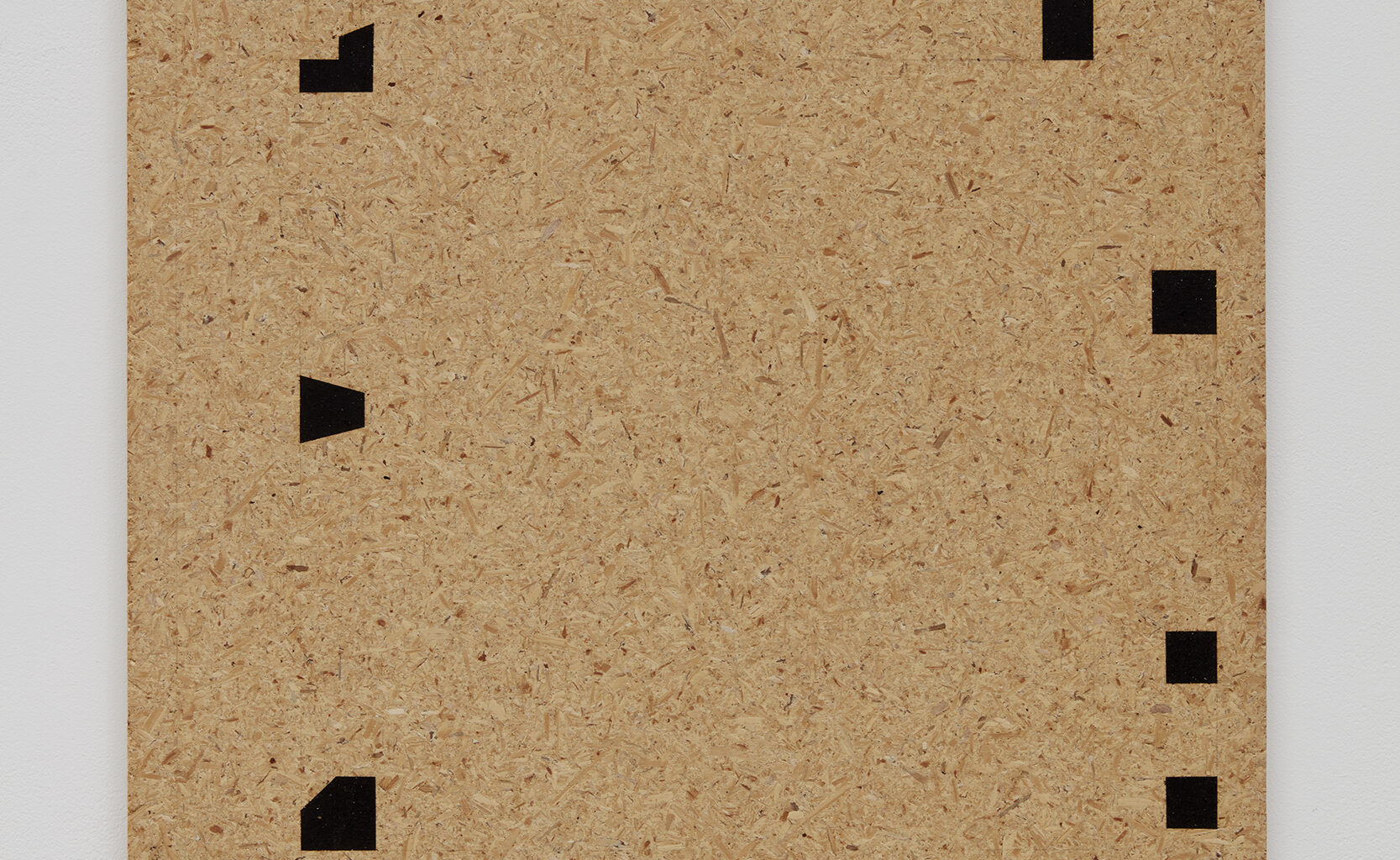
Images inherently dwell in possibility. To approximate a similar effect, language must be manipulated and abstracted, as in poetry. The seemingly disposable phrase “Beep, honk, toot.” faces the gallery entrance, reproduced in vinyl as it appeared in 1989. It has been filtered through a combinatorial digital (re)mixing process, manually adjusted, and UV-printed along with color tiles to produce the series “beep honk toot (condensed/spectrum).” What emerges are not traditional paintings, but liminal works on canvas that live between digital and analog worlds. By confusing the relation between signifier and signified, they question the “established” materiality of the sign.
The wall text hello again (2013) has been similarly gamified in hello again (condensed) 3 (2025). Figures emerge from the wordplay as circles, pillars, a tail, the pincers of a crab. The result is that both strings of text—still associated with their original signified meanings, which linger in our minds and over our eyes like a film—contain more information in their less legible forms. Conditions like ADHD and dyslexia often affect the brain’s ability to process conventional arrangements of language, creating gaps and discontinuities mirrored in this breakdown. The word becomes free to express its status as a hybrid word-image, representing another kind of borderless thinking that limns the exhibition with implicit conceptual guidance.