
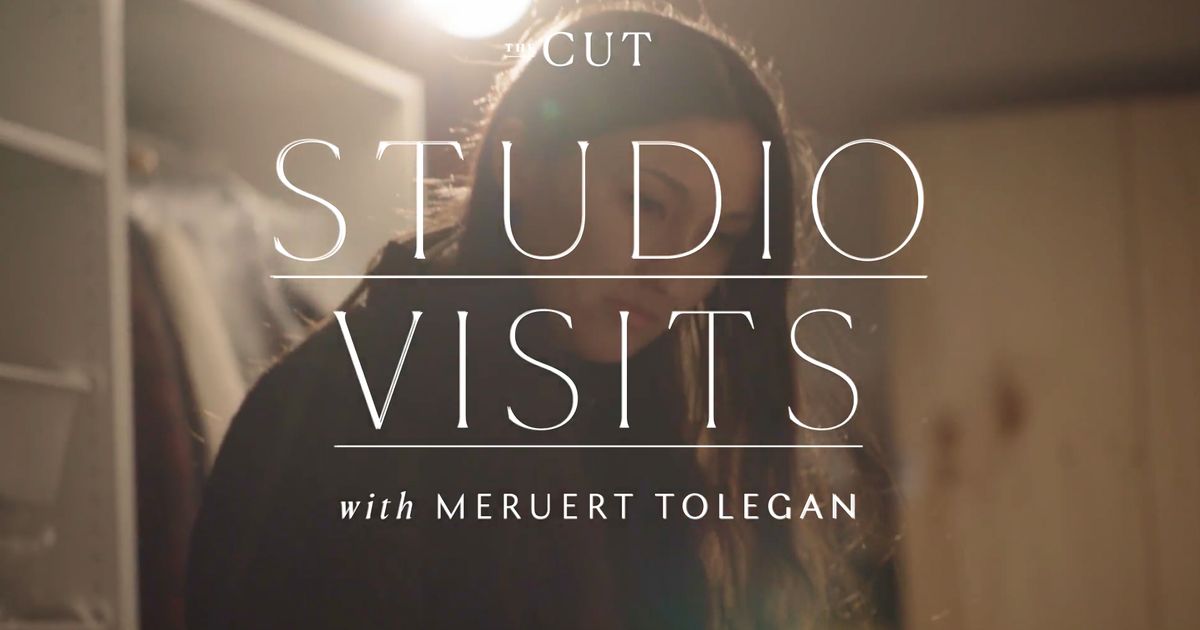
Meruert Tolegen wants you to feel something the second you walk in. Her newly opened space is moody and warm — wood, ironwork, low light, and these unexpected cones of soil tucked into the design; when they were installed, she says the smell was so alive it felt like a garden. It’s not the typical bright, “Please buy something” retail experience. It’s a place meant to be touched and experienced with rooms that Tolegen describes like chapters: a library at the front, a hall, then a salon in the back she plans to turn into a living room for the community; tea from an antique samovar; poetry readings; screenings; rotating artist installations. And today, she’s showing her latest collection in that space.
That sensory, slightly surreal approach makes sense once you hear her story. Tolegen was premed with a math and physics background, and she describes her pivot to fashion as an accident, something that started during early motherhood when a research study ended. Time opened up in a way she hadn’t planned for, and she began making pieces simply because she “can’t sit still.” A children’s line came first, then women’s pieces to match, and suddenly she was in Paris selling her first collection, still stunned that anyone wanted to wear what had felt, to her, like an art project.
Her clothes carry that same mix of rigor and play. She’s especially proud of her knitwear: hand-knit, made in New York, often in plush alpaca, alongside darker, moodier spins on unexpected fabrics (like Liberty florals). From a distance, some prints read like wallpaper. Up close, they reveal tiny story lines and quirky details — little figures, hidden jokes, even a smocked “face” motif that appears only when you really look.
How did you want the storefront to feel the moment someone walks in?
We opened the space with the intent to create some kind of moody feeling. I want it to be a space that everyone can experience, that they can touch and feel. There’s a handedness, and it mirrors a lot of what the garments display and what the collections end up looking like.
First, we envisioned the library. Everything in the space has this warm touch to it. There are mounds of soil cones. When we first installed them, the smell was really incredible. It felt like a garden.
Your designs — from far away, they read one way and then you get closer and they’re … something else. What sparked the direction behind your print choices?
I actually really like to have something quirky added into the design. Here, it’s very literal. It’s a print, so you can see it and you can explore it. You’ll see little story lines in it. From far away, it’ll look like a floral print or like a wallpaper, but if you look into it, there’s something weird and quirky always in it. I think it’s funny to put something like this into a garment and people don’t even realize it’s there. I think if they’re meticulous or vigilant, they’ll see it and they’ll value it. There’s humor in it.
When you’re starting a new season, what do you decide to carry forward, and how do you make it feel new again?
Every collection just kind of goes off of the previous. For instance, last season we really, really liked the idea of corsetry and lacing, and I really wanted to put that in there. Now we’ve established this and we’re working on this further in the new season and reimagining it in today’s world in a modern way. Finding these techniques and finding ways to work on them was my way to understand the garments and how to create them.
What’s going through your mind as you’re building a piece before anyone ever wears it?
I don’t know if other people feel this way when they create garments, but it’s like when you’re creating it, you don’t see it as a piece of clothing. You see it as a piece of artwork or an art form.
Stay in touch.
Get the Cut newsletter delivered daily
Vox Media, LLC Terms and Privacy Notice