
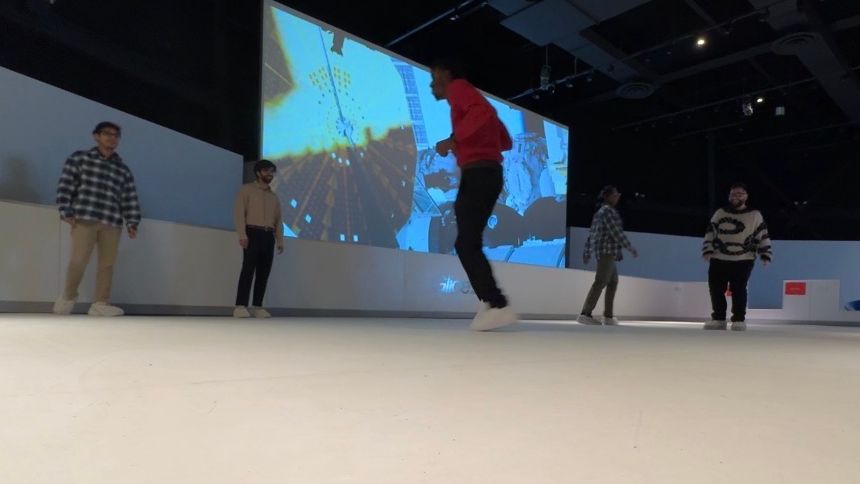
It’s a little different from the familiar scratch of skates carving into ice.
At the New York Hall of Science, the sound is softer — booties gliding across a synthetic rink as visitors push off and slide, as if floating through space.
“You just get a little momentum going and you can glide and slide,” said Grace Galbreath, a digital marketing associate at the New York Hall of Science in Queens.
What You Need To Know
“Space Glide” is an indoor skating experience at the New York Hall of Science in Queens
The rink is made of Glice, an eco-friendly, polymer-based, ice-like surface
Visitors wear special booties instead of skates to glide across the rink
The experience combines space-themed projections with lessons on momentum and runs through Feb. 22
The museum is hosting “Space Glide,” an indoor skating experience that swaps steel blades for special booties and frozen water for Glice, an eco-friendly, polymer-based surface designed to mimic ice. The experience runs through Feb. 22.
Unlike a traditional rink, the surface doesn’t require refrigeration — or skates. Instead, visitors strap on provided booties and move across the slick panels while projections transform the room into a cosmic scene. Images ripple across the floor and walls, simulating the sensation of drifting through the stars.
All ages are welcome, and while the experience leans into fun, it also stays true to the museum’s educational roots.
“You learn a little about space through the projections, and you can also learn about momentum and how when you give a little more momentum, you will glide and slide a little further,” Galbreath said.
The exhibit fits naturally inside the Hall of Science, which has celebrated space exploration since it opened during the 1964-65 World’s Fair. Space-themed artifacts remain a centerpiece of the campus.
“We have two rockets, we have a space capsule and our great hall is actually created to simulate that you are floating through deep space,” Galbreath said.
Visitors can also explore a photo exhibit highlighting women who have contributed to space exploration over the years.