
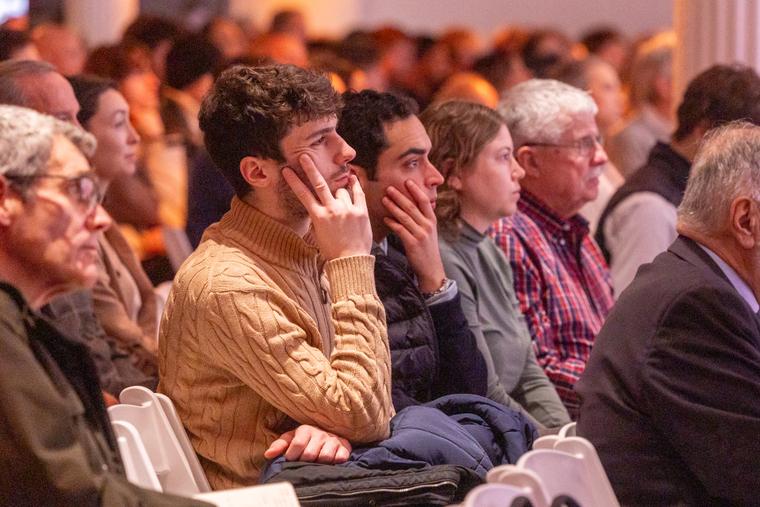
NEW YORK — The “New York Encounter” — the annual three-day cultural conference organized by members of the lay ecclesial movement Communion and Liberation taking place this weekend in Chelsea, Manhattan’s artsy West Side neighborhood — has a distinctly European feel.
Outside the Metropolitan Pavillion, where the event is held, a group of young people huddled together against the cold are likely sharing a cigarette break. Italian is spoken almost as often as English, reflecting that many attendees live in the U.S. but come from Italy, where the movement began. The Italian influence extends to the food as well: white bean and escarole soup, prosciutto crudo and mascarpone sandwiches, gelato and espresso.
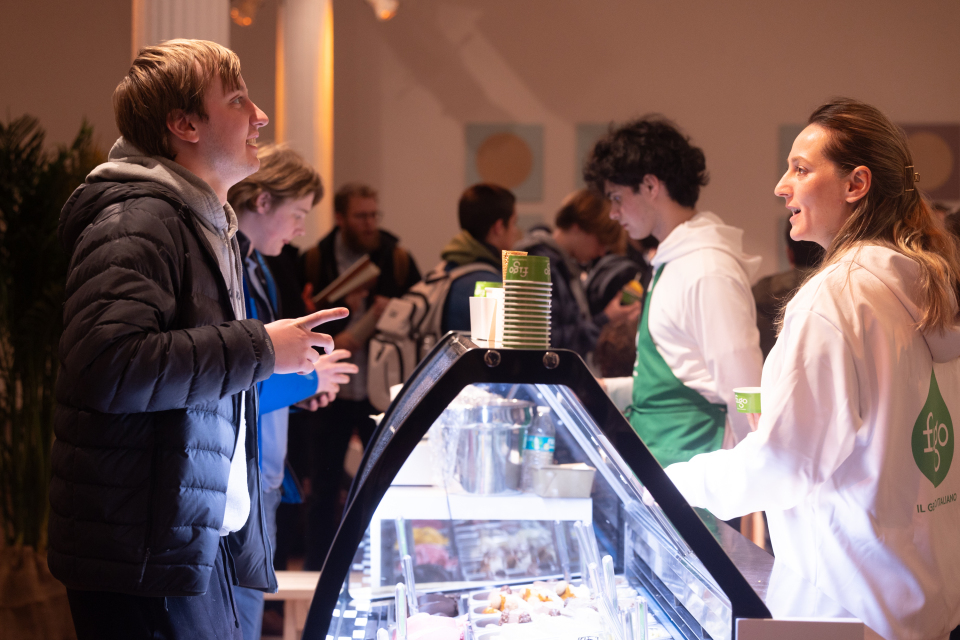 Gelato, anyone? Good and fellowship are hallmarks of the annual weekend.(Photo: Courtesy of New York Encounter)
It is not your typical American Catholic conference, to be sure. For years, though, Cardinal Timothy Dolan has celebrated Mass for the thousands who gather in faith, and papal nuncio Cardinal Christophe Pierre is a regular presence on the conference’s panels. Pope Benedict XVI called Communion and Liberation’s founder, Father Luigi Giussani (1925-2005) — whose cause for canonization was opened in 2012 — a “true friend.”
Communion and Liberation, Pope Benedict said, on the 25th anniversary of the movement’s pontifical recognition, is “an experience of faith born not from an organizational will of the hierarchy, but from a renewed encounter with Christ, and thus, we can say, from an impulse ultimately derived from the Holy Spirit.”
What Is the ‘New York Encounter’?
Since 2009, members of the Communion and Liberation movement (CL) have hosted this annual conference in New York City, bringing together writers, academics, scientists and other thinkers — many of them not Catholic — to grapple with the most urgent questions of the moment. The event, which is free, and open to the public, is a smaller version of CL’s annual conference in Rimini, Italy.
Holly Peterson, a longtime organizer of the “New York Encounter,” told the Register that every March, a group of CL members get together for a weekend to pick a theme and panels for the following year’s event.
“Our starting point is reality — what’s actually happening,” she explained.
The group begins by brainstorming on a “massive” whiteboard, Peterson explained, considering developments in literature, education, sports, the economy — anything that’s on people’s minds.
This year’s theme, “Where Everything Is Waiting for You,” begins with the observation that the world is changing but a hunger for belonging and meaning remains a constant to the human experience.
The Feb. 13-15 conference will begin with a reflection by Cardinal Pierbattista Pizzaballa, patriarch of Jerusalem, and will include panel discussions on the “perceived religious revival” in the West, Catholic teaching on just-war doctrine, and the “crisis of globalization’ with Paolo Carozza, professor of law at the University of Notre Dame. The lineup also includes a discussion of the Church and AI, the Catholic view of immigration in the U.S., and a panel discussion on America’s founding ideals with Mary Ann Glendon.
There’s more than hot-button issues on offer — this year’s conference will feature panels on art and culture, including one on Father Giussani’s writing, an exhibit exploring the meaning of time, and a look at Franz and Franziska Jägerstätter, the Austrian couple featured in the film A Hidden Life, as well as an “electronic rock-pop gospel” inspired by T.S. Eliot’s Choruses from The Rock.
What Does the ‘Encounter’ Have to Do With Communion and Liberation?
The story of the “New York Encounter” begins in Italy in 1954, when Father Giussani planted the seeds of the Communion and Liberation movement. Recently ordained and troubled by what he saw as a growing tendency among young people towards nominal Catholicism and ignorance and disengagement from their faith, he sought permission to teach religion in a public high school.
There, Father Giussani taught students that every person has an inherent desire to seek God (“the religious sense”), that faith is reasonable, and that Christ remains present in our lives throughout history to the present day.
Peterson — who first encountered Father Giussani and his followers while traveling in Italy as a young woman — explained that the Italian priest’s insight was to teach the faith to young people through examples drawn from their own lives rather than through abstractions.
“Part of Giussani’s pedagogy is if I can’t see what I learned in reality, I can’t understand it, and I’m not learning it. I’ve got to see the connection with the world around me,” she said. “He was always using examples from the reality the kids were living in, so they understood what he was talking about. “
He also, she said, used examples from his reality, including his love for classical music.
“He’d bring in a piece of beautiful music and a gramophone to play it on and have kids listen to Chopin and Schubert and have them connect what their life was to this beautiful piece of music. Then, slowly, you’d understand this need they had for a place to belong, for beauty, for truth, for goodness.”
Later as a university professor, Father Giussani published the three books The Religious Sense, At the Origin of the Christian Claim, and The Risk of Education, which make up the foundational texts that members of Communion and Liberation read and discuss in weekly meetings called “Schools of Community.”
In early 1980s, after Peterson and a few other disciples of Father Giussani introduced Schools of Community to the United States, the movement began to spread. While still small compared to other such lay movements — there are only about 1,500 registered members of Communion and Liberation in the U.S. — they are active on many college campuses, which is the primary way the movement attracts new members.
An Invitation to See the True, the Good and the Beautiful
At Schools of Community, participants gather each week to read a couple of pages from Father Giussani’s writings, reflecting on their meaning and sharing insights from their own lives to illuminate the text. That same spirit animates the “New York Encounter.”
Kristin Hurd, who leads a School of Community in the Washington, D.C., area, explained that community is central to the movement’s method of looking at the world.
“CL has within [its] charism the living of the tradition of the Church and fact that the way that Jesus instituted Christianity was to be lived in communion. This is how it is expressed, and that, naturally, through the life of communion, it generates a way of looking at society, of looking at reality,” Hurd said.
“So doing something like ‘New York Encounter’ is an opportunity for us, in terms of as a community, to look at things that are true and beautiful and good and to work on it together and help each other to see and judge what’s happening,” she said. “We’re trying to say, ‘How does our experience of the tradition of the Church inform what we’re seeing?’”
Suker Li, an engineering project manager at a small tech company, came to the U.S. 14 years ago as an exchange student and attended his first “New York Encounter” with his host family.
“I landed in the United States in January and didn’t know much English at the time. And then my host was like, ‘We’re all going to New York, if you want to come,’” he recalled. “I thought it was really fascinating, and it was also a beautiful way to make friends.”
Li has since converted to Catholicism and is an active member of CL. He hasn’t missed an “Encounter” since. He emphasized the importance of avoiding an “echo chamber,” where people only engage with ideas they already agree with.
“I think the ‘New York Encounter’ is crucial because it’s a moment when the movement becomes vulnerable to the world. It tests you against perspectives beyond your own. What’s beautiful about it is that it’s not advertised as a Catholic event in the traditional sense. It’s about listening to what people find important and engaging in genuine dialogue.”
‘We Are a Friendship’
Besides the weekly Schools of Community, members meet for volunteer activities, as well as go on an annual “summer vacation” hiking in the Rocky Mountains, with spiritual exercises while on retreat.
The “New York Encounter” serves as a chance for CL members from across the country, who know each other from past events, to meet again.
Peterson emphasized that CL is not simply intellectual exercise but a lived companionship.
“We’re not a book study group. We don’t get together and discuss a book, and then we pick another book and then discuss that book. We are a friendship,” she said, explaining that the texts read in School of Community, and the retreats and other events, are the “vehicles in which Christ has created a companionship.”
Going to the “New York Encounter,” she said, gives you an idea of what it must have been like to be an early Christian.
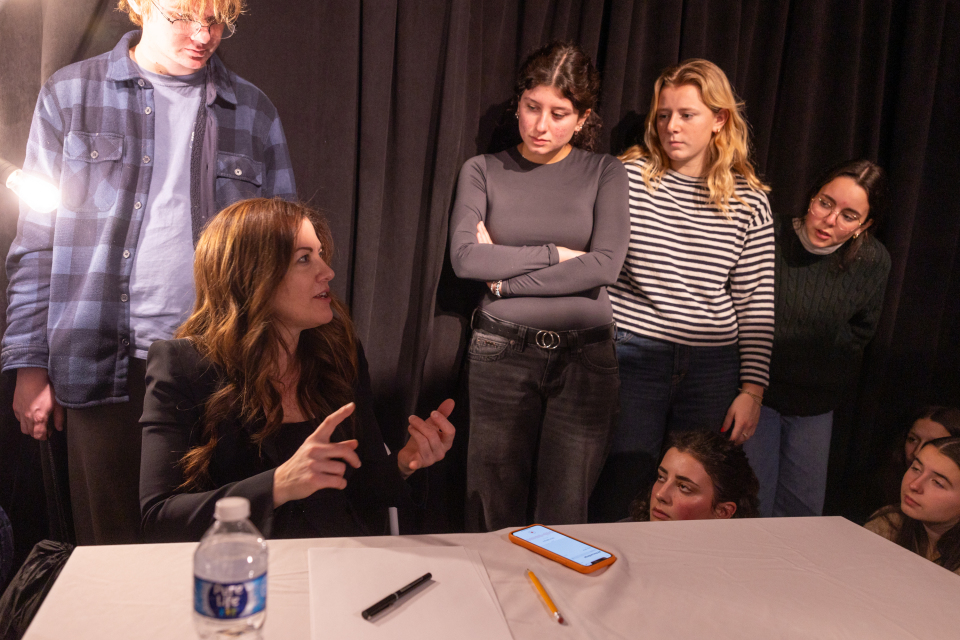 Author Christine Rosen speaks with high-school students at the 2025 event.(Photo: Courtesy of New York Encounter)
“You go there and you’re friends with people who you haven’t seen for a year. You’re friends with people who you’ve never met before because they’re friends of your friend. And that’s extraordinary,” she said.
Dave Hazen, a member of CL who works in the communications office at The Catholic University of America, in Washington, D.C., told the Register that the “sifting through reality” that takes place at the “New York Encounter” is a product of the friendships made through the movement.
“This is the collective interest, zeal and fascination of these people who put this together, who, first of all, try to emphasize this is born of a friendship that we’re living and want to live with everybody we know,” he said.
Li, too, emphasized the importance of relationships with CL. He said he was looking forward to catching up with old friends and introducing them to his girlfriend.
“I believe this is an important work, and it’s put on by the people who have loved me and found me,” he said. “And then I think I’m just happy, also, to be part of that, to build something beautiful together.”