
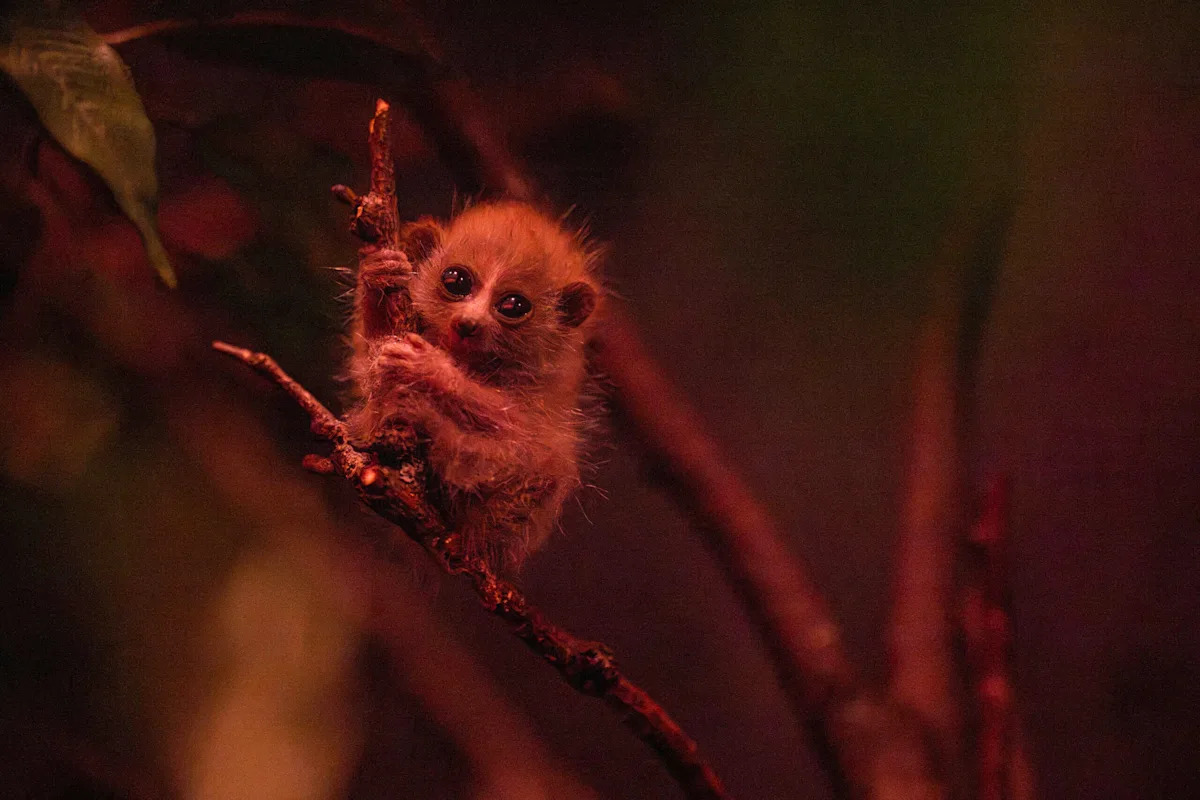
The post New Pygmy Slow Loris Baby at Bronx Zoo appeared first on A-Z Animals.
Quick Take
A pygmy slow loris baby was born at the Bronx Zoo on December 13, 2025.
The birth was the first primate for the Zoo’s newly reopened World of Darkness exhibit.
Adult pygmy slow lorises weigh about one pound, and are found exclusively in the bamboo and forests of Southeast Asia.
The pygmy slow loris is the only known venomous primate in the world.
For the Bronx Zoo, Christmas came early in 2025. On December 13, the Zoo celebrated the birth of the first primate born in the Zoo’s new immersive World of Darkness exhibit.
Its first new primate arrival? A pygmy slow loris, Xanthonycticebus pygmaeus.
Meet the Zoo’s Newest Primate Addition
The arrival of the pygmy slow loris met with outsized fanfare, at least relative to the infant’s size. It weighed roughly the same as a paperclip, between one and two ounces. Like all pygmy slow loris babies, this new arrival was born fully covered in fur and with its eyes open.
“The baby has large, forward-facing eyes, a small, pointed snout, and dense brown fur. Its short limbs are well adapted to climbing branches like those in forest canopy environments,” notes Keith Lovett, Director of Animal Programs at the Bronx Zoo. “The zoo’s animal care staff are closely monitoring the baby’s health and wellbeing as it grows.”
The infant will initially cling to mom’s stomach for protection. Mom will often “park” the baby on branches while she forages for food. As it grows, the baby will become more active and independent. It will be fully weaned by six months old, and reach its full adult weight between nine to 16 months for females and 18 to 20 months for males. The young loris typically stick close to their moms until they between 16 and 20 months old.
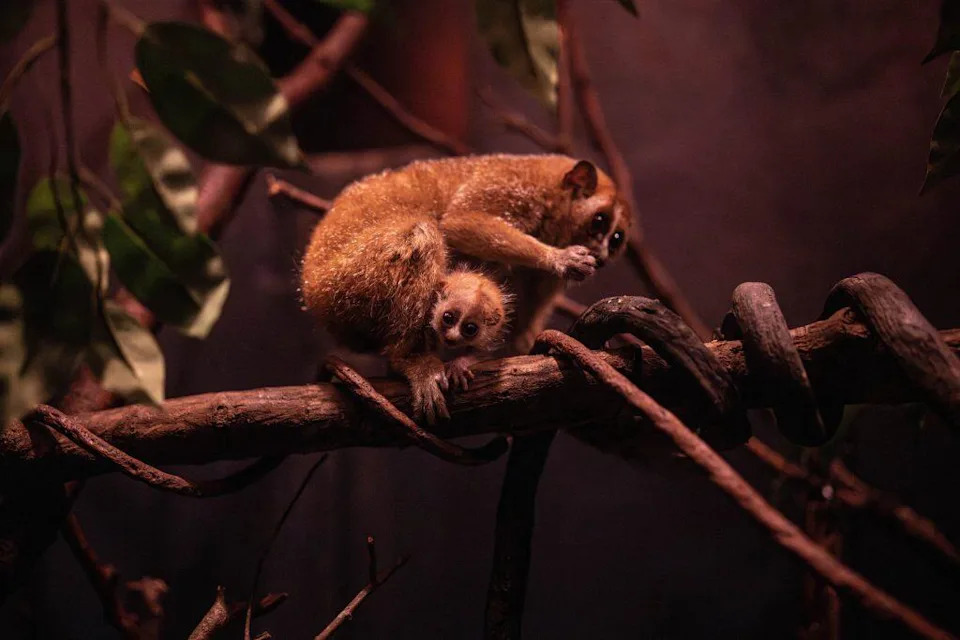
Baby pygmy slow lorises cling to their mother’s stomach for the first few months of life.
©Bronx Zoo – Original / License
(Bronx Zoo)
The sex of the new arrival is not yet known. The Zoo’s animal care staff will determine it at the infant’s first veterinary exam, expected to occur soon.
The birth was the result of the Zoo’s participation in the pygmy slow loris Species Survival Plan (SSP), a captive breeding program led by the Association of Zoos and Aquariums (AZA). The goal of the SSP is to help rebuild populations of endangered and threatened species while maintaining genetic diversity.
The baby has large, forward-facing eyes, a small, pointed snout, and dense brown fur. Its short limbs are well adapted to climbing branches like those in forest canopy environments.
Keith Lovett, Director of Animal Programs at the Bronx Zoo
Lovett notes the birth was a milestone achievement. “As of January 2026, the infant was one of just 50 pygmy slow lorises across all AZA-accredited zoos in North America.”
Why Are Pygmy Slow Loris Populations At Risk In the Wild?
The pygmy slow loris is found exclusively in Southeast Asian forests stretching across Vietnam, Laos, and Cambodia. The species is arboreal, meaning it spends its entire life living in the trees. In fact, it tends to spend most of its time up high, between 10 to 40 feet off the ground.
The IUCN considers the pygmy slow loris as Endangered on its Red List of Threatened Species. The species has experienced significant population drops due to loss of its natural habitat and illegal poaching.
Large swaths of the animal’s forest homes are being clear-cut to make way for monoculture plantations, including rice paddies and crops like coffee, rubber, and cashews. Roads and human settlements are also encroaching on these natural habitats.
Roads cut through the forests, creating forest “islands” that limit the animal’s free movement. When the treetop canopy is broken up, the loris retreat to ground level to move around. This exposes them to risks including non-natural predators like dogs and fast-moving vehicles. If they choose to stay in the treetops, they often mistake power lines for canopy vines. This leads to frequent electrocutions.
The other significant threat is illegal poaching. Pygmy slow loris are prized as exotic pets and ingredients in traditional medicine. They’re also popular to use as photo props in highly touristic areas across the region. Since pygmy slow loris are nocturnal by nature, they don’t survive long in these non-natural conditions. This results in an ever-increasing demand, making poaching a lucrative industry.
The Zoo’s World of Darkness Exhibit
The Zoo’s World of Darkness exhibit first opened in 1969 and was the first major zoo exhibit to incorporate a reverse day-night light cycle. This made it possible for zoo visitors to observe nocturnal species, like the pygmy slow loris, during their active periods.
The exhibit temporarily closed in 2009. In anticipation of the Zoo’s 125th Anniversary, the Zoo undertook an ambitious renovation plan. Its brand-new World of Darkness exhibit opened to the public in July 2025.
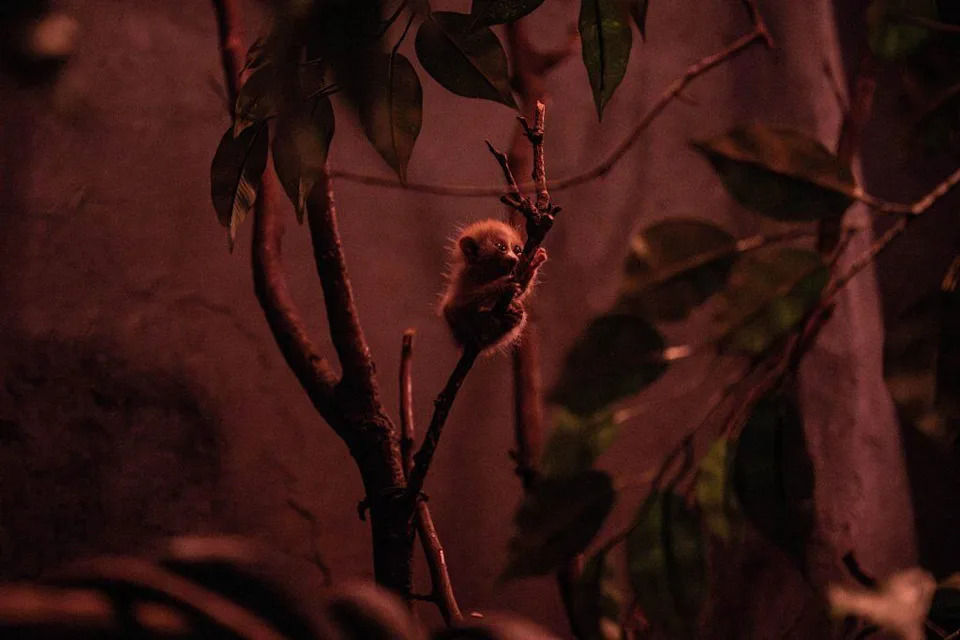
Pygmy slow lorises are one of 25 species you can find in the Bronx Zoo’s new World of Darkness exhibit.
©Bronx Zoo – Original
(Bronx Zoo)
The exhibit includes state-of-the-art programmable LED lighting, capable of mimicking the colors of sunrise and sunset. The ceilings feature an acoustic design shaped like a forest canopy. The sound-absorbing panels absorb visitor noise to ensure a peaceful environment. Visitors to the exhibit are led down a darkened path with glowing graphics to help their eyes adjust to the low light conditions.
The Zoo’s revamped World of Darkness builds on the innovations in place in the original exhibit. “When it originally opened in 1969, the World of Darkness was the first major zoo exhibit to utilize a reverse day-night light cycle, making it possible for guests to see nocturnal creatures like the slow loris during their active period,” says Lovett.
The exhibit is home to 25 species. Besides the pygmy slow loris, you can also view naked mole-rats, vampire bats, sand cats, and more. The animals are housed in 21 distinct habitats representing deserts, caves, wetlands, and tropical forests.
If you want to see the new arrival, plus all the other inhabitants of World of Darkness, here’s how to do it.
“Visitors have the chance to see the baby at the Bronx Zoo’s World of Darkness exhibit during zoo hours. In observance of winter hours, the zoo is open daily from 10a-4:30p through April 1 until summer hours begin April 2. Animal exhibits close 30 minutes prior to park closing. World of Darkness entry is included with Bronx Zoo Admission,” says Lovett.
Discover More About the Pygmy Slow Loris
The pygmy slow loris is a small, nocturnal primate that lives in the dense bamboo and forests of Southeast Asia. It eats nectar, fruit, and insects. When it sleeps, it curls up into a ball and tucks its legs over its head.
The loris resembles a tiny teddy bear with its large, round eyes and fur-covered body. The huge eyes give the loris excellent night vision, but can cause distress if the loris is exposed to bright light.
The pygmy slow loris’s cute appearance belies one of the most interesting facts about the species. The pygmy slow loris is the only known venomous primate.
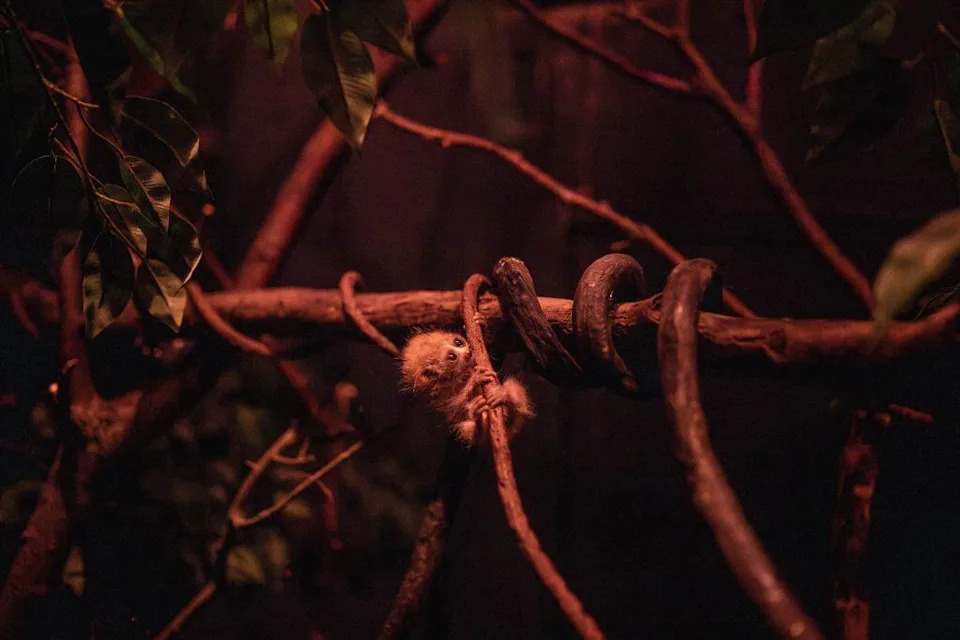
Pygmy slow lorises are the only known venomous primate.
©Bronx Zoo – Original / License
(Bronx Zoo)
When it is threatened, it secretes a toxic substance from small brachial glands in its elbow. The pygmy slow loris mixes that secretion with saliva to create a potent toxin, then uses the mixture to ward off predators or other lorises in territory disputes. When a loris bite contains the toxin, it can cause severe, slow-healing wounds and even anaphylactic shock in its victims. Lorises also use the toxin to keep parasites at bay.
Pygmy slow lorises have a lifespan between 10 and 20 years. They communicate using unique vocal sounds and their acute sense of smell. When threatened or scared, they hiss and growl. During breeding season, males and females call to each other by whistling.
Males also attract female attention by marking their territory with urine. The smell entices females by telling them the male is a strong, attractive mate. But that strategy doesn’t always work. The females are picky and prefer the scent of males whose scent they already recognize.
The post New Pygmy Slow Loris Baby at Bronx Zoo appeared first on A-Z Animals.