
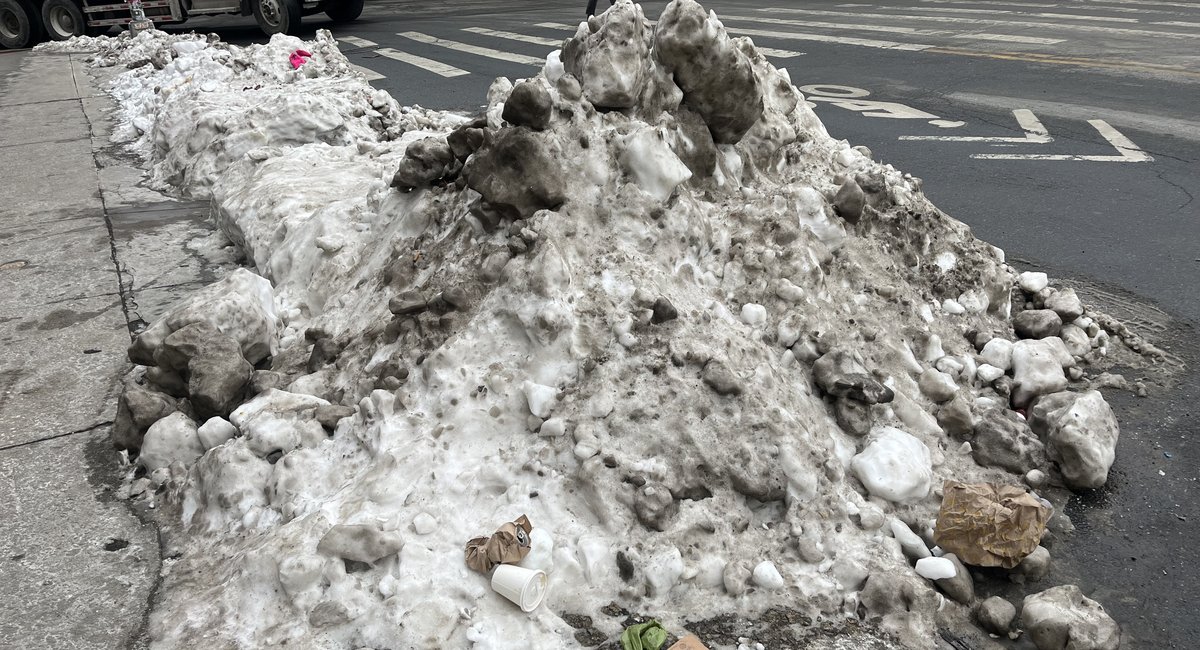
January’s beautiful white flakes have become fetid mounds of New York City snow. The heaping piles are now a disgusting pee-stained mix of garbage and brown patches to be avoided at all costs.
But what is actually in all of that mess?
Gothamist collected samples of snow from three different neighborhoods — Williamsburg, Washington Heights and Jackson Heights — and sent them to a lab to test for bacteria and 25 different metals.
The results mostly confirm what you already suspected. The snow acts like a revolting sponge for the city’s filth. The usual — and at times toxic — dirt, grime and excretions that might typically be washed away by the wind and rain have been trapped in a glacial suspension for weeks now.
“It really teaches us a lesson about urban sanitation and health,” said Jack Caravanos, an environmental public health professor at NYU. He added that the snow poses no greater risk to public health than what’s always in New York City’s air and in the ground — as long as you leave it alone.
Gothamist tested this snow pile in Jackson Heights. A lab analysis showed relatively high levels of lead and Enterococcus, a common bacteria in the feces of warm-blooded animals.
Joe Hong/Gothamist
We grabbed one particularly foul sample from a pile under the 7 train at the Jackson Heights-Roosevelt Avenue station. Elevated rail lines are notorious for shedding lead paint. When a Gothamist reporter arrived with a bucket, a small scoop and a pair of thick rubber gloves, the snow underneath the tracks was covered in pigeon poop.
As we suspected, lead levels among our three samples were highest in the snow under the tracks, at a whopping 279 parts per billion.
While federal guidelines for drinking water aren’t a perfect comparison, they do offer some kind of a metric for assessing the snow. Those regulations require lead levels in water to be at or below 15 parts per billion.
Several miles away in Williamsburg, a garbage-filled snow pile under the Brooklyn-Queens Expressway tested at 125 parts per billion for lead. Another in Washington Heights that was pockmarked with yellow pee stains came in at 113 parts per billion.
“A kid is skimming some snow and putting it in their mouth, they would get a decent dose of lead,” Caravanos said.
A sample of melted snow from Jackson Heights ready for testing.
Christopher Werth/Gothamist
But those lead levels are still far lower than what you would find in much of New York City’s soil, said Joshua Cheng, a professor of earth and environmental sciences at Brooklyn College. A 2019 study found that the city’s soil-lead levels range widely — reaching as high as 45,000 parts per billion in some parts of Brooklyn — a byproduct of old lead paint and burning leaded gasoline for decades.
Cheng said even a small nugget of dirt in our snow samples could have caused a spike in lead levels.
Snow under the elevated 7 line in Jackson Heights.
Joe Hong/Gothamist
Our Jackson Heights sample also contained the highest concentration of Enterococcus, a type of bacteria found in the feces of warm-blooded animals like dogs or, God forbid, humans. You’ve also likely noticed a preponderance of poop on the snow-covered sidewalks.
Again, Cheng said, even just a little excrement in our sample could have skewed the numbers significantly. Snow scat is gross for sure, but he said if no one is going to do the right thing and pick it up, it’s better kept on ice than in the steaming sun.
“On warm days you would have flies and other things transmitting these potential risks,” Cheng said. “Now it just looks bad.”
Yellow snow in Washington Heights
Joe Hong/Gothamist
Now, to one of our more curious findings: The snow samples from Washington Heights and Jackson Heights contained over 30 times more strontium than the Williamsburg sample.
What is strontium, you ask? It’s a metal used in fireworks to produce the color red. It’s also pretty common in Earth’s minerals.
Caravanos wasn’t quite sure how strontium could have ended up in the snow. But Cheng said there’s “plenty” of strontium in the city’s soil. The element sometimes occurs naturally. Other common sources include fertilizers and coal ash.
Melted snow samples in a cooler for bacterial testing.
Christopher Werth/Gothamist
Unsurprisingly, our tests also showed high levels of calcium and sodium, which are key ingredients in road salt. The city has dumped 116 million pounds of it on the street during this recent cold spell as of last week, according to officials.
Steven Chillrud, an environmental geochemist at Columbia University’s Lamont-Doherty Earth Observatory, said it’s now creating a mist of aerosolized salt.
“It’s uncommon at least in New York City to have such an extended cold period after the salt has been put down,” Chillrud said. “As I walk the streets, I’m tasting the salt and occasionally I have a stinging sensation in my eyes.”
A pile of garbage on a pile of snow in Williamsburg.
Christopher Werth/Gothamist
When the snow melts or is finally washed away by rain, the city’s sewer system will treat some of the contaminants, depending on how fast the thaw is. Large amounts of stormwater flow directly into waterways during peak flows. Caravanos said it’s fortunate that the snow will be returning to our natural waterways during the colder months when — polar bear plungers aside — people are less likely to be in the water.
“The good news is that we don’t swim during these periods,” he said. “If this was happening in the summer where the outfalls go into the East River and possibly to Rockaway Beach, that would be a bit more risk.”