
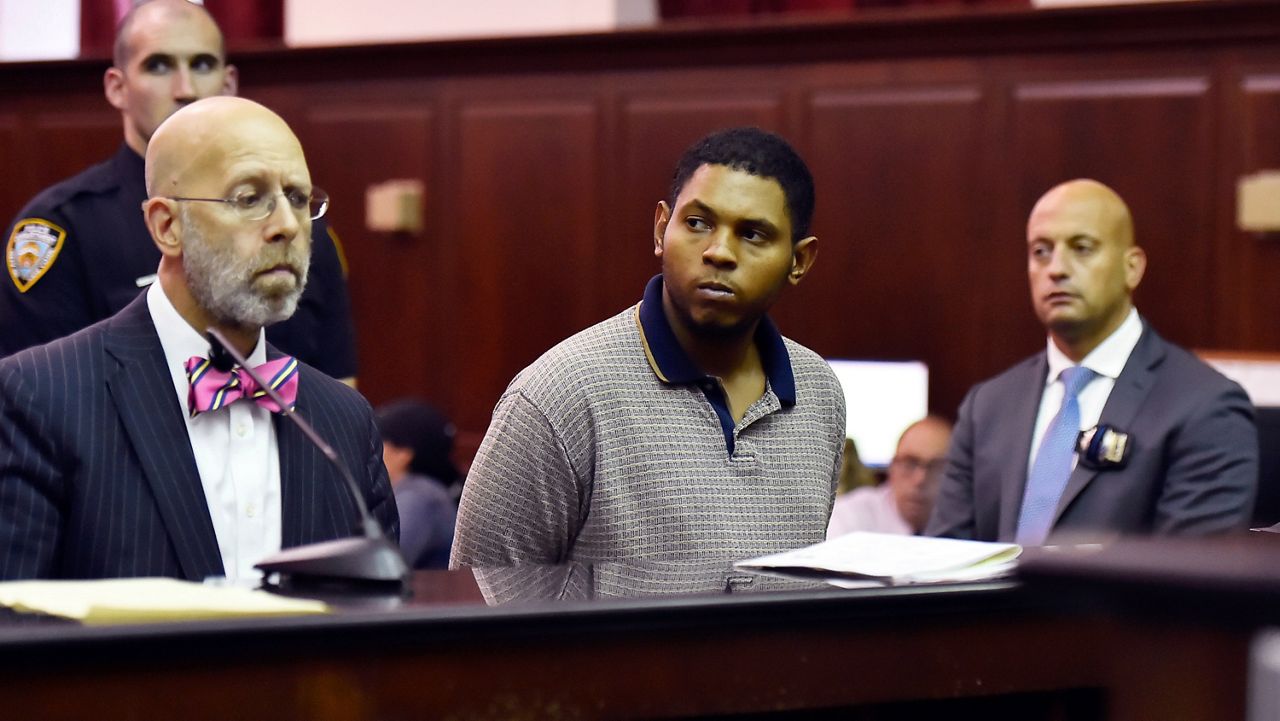
Prosecutors in Manhattan on Wednesday sought to counter an insanity defense in the trial of Randy Santos, who is accused of killing four men in a 2019 attack in Chinatown.
Santos has pleaded not guilty to first-degree murder in the deaths of Florencio Moran, Nazario Vásquez Villegas, Anthony Manson and Chuen Kwok. He also faces attempted murder charges for assaults that left two other men severely injured.
What You Need To Know
Randy Santos has pleaded not guilty to first-degree murder in the 2019 killings of four men in Chinatown and faces additional attempted murder charges
His defense argues he has schizophrenia and was hearing voices telling him to kill 40 people, asserting an insanity defense
A defense expert testified Santos knew he was killing the victims but could not understand right from wrong, while a prosecution expert said he knew his actions were wrong
The Manhattan District Attorney’s Office argues that Santos knowingly carried out the attacks. Prosecutors say evidence shows he had gone on a “trial run” a month earlier, when he attacked another homeless man in a similar manner.
Santos’ attorney from the Legal Aid Society has argued that he had been diagnosed with schizophrenia and was hearing voices telling him he needed to kill 40 people or he would die himself. Santos, now 31, is asserting the insanity defense.
Last week, the defense called a clinical forensic psychologist who evaluated Santos following the attacks and diagnosed him with cannabis misuse disorder and schizophrenia.
She testified that Santos knew he was killing the victims but said, “His irrational thinking made it impossible for him to understand the difference between what was right or wrong.”
On Wednesday, prosecutors called their own psychiatric expert, Dr. Jason Hershberger, a forensic psychiatrist who interviewed Santos after the attacks and reviewed body camera footage of his arrest, along with crime scene images.
Hershberger testified that despite Santos’ cannabis intoxication and mental illness, he retained the capacity to understand that his actions were wrong.
“He knew it was illegal and he knew it was against generally acceptable moral principles,” Hershberger said.
Addressing Santos’ claim that he heard voices telling him to kill 40 people or be killed himself, Hershberger testified, “In my opinion it is likely he came up with a shallow excuse of a symptom.”
Hershberger also said Santos had a propensity to lie and noted that in body camera video of his arrest, Santos did not appear to be in distress or fear for his life.
If jurors accept the insanity defense, Santos could be committed to a psychiatric treatment facility instead of prison. If they reject it, he could face a sentence of life in prison.