
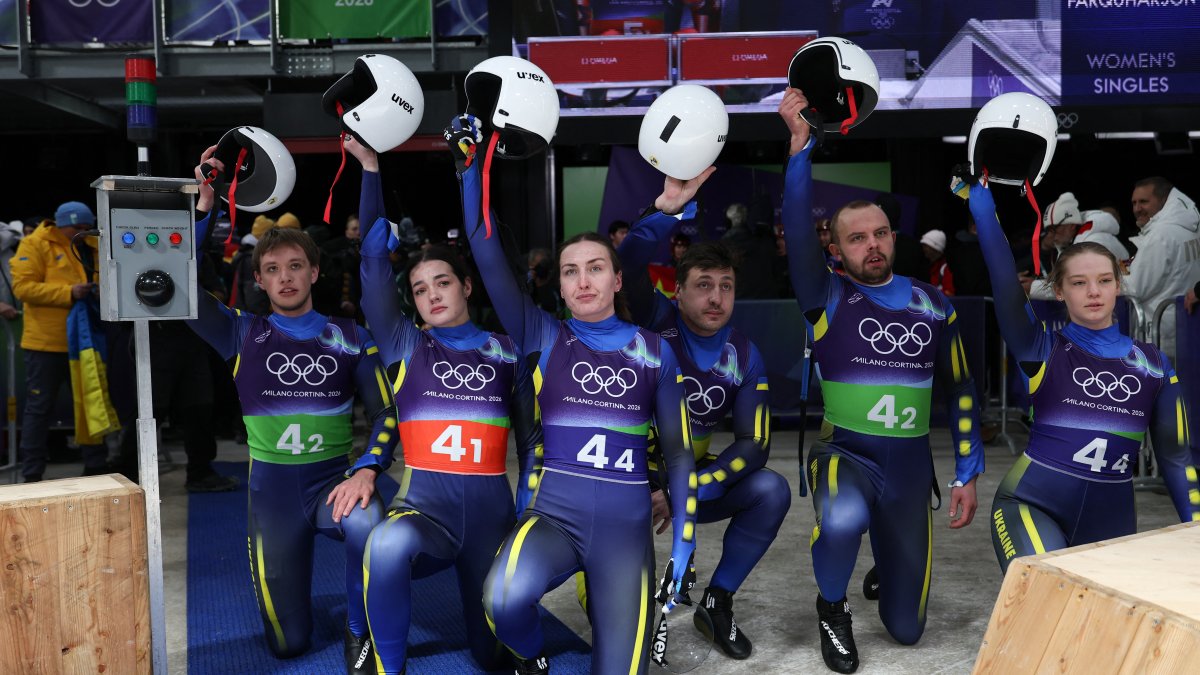
The luge team representing Ukraine took a collective knee, raising their helmets over their heads after the relay event in solidarity with disqualified teammate Vladyslav Heraskevych.
The team, after finishing sixth in the four-part relay, signaled their dissatisfaction with the International Olympic Committee’s action against Heraskevych in a silent gesture.
Getty ImagesGetty Images
Ukraine’s Ihor Hoi, Ukraine’s Yulianna Tunytska, Ukraine’s Oleksandra Mokh, Ukraine’s Andriy Mandziy, Ukraine’s Nazarii Kachmar and Ukraine’s Olena Stetskiv kneel on one knee after competing in the luge team mixed relay at Cortina Sliding Centre during the Milano Cortina 2026 Winter Olympic Games in Cortina d’Ampezzo on February 12, 2026. (Photo by FRANCK FIFE / AFP via Getty Images)
Hours earlier, the IOC disqualified Ukrainian skeleton athlete Vladyslav Heraskevych because he insisted on wearing a helmet that honors more than 20 of the athletes and coaches killed in the war with Russia.
Heraskevych was a medal favorite in the skeleton event.
International Olympic Committee President Kirsty Coventry was waiting for Heraskevych at the top of the track when he arrived around 8:15 a.m. Thursday, or roughly 45 minutes before the start of the men’s skeleton race.
Tiziana FABI / AFP via Getty ImagesTiziana FABI / AFP via Getty Images
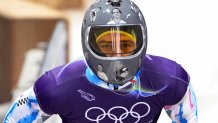
Ukraine’s Vladyslav Heraskevych wears a helmet depicting Ukrainian sportsmen and women during the skeleton men’s training session at Cortina Sliding Centre during the Milano Cortina 2026 Winter Olympic Games in Cortina d’Ampezzo on February 10, 2026. The International Olympic Committee on February 10, said a Ukrainian skeleton racer could wear a black armband at the Winter Olympics but confirmed it had banned his helmet that features Ukrainian sportspeople killed in the war with Russia.
They went into a private area and spoke briefly, and Coventry was unable to change Heraskevych’s mind. He was holding the decision from the International Bobsled and Skeleton Federation when he briefly addressed reporters and said he would appeal to the Court of Arbitration for Sport.
“It’s hard to say or put into words. It’s emptiness,” he said.
Coventry spoke with reporters after the meeting, tears rolling down her face as she spoke.
“It’s a message of memory and no one is disagreeing with that,” Coventry said.
The IOC added that it made its decision “with regret.”
IOC president Kristy Coventry got emotional when speaking about having to disqualify Ukrainian skeleton racer Vladylsav Heraskevych over his helmet remembering athletes who have died in Ukraine’s war with Russia.
Heraskevych came to the Olympics with a customized helmet showing the faces of more than 20 Ukrainian athletes and coaches who were killed during the war, a conflict that started shortly after the 2022 Beijing Games ended.
The IOC said Monday night that the helmet wouldn’t be allowed in competition, citing a rule against making political statements on the Olympic field of play. Heraskevych wore the helmet for training Tuesday and Wednesday anyway, knowing the IOC could ultimately keep him from the Olympic race.
“The helmet does not violate any IOC rules,” Heraskevych said.
The IOC had no immediate comment.
The IOC had sided with Heraskevych before. When he displayed a “No war in Ukraine” sign after his fourth and final run at the 2022 Beijing Olympics, the IOC said he was simply calling for peace and did not find him in violation of the Olympic charter.
“We want him to compete. We really, really want him to have his moment,” IOC spokesman Mark Adams said Wednesday. “That’s very, very important. We want all athletes to have their moment and that’s the point. We want all our athletes to have a fair and level playing field.”