
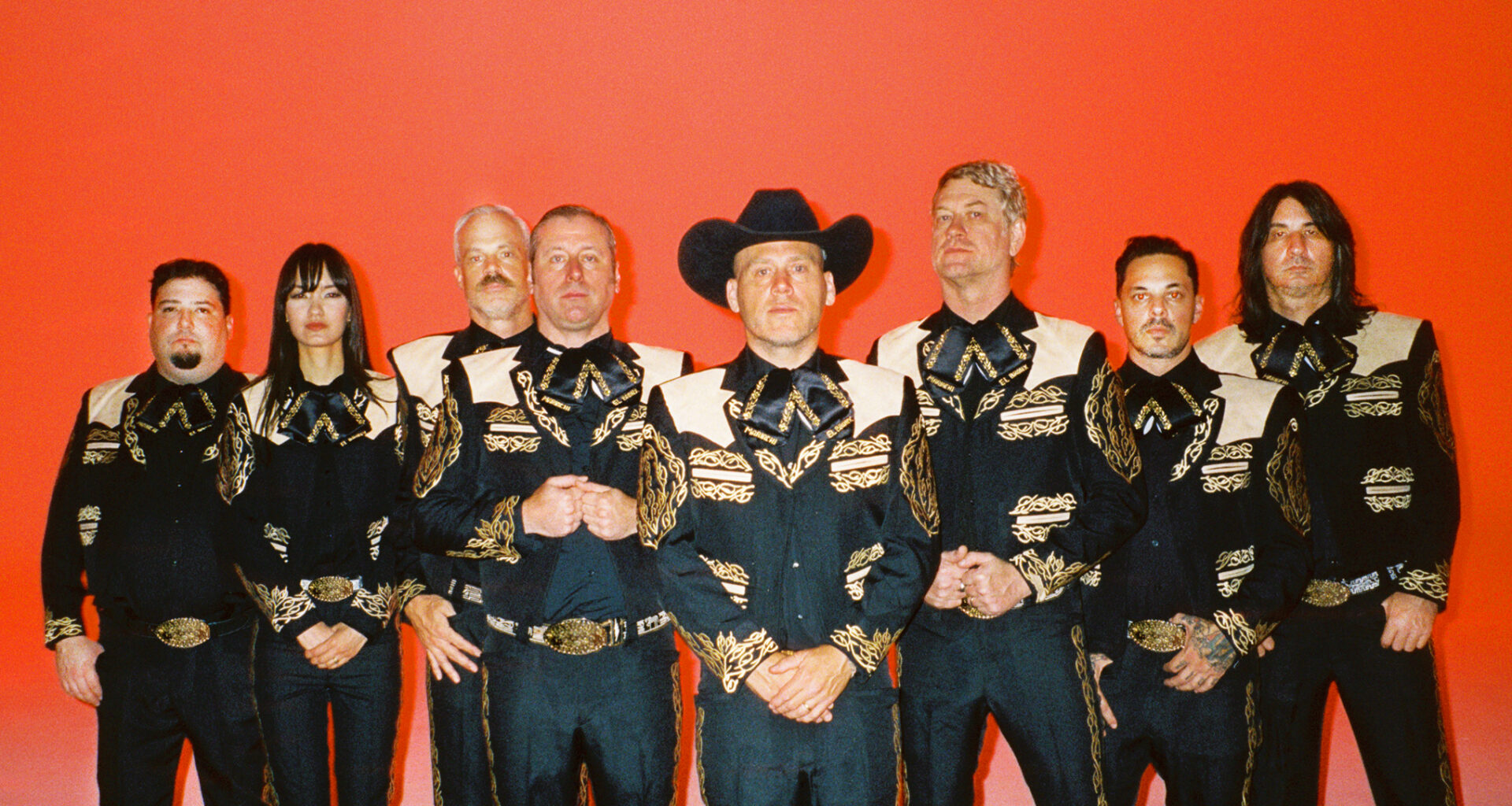
After a decade-long hiatus, Mariachi El Bronx is back. The popular offshoot of punk band The Bronx reemerged in 2025 with a new single, the lush and dramatic “Forgive or Forget,” a precursor to the album Mariachi El Bronx IV set for release on February 13.
Initially formed for an acoustic TV spot in 2008, Mariachi El Bronx is rooted in downtown Los Angeles, where The Bronx rehearsed daily and would listen to Latin American music emanating from the car wash outside the studio window. “We had grown up with Slash Records and Los Lobos and X, bands who were crossing the creative streams between cultural music and rock ’n’ roll or punk rock and that sort of thing,” says singer Matt Caughthran. “That found its way to us. It was our time.”
Over the years, the band dove deep into Mexican regional music and their musicianship has continued to grow in the time away from Mariachi El Bronx. On IV, they seamlessly add their rock twist to songs that reverently draw from traditional genres as Caughthran sings tales love, hardship and, on “El Borracho,” the drunk guy at the bar. We caught up with Caughthran to talk about making the new album and the continued inspiration of Los Angeles.
Returning to Mariachi El Bronx
For us, going back and forth between our punk band, The Bronx, and El Bronx has always been about where the inspiration takes you.
We had a lot of stuff going on with The Bronx. We were super busy for a long time and then we reached the end of the record cycle and it was just like, it felt like time. So we started writing.
The initial writing process was like, can we still do this? Does it still feel good? Does it still feel inspired and does it still feel meaningful? And it did. It did straight off the bat. The first demo we did was a song called “Forgive or Forget.” Joby [Ford] and I worked on it and it just felt great, so that was it.
Narrative Songwriting
I really look up to artists like Nick Cave and people who can really sit down with an idea and flesh it out and write something beautiful. It’s really hard for me. It was really hard for me over the years, initially. Especially with punk rock, every song felt like I was just ripping my guts out. It had to be this deep, emotional, gut-wrenching confessional. You can only do that so many time. You never want to feel like you’re repeating yourself and you never want to feel like the well is dry. You have to evolve as an artist.
One of the things that El Bronx unlocked for me, which I didn’t really know, was early on, it released this whole other side of me. There are songs about love and loss and storytelling of betrayal and characters and addiction and all these different things that I was able to tap into in a much more romantic way.
For me, lyrically, it’s an opportunity. It’s a moment to tell not just my stories but to jump into the lore of mariachi music and tell these big stories of characters, of love and loss and all that. I dive in all the way. It’s a hard process, I’m not going to lie. On this album, particularly, I rewrote these songs probably five, six, seven times each. I just kept writing and writing and I want to make sure that it’s something that I love and something the rest of the band loves and then in turn we hope that the audience will love it too.
L.A. inspiration
A lot of people ask why did you choose mariachi music? It’s not like we spun a wheel and it landed on mariachi. It was just the obvious choice for us. It was in the subconscious. Every day, it was around us.
For me, how Los Angeles plays a part in the band is just relying on the feeling of growing up and living a life where you grew up. You go through life in these beautiful neighborhoods and you find music and you tour the world and it all comes back to where you came from. I drove through Pico Rivera last week. I always go and I look at my old house and I think about growing up and it’s something, it’s my heart. You could write a song about Los Angeles. God knows the Red Hot Chili Peppers have written a million of them, but it’s more just the soul of southern California and L.A. that inspires me. You see the beauty in the streets and the people. It just works its way into the music. It’s hard to pinpoint exactly how, but it just does.
Making music in hard times
When we were making this album, literally, while we were in the studio, all the fires came about. We were in San Gabriel and the Eaton Canyon Fire was seven miles up the road. We lost power in the studio. We knew a couple of the guys were still living in proper L.A. and one guy was living right outside of Altadena, nothing happened to his spot or anything, but we were right there and it was so intense.
The whole vibe, everything that has been going on outside of the immediate fires in Los Angeles, the political landscape and all that stuff, is just so overwhelmingly sad and frustrating. Music is an opportunity for us as a band to come together and create something that takes us out of that and lifts our spirits and, obviously, you hope that you’re able to do that for other people as well. I know that’s what music gives me. It transforms you and it lifts your spirits up and takes you to a place where you feel something.
I get so worn down feeling overwhelmingly negative sometimes, just about anything and everything. Big picture, the political landscape. Small picture, the music industry. It can feel like the world is just crumbling around you and, in a lot of ways it is, and I know that it’s a popular thing as an artist to say that music is under-appreciated nowadays and I think that, in certain aspects it is, but the core of what music does, the core of what music is about is something that people need now more than ever.