
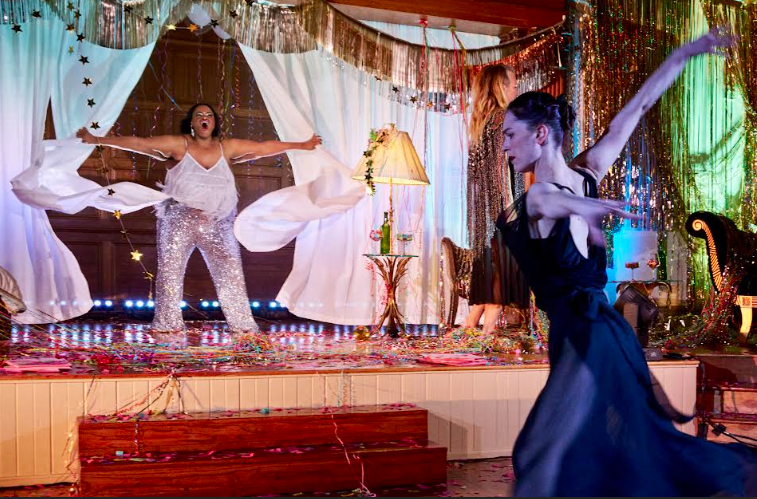

Because this is “a reduced season” for Long Beach Opera, “[…] a chance for us to do some resetting of some of our practices” (CEO Michelle Magaldi), Crash Out Queens — soprano Tiffany Townsend’s two-night stand in the lovely wooden confines above Altar Society on Pine Avenue — appears to be just about all the home-grown opera we’re gonna get in 2026.
Billed in the program as “both a recital and a dramatic exploration,” Crash Out Queens was intended to “trac[e] a journey through opera’s most iconic moments of reckoning — examining the inner lives of women pushed to their psychological limits.” In practice, however, the thematic aspirations were little more than a fishing line on which to string together seven arias that were a demanding program for any singer.
Although LBO patrons already knew Townsend could bring it from her turn as Idleness in the 2023 world premiere of Kate Soper’s The Romance of the Rose, the recital format should — and in this case, does — train a microscope on a singer in a way almost no full-blown opera can, if for no other reason than the back-to-back-to-backness of her arias. Well, if you were unsure about Townsend’s strength and stamina, perish the thought, as the high C (at least) that closed opener “Dis-moi que je suis belle” from Massenet’s Thais was mere prelude to the power she generated during Mozart’s “D’Oreste d’Ajace” (from Idomeneo), power she continued to flaunt periodically for the remainder of the performance.
But it could be argued that Townsend’s most effective vocalizations were not the moments of brute force but the subtler colors found particularly in Britten’s “Embroidery in Childhood Was a Luxury of Idleness” (from Peter Grimes) and Verdi’s “Una macchia è qui tuttora (from Macbeth). The aural pensiveness in such moments enabled Townsend (accompanied only by pianist Lucy T. Yates) to display just how fine her instrument can be.
Conceptually, well, let’s just say that Crash Out Queens fits perfectly in LBO’s new tradition (i.e., over the last five years or so) of occasionally offering Rorschachean presentations into which they hope we’ll read whatever the program says the show is about. Here we got a background of sheer drapes and tinsel fringe fronted by a set consisting of a chaise lounge, a lamp/table combo, a booze cart, some empty bottles and glasses and spent streamers lying about — so I guess it’s the wake of New Year’s Eve? Decked out in a disco ball of a suit (which Azra King-Abadi’s lighting exploited delightfully), Townsend tore down at the tinsel from time to time, symbolizing that she’s, er … (Paging through the program) … a woman pushed to her psychological limit? A couple of dancers moved about, sometimes in abstractions of distress? longing? and sometimes just on the breeze. During the Verdi the dancers blindfolded and bound Townsend, while we were silently instructed to don the sleep masks we received upon entry. I can’t even guess at what that was about (not that it had to be about anything). The most effective marriage of music and mise en scène was closer “To This We’ve Come” (from Menotti’s The Consul), where the dancers threw around a lot of pink paper to illustrate the Kafkaesque bureaucracy the song explicitly evokes (“Papers! Papers! Papers!”). That was fun.
Unless you count a forthcoming gala to celebrate the original cast recording of The Central Park Five, which world premiered at LBO in 2019 and garnered a Pulitzer for composer Anthony Davis, Long Beach Opera concluded its scheduled programming for 2026 on February 1st after one well-paced hour. That’s too much weight for any recital to carry. But Crash Out Queens shined a spotlight on a soprano that hopefully we’ll see again ‘round these parts once Long Beach’s resident opera company cycles through their self-imposed reset.
Like this:
Like Loading…
Related