
This column originally appeared in On The Way, a weekly newsletter covering everything you need to know about NYC-area transportation.
Sign up to get the full version, which includes answers to reader questions, trivia, service changes and more, in your inbox every Thursday.
The NYPD’s failure to crack down on dogs illegally roaming the city’s subways turned deadly last week when an internet-famous chow chow named Meatball broke free from its owner and jumped down onto the tracks at the Bowling Green station, where she was fatally electrocuted by the third rail.
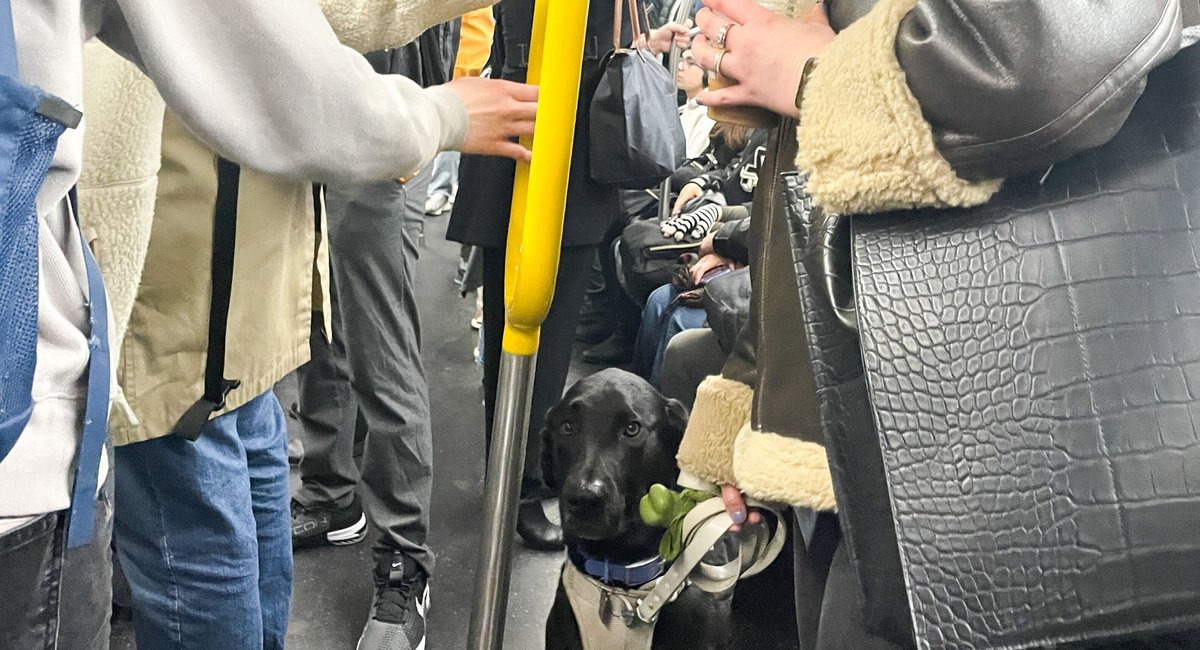
The tragedy was a dark turn in a trend that began when transit ridership plummeted during the COVID-19 pandemic. Dog owners began taking advantage of the extra space by bringing their furry friends on their commutes. The dogs don’t pay a fare as they are unable to use the OMNY system. In many cases, the furry fare beaters’ presence in the transit system violates the MTA’s rules, which require all pets to be in a bag or carrier to avoid annoying other passengers.
According to NYPD data, cops are giving the hounds a pass. Officers doled out just 13 summonses to riders breaking the “bag rule” for pets in 2025, and only nine the year before.
“I’ve been annoyed by a dog more than 13 times myself,” said Naveed Javid, 24, who was commuting through the Union Square station.
More enforcement could discourage people like Meatball’s owner from taking their dogs into the subway.
According to an incident report obtained by Gothamist, Meatball weighed between 50 and 60 pounds and escaped as her owner boarded the train. The dog jumped onto the track and was killed. Her demise delayed 31 trains over four subway lines, discharged 1,250 passengers and suspended service between the Bowling Green and Atlantic Avenue stations on the 4 and 5 lines for over an hour, MTA officials said.
The ongoing canine presence in the subways risks turning the trains into a moving dog run as more riders return to the system. Human passengers already struggle with basic etiquette, which has deteriorated post-pandemic. They linger by the doors instead of moving to the center of a car. They blast music instead of wearing headphones. These problems led the MTA to launch a campaign in 2023 reminding riders to be “courteous” to their fellow passengers.
Dog owners commuting on the subways Wednesday morning said they’ve never put their pets in carriers — and don’t see why they should. Gothamist only observed dogs traveling through the system on leashes, not in carriers.
Heather Curry, a commuter with a pit bull-Stafford mix named Shadow, said she’s never run into trouble from the authorities while walking her dog on the train.
“They [cops] are always very nice, very professional,” Curry, 36, said of her encounters with police when riding the trains with her pooch. She said other straphangers love Shadow. “It’s very positive. Everybody on the train is always complimenting him because he’s very calm and they get a kick out of him knowing his stop.”
For Jemmifer Miller, who walked her Pomsky service dog, Oreo, on a leash at Union Square, the subway rules might as well not exist.
“I’m not really much of a rule follower,” said Miller, 27. “So even if there was a rule, I probably wouldn’t follow it anyway.”
Even though the NYPD barely enforces the rule, one rider said MTA Chair Janno Lieber is a stickler about dogs on trains.
Dom Zagara, another commuter who takes his dog on transit, said Lieber approached him outside the MTA headquarters a few months ago.
“He told me to put him in a box on the subway,” Zagara said, pointing to his goldendoodle, Blaze.
An MTA spokesperson confirmed Lieber sometimes approaches dog owners in the system and encourages them to put their pets in carriers.
Unlicensed tow trucks. If you get in a car crash in New York City, there’s a good chance that an unlicensed tow truck driver, or “chaser,” will race to the scene, potentially putting other drivers and pedestrians in danger. A Gothamist investigation looks at how a change in NYPD policy, wherein officers were told to stop responding to minor crashes, enabled an underground towing industry to flourish.
Unlicensed ride-hail app. Empower, an illegal e-hail app, says it lets drivers take home 100% of their fare while charging less than Uber and Lyft. The city’s Taxi and Limousine Commission is warning New Yorkers not to use it.
Gross snow. We sent samples of snow piles from three different neighborhoods to a lab for testing and found that snow under elevated train tracks contains dangerous levels of lead.
Waymos are unpopular. According to a new Siena poll, a majority of New Yorkers oppose driverless robot cars over concerns about lost jobs for drivers, as well as the taxis’ ability to drive in bad weather on the city’s chaotic streets.
DMV down. Department of Motor Vehicles offices and services across New York state will close from 2 p.m. Friday until Wednesday morning so that the agency can upgrade its technology systems.
Curious Commuter
Question from Vincent in Brooklyn
Why do the A/C and G trains (and probably others) name many stations after parallel streets rather than intersections? For instance there is a Clinton–Washington station on both the blue and green lines. Wouldn’t it be more informative if the stations were named Fulton–Washington and Lafayette–Washington?
Answer
Subway stations typically don’t bear the name of the streets they run along. For example, there are 14th Street stations on several lines in Manhattan — but the MTA doesn’t include the corresponding avenue in their names. That’s partly because the names of those avenues were once baked into the names of the lines themselves. For example, the tracks running on the A, C and E lines on Manhattan’s West Side are also referred to as the “Eighth Avenue Line.” And that stretch of the A and C in Brooklyn that Vincent is referencing is known as the “Fulton Line.”