
Every four years, people watch some of the world’s best athletes do the extraordinary at the Winter Olympics: Skiers fly down mountains at 80 mph, and figure skaters land triple axels with effortless grace.
And then, suddenly, the broadcast cuts from an Olympian hurtling down a track headfirst on a sled to an odd scene of a guy violently sweeping across the ice with a broom.
It’s curling — a sport that’s a sort of frozen combination of shuffleboard and darts, where people slide granite stones across a sheet of ice toward a bullseye-shaped target.
Instead of being filled with adrenaline and wonder — the way one might be when watching Chloe Kim somersault through the air on her snowboard — a lot of folks (myself included) usually watch curling with a bemused interest. Is this really a sport? Why do some of the players look like they’d fit in better at a bar watching the Olympics rather than accepting a gold medal on the podium?
Anna Rawls
Surely it takes skill and practice, but how hard could it be? Couldn’t I do that?
Given the paucity of available curling rinks, this can be a difficult question to answer. But there is a curling club here in New York City, right in the heart of Prospect Park: the Brooklyn Lakeside Curling Club.
When I visited recently, members were more than happy to introduce me to curling, let me catch some games between seasoned players and try it out myself.
I trudged through the snow and 20-degree weather on a recent February weeknight to meet Miggy Gutierrez and Rachel Conley — longtime club members and a couple who actually got together in part because of curling.
“I swiped right on his profile because I saw he was a curler,” Conley said as Gutierrez laughed. “I thought that was bada–.”
Anna Rawls
Both repped gear from their respective international curling teams: Conley wearing Team Puerto Rico, where she competes for the women’s team, and Gutierrez sporting Team Philippines, where he coaches the men’s team who got oh so close to qualifying for this year’s Olympics.
Not a bad duo to show me the ropes. First, they explained the rules.
Traditional curling involves two teams of four players. Each team takes turns sliding — or “throwing,” as it is called — a curling stone across the 150-foot sheet of ice toward the 6-foot target, known as “the house.”
The house is made up of four sets of concentric circles, whose center is referred to as “the button.”
After eight throws per side, the team with the stone closest to the button scores a point. If they have the two closest stones, they score two points, and so forth, until the other team’s nearest stone is next closest.
After 10 rounds, or “ends,” the team with the most points wins.
While there are more rules and certainly more complicated strategies, this was a good starting point to try throwing myself.
Anna Rawls
First, I attached grippy booties to the outsides of my shoes so that they wouldn’t slip on the ice. As someone who has been sliding across the city’s icy streets the past couple of weeks, it felt surreal walking across the ice with perfect control.
Then, things get a bit difficult.
I was instructed to crouch down on a set of starting blocks — like a runner — while holding a curling stone in one hand and a tool called a stabilizer in the other. The stabilizer resembles a refrigerator handle. When you slide along the ice while gripping it, it does exactly what it sounds like: It stabilizes you once you release the stone.
I slid forward in a lunge … and came quickly to a rest. I was well before the hog line, which — apart from being the most amusing curling term I heard all night — refers to the red line 21 feet from the starting point where a curler must release the stone.
I tried again, and this time managed to get closer to the hog line and throw the stone. It limped down the ice and came to a rest a solid 50 feet short of the house.
On a third attempt, I pushed off hard and gave the stone an extra shove before releasing it. The stone had some giddy-up but veered off to the left, once again nowhere close to the house.
I guess you could call it progress.
Anna Rawls
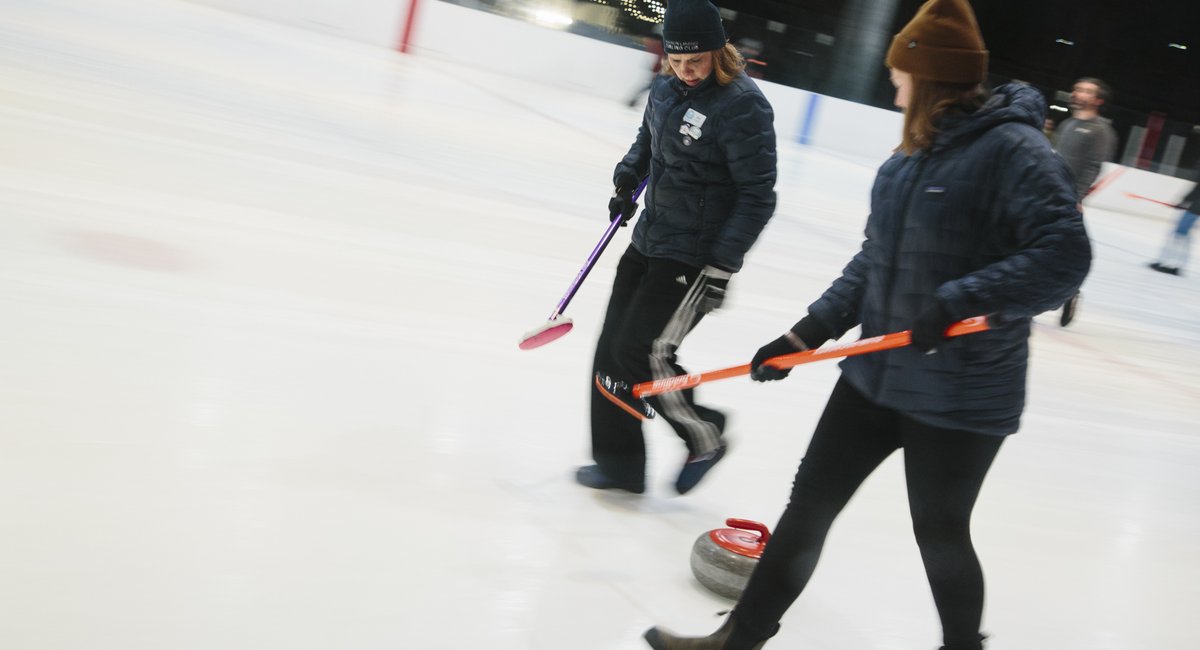
Next up was the other essential task a curler must master: sweeping.
As you may have seen on TV, the thrower’s teammates follow the stone down the ice, vigorously sweeping directly in front of it with brooms. It turns out they are clearing a smoother path for the stone, enabling it to go further.
The ice surface is actually seeded with water droplets that freeze. When swept, these “pebbles” melt, creating a layer of water that allows a stone to glide more smoothly — almost like a car hydroplaning in wet conditions.
Anna Rawls
By controlling the intensity of the sweeping, curlers can manipulate how far a stone travels. When combined with a stone thrown with some spin, the stone’s path can be bent, or “curled,” one way or another — giving the sport its name.
Gutierrez tossed a stone and I followed it along, broom in hand.
“HARD! HARD! SWEEP! ALL THE WAY!” Gutierrez barked as I scrubbed back and forth, trying to keep up with the stone shooting its way across the ice.
After some more sweeping and more (playful) yelling from Gutierrez, I took a break. There was a great variety of competition taking place in front of me. Off to the sides were first-timers learning the basics from seasoned veterans. Matthew Quan and George Dilthey were there for a company outing.
“I usually don’t go outside in the winter, I f—ing hate winter sports,” said Quan. “But it’s just like a nice game. I like that people are hanging out.”
But they also found it more tiring than they expected.
“It’s exhausting,” Dilthey said. “I’m going to be sore in the morning.”
Anna Rawls
Then, I heard a commotion from the other side of the rink. I looked over to see a stone gliding forward slowly, sweepers out in front. It slid past other stones on its way into the house. The entire team rushed forward to watch its slow march.
The stone came to rest right on top of the button. The team went wild — jumping up and down, high-fiving and gathering around the perfect shot for some celebratory photos.
This was the last shot of what had been a tie game: the curling equivalent of a walk-off home run.
Afterwards came an essential part of curling called “broomstacking,” where both teams put away their brooms, head inside and hang out over drinks. Usually, the winning team buys the losing team a round.
“Curling is a drinking sport,” Conley said.
I caught up with the team who hit the perfect shot — the Broom-Shakalakas — and learned they were part of the rookie league.
Dominique Rennell, who threw the winning shot, said she had a new appreciation for the sport after learning the ropes for the past month, having watched it on TV for years.
“I didn’t realize the strategy, watching the ice and seeing where you should be aiming, guiding the stones a certain way,” she explained. “It’s really interesting.”
I asked her about her winning shot.
“I thought it was going out, past the house,” she admitted with a smile.
“A Cinderella story,” her teammate Mia Naccarato joked. “Rookies no more.”
Anna Rawls