
United for Brownsville is a nonprofit that trains parents on how to advocate for their children amid the often lengthly and confusing early intervention process.
Despite freezing temperatures, a group of Brownsville education advocates and parents gathered on a recent weekend, united by a shared mission: securing additional early intervention resources for eastern Brooklyn.
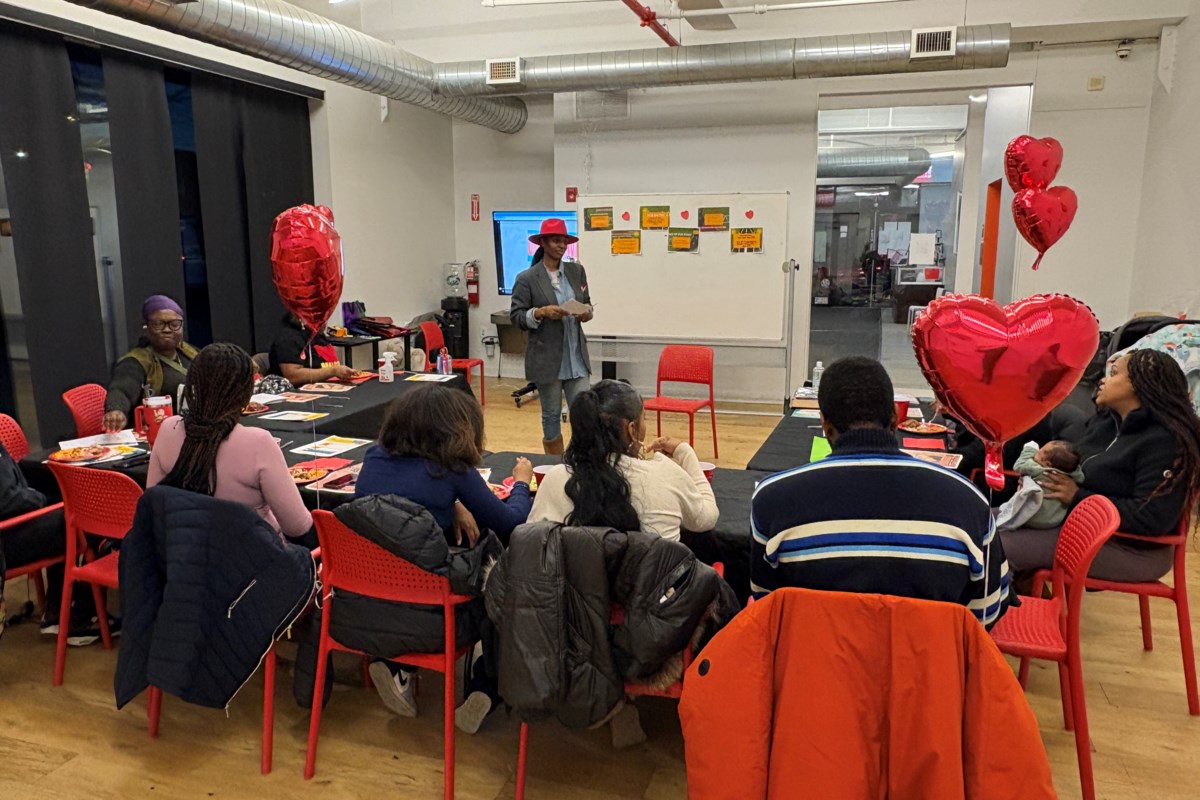
About 10 parents attended a training session led by the nonprofit United for Brownsville at the Greg Jackson Center on Rockaway Avenue. Parents learned how to advocate for themselves and their children, find support in their community, and prepared to head to Albany to ask for more funding.
Early Intervention (EI) serves children from birth to age 3 who are experiencing developmental delays. That includes delays in speech, not playing with other children, and not responding when someone calls them by name.
Parents whose children need EI often say there are many obstacles when it comes to the referral process, including long wait lists for evaluations and limited insurance coverage. Another difficulty is the lack of awareness of how to recognize symptoms and finding services.
UB’s Family Advisory Board sought to address this issue after it noticed that many Brownsville families were sharing similar experiences.

Danny Herring, the Early Intervention Ambassador for United for Brownsville, speaks to parents during the most recent advocacy training session. Megan McGibney for BK Reader
Danny Herring, the Early Intervention Ambassador at UB, said when the organization first started in 2018, there were about 20 families that came forward with similar patterns with their children.
“It just so happened to be that everyone was speaking about EI, not necessarily because they knew the word ‘early intervention,’ but speaking about services for their younger children,” she said.
Soon after, FAB petitioned the city Department of Health and Mental Hygiene to share data to see if official figures reflected what Brownsville parents were experiencing. The data showed racial disparities when it came to accessing EI: Black toddlers were 40% less likely to get EI services than white toddlers citywide, according to the organization.
With the newfound information, UB began to address the needs by partnering with DOHMH that created Herring’s role. As ambassador, she acts as an intermediary between parents and providers, like speech or occupational therapists, and helps parents navigate the system.
Because of FAB’s program, the gap between Black toddlers in Browsville and white toddlers citywide is closing, according to the organization. Outreach efforts resulted in 13 parents now trained for statewide advocacy, while 30 families received support navigating the Committee of Preschool Special Education process, where preschool-aged children are screened for disabilities, and then are directed towards services.

Parents warm up for the training session with some breathing and meditation. Photo: Megan McGibney for BK Reader
UB, a member of the Kids Can’t Wait campaign that seeks to improve children’s health and education, hosts a four-part weekly series where parents can learn how to advocate for themselves and their children at school. Herring has pushed parents to “lead from the heart.”
“Whatever your heart feels, that is the position you will take on if we do not address the feelings,” Herring said. “Anything filtered through that will be skewed, and our perspective will look very differently. So we meet everyone where they are, we let them know, that they are the experts in the room, that they do have the voice and the capacity to do this.”
Many of the training sessions were done virtually, but in January, everyone was together in person. Konis Pierre, a Brownsville resident, said one of her children needs speech therapy, and insurance coverage proved to be an obstacle. As a PTA member at her son’s school, she hopes to help other parents with what she has learned.
“Evaluation takes a long time,” she said.”We need to keep advocating for parents and telling them to get services. The earlier the better.”
Georgina Gooden, an EI Ambassador Assistant who has a son with special needs, said she will advocate for Albany legislators to listen harder to parents.
“The parents’ voice is missing,” she said. “The professionals are making a difference, but not the parents.”
At the final day of training, which also included breathing exercises, Herring left the parents with some final words: “Focus on the process, not the end goal. Understand a house is being built.”