
When Tamara Chubinidze moved to the United States from Georgia in 1996, people would ask the teenager where she was from. Her response would often elicit a blank stare. Occasionally, someone would vaguely recognize her country of birth, light up, and say, “Oh, that’s in Russia, right?”
Tamara would be crestfallen. “I was in New York City, a place where diversity rules, and no one knew where my home was,” she says over lunch.
Those experiences inspired Chama Mama, the Georgian restaurant she opened in Chelsea in 2019. “I not only want people to know where and what the Republic of Georgia is, but to really appreciate what we have to offer the world,” she says.
Since then, Chubinidze’s mission has picked up steam. After opening restaurants on the Upper East Side and Brooklyn Heights, she’s opening the fourth and fifth locations in Bushwick and Greenpoint this winter.

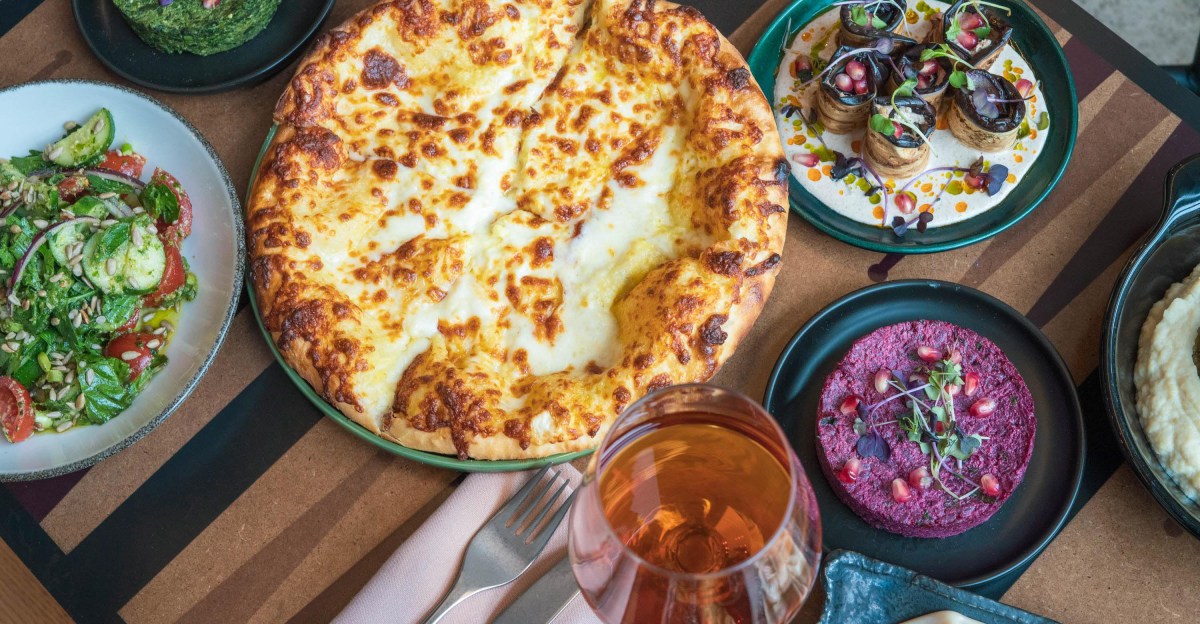
A tablescape from Chama Mama. Ivana Larrosa
Chama Mama’s expansion is no anomaly. In the last five years, Georgian restaurants have gone beyond their south Brooklyn bubble. For years, there was one Georgian restaurant in the West Village (Old Tbilisi Garden). Today, there are seven. In all, there are about 40 Georgian restaurants in New York today.
“Georgian food is both familiar and exotic,” said Carla Capalbo, whose book, Tasting Georgia: A Food and Wine Journey in the Caucasus, is a comprehensive English-language tome on the country’s cuisine. “It’s like a cross between Mediterranean and Middle Eastern food, but with a flavor palette built around blue fenugreek, coriander seed, and marigold,” she told me.

Outside Askili Orchard in Greenwich Village. Ivana Larrosa
There’s the ubiquitous Adjaruli khachapuri, a canoe-shaped baked cheese bread filled with cheese and a raw egg, which is stirred into the mixture. There are also broth-and-meat-cradling dumplings called kinkhali, lamb stews laden with tarragon, and chicken drizzled in walnut sauce.
During the 20th century, Georgia lost its culinary identity when it was incorporated into the Soviet Union in 1922. At the time, “people went for ‘easy’ food and forgot old recipes,” chef Meriko Gubeladze, owner and chef of Tbilisi restaurant Shavi Lomi, says. That led to Slavic dishes becoming popular, such as borscht and salads with mayonnaise, he explains. After the fall of the Soviet Union in 1991, Georgia gained independence, and chefs modernized the country’s cuisine and brought back old recipes.

Inside Saperavi in the East Village. Ivana Larrosa
Two events in Georgia explain why we now have more khachapuri restaurants in New York and across the United States. In 2008, Russia invaded Georgia, occupying South Ossetia and Abkhazia. Four years later, the conservative, Russia-leaning Georgian Dream political party took power and has remained in power today. Those instances created a large-scale exodus from the country. Since 2010, 23 percent of Georgia’s population has emigrated, and the United States has seen the largest increase in Georgian immigrants.
At the same time, more Americans are visiting: in 2013, about 25,000 visited, and by 2024, that number doubled to 50,000. In 2018, the Georgia National Tourist Association brought 800 foreign journalists to the country, resulting in abundant publicity. So while more Georgian restaurants have opened thanks to immigration, more diners want Georgian cuisine following their trips to visit the country.
“There’s been a greater urgency to promote and make the world aware of Georgia’s cultural heritage, and that includes its food and wine,” says Tina Kaadze, the owner of Saperavi. The restaurant began serving Georgian fare in the East Village in 2024 and recently opened outposts on the Upper East Side and the Upper West Side.

Kinkhali, or dumplings, from Chama Mama.

Kebabs from Chama Mama.
According to Gurami Oniani, owner of Laliko, a year-old Georgian spot in the West Village, the first wave of Georgian restaurants in South Brooklyn catered mostly to Soviet immigrants and were family-run. “These days, the new wave of Georgian restaurants is helmed by young, talented chefs from Georgia who were part of the more recent influx of immigration out of the country,” Oniani says. As a result, he adds, “The level of Georgian cooking that is happening here right now is very high.”
Oniani points out that one should not overlook the growth of the Georgian wine industry, which is happening at the same time. “Our cuisine and our wine are inherently linked, so it’s not a surprise that as Georgian wine has become more popular in the U.S., so has the cuisine.” From 2011 to 2021, sales of Georgian wine in the United States have quadrupled.
The foundation of Georgian cuisine in New York is now solid enough that some new restaurants are beginning to stray from tradition, like Askili Orchard in the West Village. Owner Georgi Papiashvili moved to New York when he was 23 and began working at Georgian restaurant Oda House in the East Village in 2013. “When I had the idea to open my own restaurant here, I was set on it being a very traditional spot,” he says. “But then I went back to Georgia for a visit and saw how many restaurants there were cooking modern and creative Georgian food, and I was inspired.”

A spread at Laliko.
The result is a menu that deviates from tradition but not so much that you can’t recognize Georgian flavors. A truffle-loaded khachapuri resembles a French puff pastry. Another khachapuri is filled with pear and gorgonzola. Askili Orchard’s version of satsivi — traditionally a chicken dish laden with walnuts, garlic, Georgian herbs, and topped with pomegranate seeds — swaps chicken for shrimp and walnuts for pistachios.
The latest example is Ubani Bistro, a new offshoot from the three other Ubani outlets. The new Bleecker Street location will be a French Georgian fusion restaurant.
For many Georgian immigrants in New York, their Georgian dream is coming to fruition: one khachapuri at a time, the city is appreciating the culinary bounty of the Republic of Georgia.

Outside Laliko.