
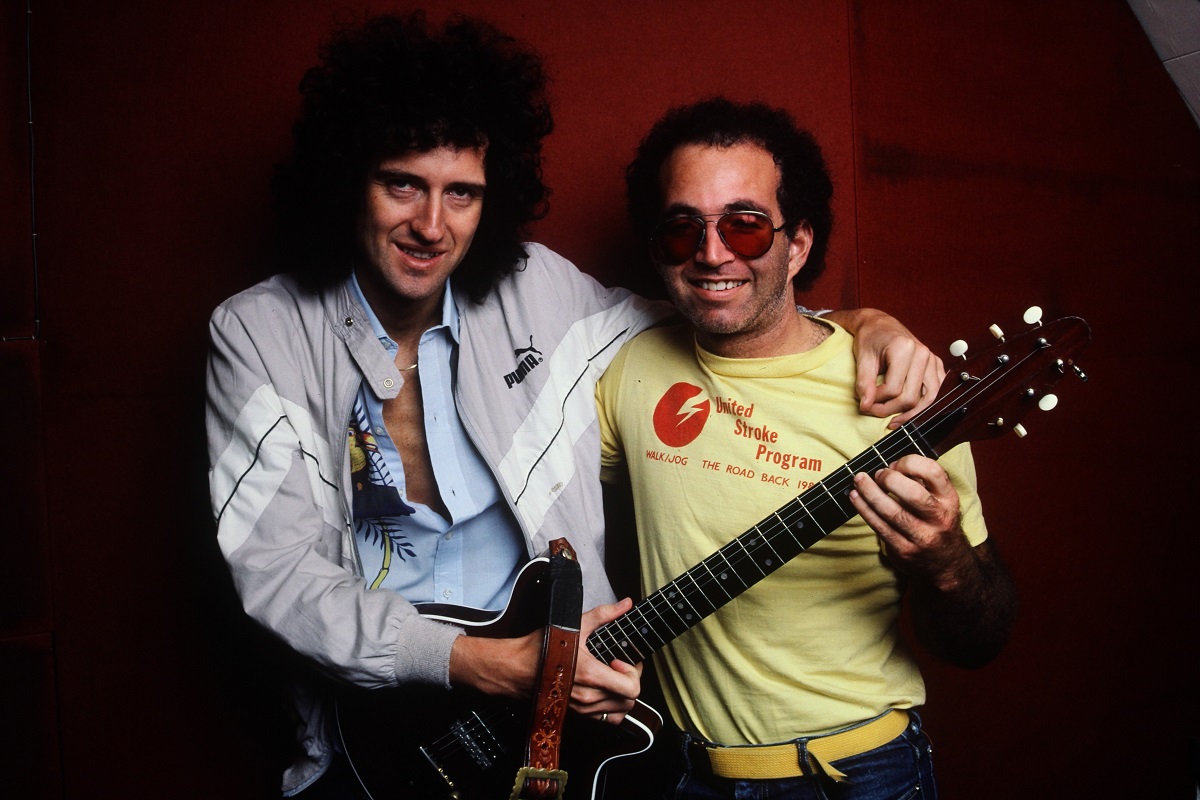
Brian May and Steve Rosen
Share:
The return of our Behind the Curtain column continues with another anecdote from longtime music journalist and writer Steve Rosen — recalling his encounters with Brian May of Queen.
Whenever I hear a Queen song on the radio, which is just about every day, it brings me both joy and disgust; pleasure and pain. These emotions are especially strong whenever “Keep Yourself Alive” comes on. I hear Brian May’s muted riff kicking off the song and all I can think about is, “I could have been possibly the first rock journalist ever to interview Brian back in 1973 when this song first came out.” I continue listening and hear that beautiful, almost country-sounding lick come in and I immediately ponder, “What the fuck were you thinking?”
I’m usually in the car whenever I listen to the radio, and at this point if I can keep myself from driving over the nearest cliff, I’ll let the song play on. The rest of the band comes in and then Freddie Mercury sings his first lines: “I was told a million times of all the troubles in my way/Mind you grow a little wiser, little better every day.”
I listen to the words he’s singing and hope I’ve gotten smarter over the years, but at that particular moment I feel about as dumb as a bag of guitar picks. Queen hold a special—and terrible—place in my heart. Every single time I hear a Queen song or someone mentions their name or I even see the Queen of England on television, I’m left with one unalterable, undeniable and inexorable memory: I could have interviewed all four members of Queen—Brian May, Freddie Mercury, Roger Taylor and John Deacon—in 1973 when their first self-titled album came out, but I turned it down. I said no. I passed. I didn’t want to do it.
Want more stories like this? Click HERE to sign up for our Rock Cellar email newsletter!
By this time, I’m so deep in my own head and stuck in the bowl of mush that is my brain, I barely register Roger Taylor’s sweet little drum solo or Brian’s soaring harmony guitar solo. Each time Taylor hits one of his Ludwig drums, I can feel the drumsticks rattling around my skull. And every time May picks out another high-flying riff drenched in echo and delay, I feel like I am being transported down a long, dark tunnel. I hear the notes swimming around me and when I regain my senses, I am back in 1973.
I had flown to Europe to trek around the continent and enjoy the simple pleasure of being 20 years old. My journey began in London, where I spent several weeks hitchhiking around. In between jaunts around the city, I would contact various publicists and managers whose names had been given to me before leaving the U.S. One of the names on my list was Tony Brainsby, a publicist who was then handling Deep Purple, Fleetwood Mac, Curved Air and several other bands.
Tony was one of the sweetest people I had ever met. At that time, I was a rock writer ghost. I had barely written anything. Nobody knew my name. I was of little consequence in the world of music journalism. But Tony didn’t treat me that way. He made me feel like a professional and someone with value. He arranged an interview with Sonja Kristina, the lead singer for Curved Air. Their fourth album titled Air Cut came out right around that time and Tony may have played the album for me in his office, but I don’t remember that. What I do remember is sitting across the table from one of the most stunningly beautiful women I had ever seen. I can’t remember a single note of the band’s music, but I absolutely remember her. She was wearing this leather-fringed vest, which was rather low cut and I’m certain all I did during our conversation was not try and stare at her. I don’t have a clue or any recollection of what I said to her, though it wouldn’t surprise me if one of my questions hadn’t been, “Would you marry me?”
Several days later—and this is where the nightmare begins—Tony told me about this new group he had been working with called Queen. Before hearing a single note of music or listening to anything Tony had to say about the band, I had made up my mind: “I am not interviewing this band. I hate their name.” And that was that. I said yes to Curved Air and no to Queen simply because I didn’t like the sound of their name. I was no fan of glam and really never cared for David Bowie or Mott the Hoople or any of the other early ‘70s artists who wore lipstick and hi-heeled shoes. I just assumed Queen was of that particular variety, and I wanted no part of them.
Tony told me how great they were and how amazing the singer was. He said, “Queen is going to be a huge band one day.” I figured he was just saying what any other publicist would say about a band with whom they were working. “No, thank you, Tony,” I said. “I’m not interested.”
I’m not interested. Those three words should be etched on my gravestone. I was so stupid and narrow-sighted. Tony had given me a copy of their debut album, which had just come out. I never listened to it at that point and Tony didn’t make me sit down and check it out. When I told him I wasn’t interested, he didn’t try to force me into listening to the music in order to change my mind. I wish he had.
When I returned home after about three months of backpacking around Europe, the album was there waiting for me. Tony had kindly mailed the record to me even though I had declined his invitation to interview the band. That was the type of person he was. There were no graphics on the album sleeve—this was just a white label test pressing—so I couldn’t see the photo of Freddie Mercury famously standing there beneath the spotlight with his microphone stand raised high above his head in some gesture of triumphant domination.
Had I seen that picture, I might have put the album on my little portable record player, but probably not. As it was, I simply filed the album under Q in my ever-expanding record collection and forgot about it. At least I forgot about it until I was driving around in my car one afternoon and this song called “Keep Yourself Alive” came on. I came in just as the song was starting so I hadn’t heard which band it was. I heard these chunky, muted rhythms opening the song and then these great melodic vocals and a surreal guitar solo drenched in echo and delay and sounding like there was an entire orchestra of electric guitars being played. I listened to the song until the end and thought, “What an amazing band.” Then the DJ said, “That was the new English band Queen from their first album,” and I almost swallowed my tongue.
I drove around for a few more minutes, not entirely sure where I was going. My jaw dropped in astonishment and my mouth hung open as if I couldn’t get enough air. I kept hearing the band’s name repeating in my head like a mantra: Queen…Queen…Queen. I went back to the exact moment when Tony Brainsby had offered me the intro. I could picture him handing me the album. I could myself saying, “No, thank you, Tony. I’m not interested.”
I cruised back home as fast as my mid-‘60s Triumph Herald would take me—which wasn’t very fast—and virtually jumped out of the car. I raced into my bedroom and rifled through my album collection and located the white label album. I pulled it from the sleeve, placed it on the turntable of my little compact record player—I was still living at home and hadn’t earned any money yet as a rock journalist, so separate stereo components were still many paychecks away—and put the little plastic arm and needle down on the first song. There was no track listing and no way of knowing which song was which. There was a few seconds of crackle and pop before the needle found its way into the grooves and then I heard the unmistakable muted chunks of “Keep Yourself Alive.”
I groaned. I thought there was an outside chance that maybe another band had been called Queen, but I knew there wasn’t. This was the same band I turned down, and now they were being played all over radio and magazines were already starting to do interviews with them. I was sick. I could have beat every other journalist to the punch. Maybe that interview I turned down with the entire band could have turned into one of my first published stories in Circus or Creem. But that wasn’t to be. I had my shot and I blew it.
But I would get another one. A little over 10 years later, I had the opportunity to sit down with Brian May and this time I jumped on it. Queen was releasing The Works and the guitarist was in Hollywood at the Capitol Records building doing press. I jumped into my Triumph Herald, coasted down the hills from my guest cottage in Laurel Canyon and made a left on Hollywood Boulevard. I made another left at the famous intersection of Hollywood and Vine and up about two blocks on the right side loomed the imposing round edifice of the Capitol Records building. Looking like a huge stack of records piled one atop each other on a turntable, the 13-story building was never meant to resemble a whole bunch of albums stacked on top of each other. The wide curved awnings over the windows on each story and the tall spike emerging from the top of the building only coincidentally made the structure look like a stack o’ wax.
I entered the lobby on the bottom floor and took the elevator up the fifth level where publicity was located. I loved coming to this building. I had done many interviews here and even saw John Lennon coming out of an elevator one afternoon. Unable to speak, I simply smiled and he smiled back. There was a lot of history here.
I walked to the publicist’s office, and she took me down a curved hall to one of the myriad cubicles to await Brian’s arrival. A few minutes later he materialized in the doorway. He was taller than I thought he would be, though I had no idea why I pictured him shorter. We shook hands and sat down on the couch in this little conference room. He seemed a little fatigued. When he lowered his lanky frame down onto the cushions, his bones wanted to sink into them. His eyes were mildly bloodshot, as if sleep-deprived, and no wonder. Brian was in town to complete The Works and was also overseeing the release of his first jam-oriented solo record called The Star Fleet Project. On top of all of that, he was coordinating a band video and most importantly was frantically looking for a way to pick up his child at school. Capitol Records people walked in and out of the room to confer with him and after schedules were rearranged and activities juggled, he was able to finally sit back, take a deep breath and concentrate on the interview.
He removed his clogs, sank deeper into the couch and said, “So what would you like to talk about?” “What would I like to talk about?” I said to myself. I recalled the scene 11 years earlier when I stood in Tony Brainsby’s office and turned down his offer to talk to this new band called Queen. I both smiled and groaned at the recollection. Brian sat there calmly and patiently as I shrugged off the memory. I looked at my notes—a list of questions I should have asked him over a decade ago—and decided to start at the beginning. “When did you realize guitar playing was going to be a part of your life?”
We talked for nearly an hour. Extraordinarily articulate and erudite, Brian talked about his early days as a guitarist and the formative years of Queen. I honestly can’t remember if I told him about the aborted interview some 11 years earlier. I probably did. I would have told him I didn’t want to interview the band because I didn’t like the name. Any other guitar player might have thrown me out of the room. But I’m pretty sure Mr. May simply smiled and said something like, “You’re here now.” I was, and this time I was going to get it right.
Maybe I had learned my lesson from listening to Freddie Mercury’s lyric, “Mind you grow a little wiser, a little better every day.” It had taken 11 years to learn that lesson—don’t jump to conclusions—but here I was. Had I grown a little wiser and a little better? Probably not.
Previous Article

Top 11 Fifth Beatles — and Others Closely Tied to the Fab Four
Published on 2026/02/13
Since the tidal wave of Beatlemania swept the world in the early 1960s, a variety of second bananas have been […]
Next Article
Behind the Curtain: Queen’s Brian May and a Second Chance to Make a First Impression
Published on 2026/02/13
The return of our Behind the Curtain column continues with another anecdote from longtime music journalist and writer Steve Rosen […]