
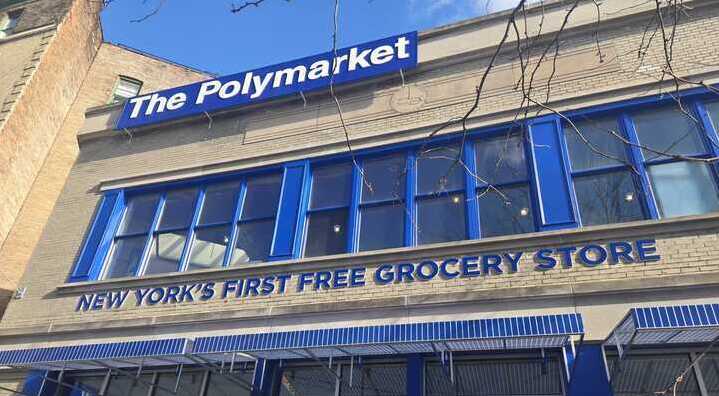
On February 12, Polymarket, a cryptocurrency-based prediction market, opened what it billed as New York City’s first fully free grocery store.
By the time the doors opened around 2 p.m., a four-block line had formed along 7th Avenue South in the West Village. Shoppers shuffled forward with blue Polymarket tote bags as staff handed out coffee and granola bars.
Branded The Polymarket, the pop-up is open to the public for four days, offering staples like milk, eggs, bread and produce alongside familiar brand-name snacks — no payment required, no income verification and no purchase limit.
Polymarket is a company that allows users to wager on the likelihood of future events, from elections and economic data to sports championships and geopolitical outcomes, using cryptocurrency. The platform has drawn attention for enabling large payouts tied to real-world crises, even as supporters argue it offers a novel way to aggregate public sentiment.
According to an announcement published on the company’s Substack, the opening coincided with a $1 million donation to Food Bank For NYC, which serves food-insecure households across all five boroughs (1).
“We’re open to all New Yorkers. A real, physical investment in our community,” the announcement reads. “Free groceries. Free markets. Built for the people who power New York. We’ll see you at The Polymarket’s grand opening next week. We love you, New York City.”
For Thaddeus Romero, a Brooklyn resident who works nights as a doorman and concierge, the draw was practical. He arrived shortly after 10 a.m., hoping to get a decent place in line after finishing his shift the night before.
“Every crazy idea always makes good music,” Romero told Moneywise as he waited. By mid-afternoon, with the line still stretching down the block, he described the scene as calm and orderly.
Romero was most interested in the meat options. “You go to the grocery store right now, some of the meats are very expensive,” he said, pointing to how widely prices can vary depending on where you shop. At certain stores, he noted, a ribeye can still cost between $10 and $14, but finding it at that price isn’t guaranteed.
Story continues
 Moneywise/Rebecca Stropoli
Those costs reflect a broader strain many New Yorkers are already feeling. The average U.S. household spends about $504 a month on groceries, according to Bureau of Labor Statistics data (2). In New York City, grocery prices surged 65.8% between 2012 and 2023, according to a report released last year by the New York State Comptroller’s Office (3).
Romero said the most he’s spent on a grocery trip was about $120. While he prefers to buy chicken, beef, T-bone steaks and ribeye, he tries to keep his weekly grocery bill under $100, typically landing closer to $90. Living alone, he shops with the goal of stretching that spend across the week.
“They had really good chicken breast in there. I picked up some ground beef and, surprisingly, bison meat,” he added.
Read More: The average net worth of Americans is a surprising $620,654. But it almost means nothing. Here’s the number that counts (and how to make it skyrocket)
The pop-up followed a similar move by rival prediction market Kalshi, which hosted a $50 grocery giveaway for East Village shoppers earlier this month (4). But the timing also taps into a much bigger conversation unfolding across New York City: how expensive food has become, and who, exactly, should be responsible for making it more affordable.
Mayor Zohran Mamdani has floated a proposal to open city-run grocery stores in every borough, selling food at wholesale prices. The idea has split affordability advocates and industry groups, sparking debate over whether public grocery stores would meaningfully lower costs or disrupt private markets.
Mamdani appeared to acknowledge that tension, responding to Polymarket’s free-store announcement on X (5). He posted a screenshot of a deadpan headline that read: “Heartbreaking: The worst person you know just made a great point.”
Inside the store, however, there was little visible reference to Polymarket’s core business. No betting prompts appeared alongside the shelves of free food.
Elsewhere in the country, free grocery stores aren’t stunts, they’re standing community services. In Maryland, the Enoch Pratt Library launched the Pratt Free Market in fall 2024. Open twice a week and serving roughly 200 people a day, the store allows anyone to take groceries with no ID and no income requirements. M’balu “Lu” Bangura, the library’s chief of equity and fair practices, said the idea grew out of pandemic-era shortages and a simple conviction that watching people go hungry wasn’t something she could accept (6).
That contrast loomed over Polymarket’s pop-up, which drew criticism for framing free food as a marketing play. Still, shoppers waiting in line appeared largely unfazed by the controversy. Several told The Post they hoped the market’s offerings would become a permanent fixture, not a one-off activation (7).
Among them was Luke McInerney, a 31-year-old software engineer from Manhattan, who brought a folding chair and worked on his laptop.
“I just think this is a quintessential New York experience,” he said.
Join 200,000+ readers and get Moneywise’s best stories and exclusive interviews first — clear insights curated and delivered weekly. Subscribe now.
We rely only on vetted sources and credible third-party reporting. For details, see our editorial ethics and guidelines.
Substack (1); Bureau of Labor Statistics (2); Office of the New York State Comptroller (3); New York Post (4, 7); @NYCMayor (5); Civil Eats (6)
This article provides information only and should not be construed as advice. It is provided without warranty of any kind.