
By Sam Mellins | New York Focus
This story originally appeared in New York Focus, a nonprofit news publication investigating power in New York. Sign up for their newsletter here.
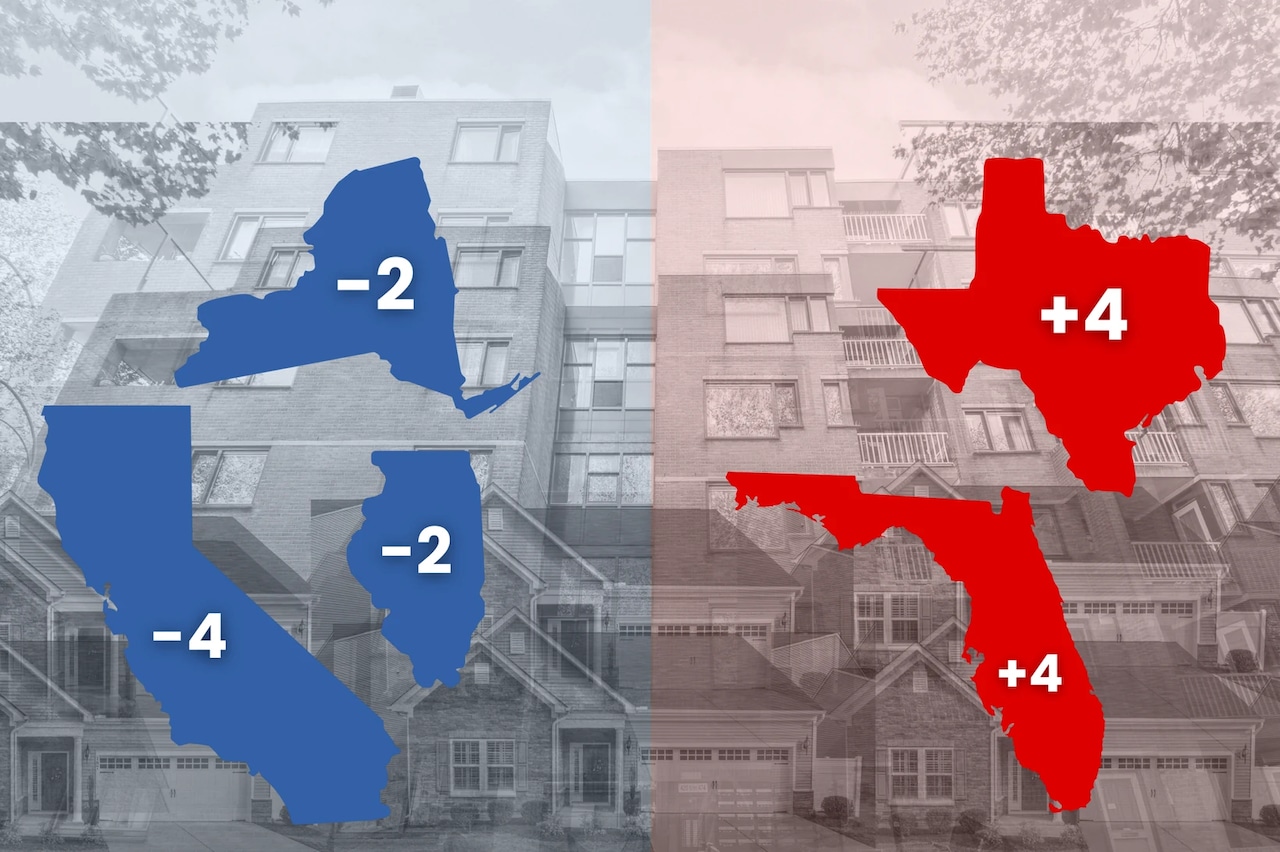
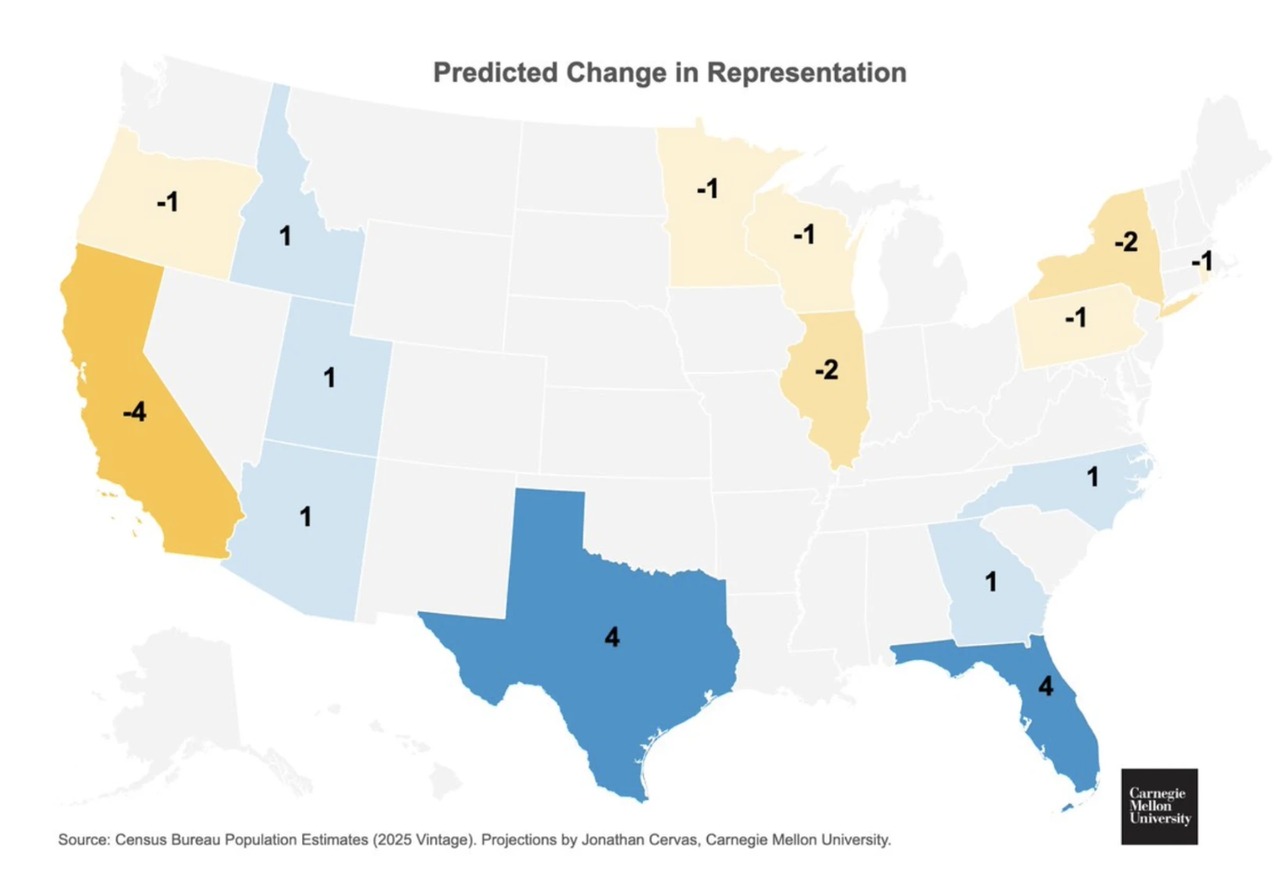
The next U.S. Census likely won’t be good for New York. Because of nationwide population trends, the state is projected to lose two congressional seats, and with them, two electoral votes for president, according to recent findings from Carnegie Mellon University.
The other states that are projected to lose multiple congressional seats and electoral votes are California and Illinois, according to the research. All three states consistently support Democrats at the statewide level and in presidential elections.
On the other hand, two states are projected to gain multiple seats and electoral votes: Florida and Texas. Both are set to add four seats, and both consistently support Republicans at the statewide level and for president.
If these projections are accurate, the Democratic candidate for president in 2032 could win every state that Kamala Harris won in 2024, plus Michigan, Nevada, Pennsylvania and Wisconsin — and still lose the election.
One reason why blue states are losing ground: The red states build far more housing than they do.
From 2021 to 2024, Florida and Texas issued permits for over 1.7 million new homes. California, Illinois, and New York issued fewer than 700,000 total, despite having a combined population over 15 million people larger than Florida and Texas’s total.
“Florida and Texas have a lot of laws that facilitate and incentivize housing production,” said Paul Williams, director of the Center for Public Enterprise, a think tank.
The final changes after the 2030 Census could be less dramatic than the current projections, Williams noted, since the flow of people out of blue states and into red ones has been trending down recently, though it remains significant.
New York’s housing shortage is driving people out of the state, to places with cheaper options, according to research from the Fiscal Policy Institute, a liberal think tank.
Even when moving to a low-tax state like Florida, middle-income people save significantly more on their rent or mortgage than they do from lower taxes, FPI’s research found.
“Actually making it possible and affordable for people to stay in New York is existential for the Democratic Party,” said Annemarie Gray, executive director of the pro-housing development group Open New York.
In New York, a major reason for the lack of new housing is local zoning codes, which often heavily restrict new housing in towns and cities, or even bar it entirely.
Are New York lawmakers concerned about this? Perhaps, but bold, paradigm-shifting ideas have been largely absent from the legislature.
“Everybody bemoans the predicament we’re in, but that’s where the concern stops,” said Assemblymember Linda Rosenthal, who chairs the chamber’s housing committee.
As the legislature stalls, Governor Kathy Hochul is taking on a project that could boost housing statewide: relaxing New York’s state’s environmental review law. As it stands, the law can require developers to spend years seeking approval for even minor new projects, and leaves them open to lawsuits by NIMBY communities seeking to derail new housing altogether.
Hochul’s proposed change would allow small and medium-sized developments to skip the state environmental review process. This wouldn’t turn building into a free-for-all — developers would still have to follow all relevant environmental regulations and protections in New York law.
Outside New York City, the exception would only apply if the buildings are located on sites that have already been developed — heading off concerns that it would allow open space to be paved over for new housing.
“When a community says yes, the state is going to step out of the way and let them go forward and build,” Hochul said at an event Tuesday. New York City Mayor Zohran Mamdani was also in attendance and praised Hochul for her “taking the action necessary to speed up the housing process.”
In response to a question from New York Focus, Hochul described the proposal as just a first step towards boosting housing statewide: “If we fix this one aspect, we can get that much further. It is not the end game at all.”
 New York Focus
For much of her tenure, Governor Hochul has touted pro-housing bona fides. In 2024, she and the legislature reached a deal to boost housing construction that she called “transformative” and “comprehensive.” But the deal’s tax breaks and zoning changes were mostly focused on New York City, and didn’t have a major impact in the rest of the state.
In 2023, Hochul proposed a more far-reaching plan that would have required all areas of the state to build new housing, but it was defeated by fierce opposition from the legislature, especially among representatives of suburban areas.
New York City’s suburbs have been especially resistant to allowing new housing. The four suburban counties surrounding New York City — Nassau, Rockland, Suffolk, and Westchester — have issued just five new housing permits per 1,000 residents so far this decade.
Even a “region-wide consensus” that more housing is needed on Long Island, particularly more affordable housing, hasn’t shifted this trend, said Lawrence Levy, dean of the National Center for Suburban Studies at Long Island’s Hofstra University.
Since housing policy is managed town by town rather than regionally, many localities “become villages of no,” Levy said.
In Huntington, Long Island, for example, the town board ditched a 2023 proposal to allow more basement apartments after massive opposition at a public meeting, including one resident who expressed fear of “migrants, pedophiles, or criminals” moving into the apartments, and another who urged the board not to change the “complexion of this beautiful community.”
Senator Brian Kavanagh, who chairs the chamber’s housing committee, said that he thinks state lawmakers should “be stepping in and putting more pressure on localities to build.”
But it’s not a sure bet that they will, he acknowledged. “I don’t want to make some grand prediction about what will happen,” he said.
To become law, Hochul’s plan has to pass the legislature, which is not a given. Rosenthal, the assembly housing chair, said she’s still making up her mind, and is concerned about unintended consequences.
“I certainly don’t want that in the haste to facilitate more housing, we lose environmental protections,” she said.
In New York City, experts say it’s likely there will be a boost in home-building from former Mayor Eric Adams’s signature City of Yes housing plan, which was enacted in December 2024. His administration estimated that the zoning changes in the plan will allow for the building of 80,000 new units in New York City over the next decade.
Mayor Zohran Mamdani appears to be interested in continuing that work. He has kept Adams’ housing staffers in his administration, and campaigned on a platform of using city funds to build 200,000 new units of affordable housing over the next decade.
Sharing a podium with Hochul on Tuesday, Mamdani sounded hopeful that the city and state can put an end to the high housing costs that drive New Yorkers out of the state.
“Everywhere you look in this city, there is proof of what a city that is willing to build can deliver,” he said. “And yet for too long, we have not extended that same limitless ambition to the kind of building that matters most to New Yorkers: the housing they need to live.”
Even so, Adams’s and Mamdani’s combined efforts, if they came to fruition, would still fill less than half of the 600,000-home gap that opened up over the past four years between Florida and New York.