
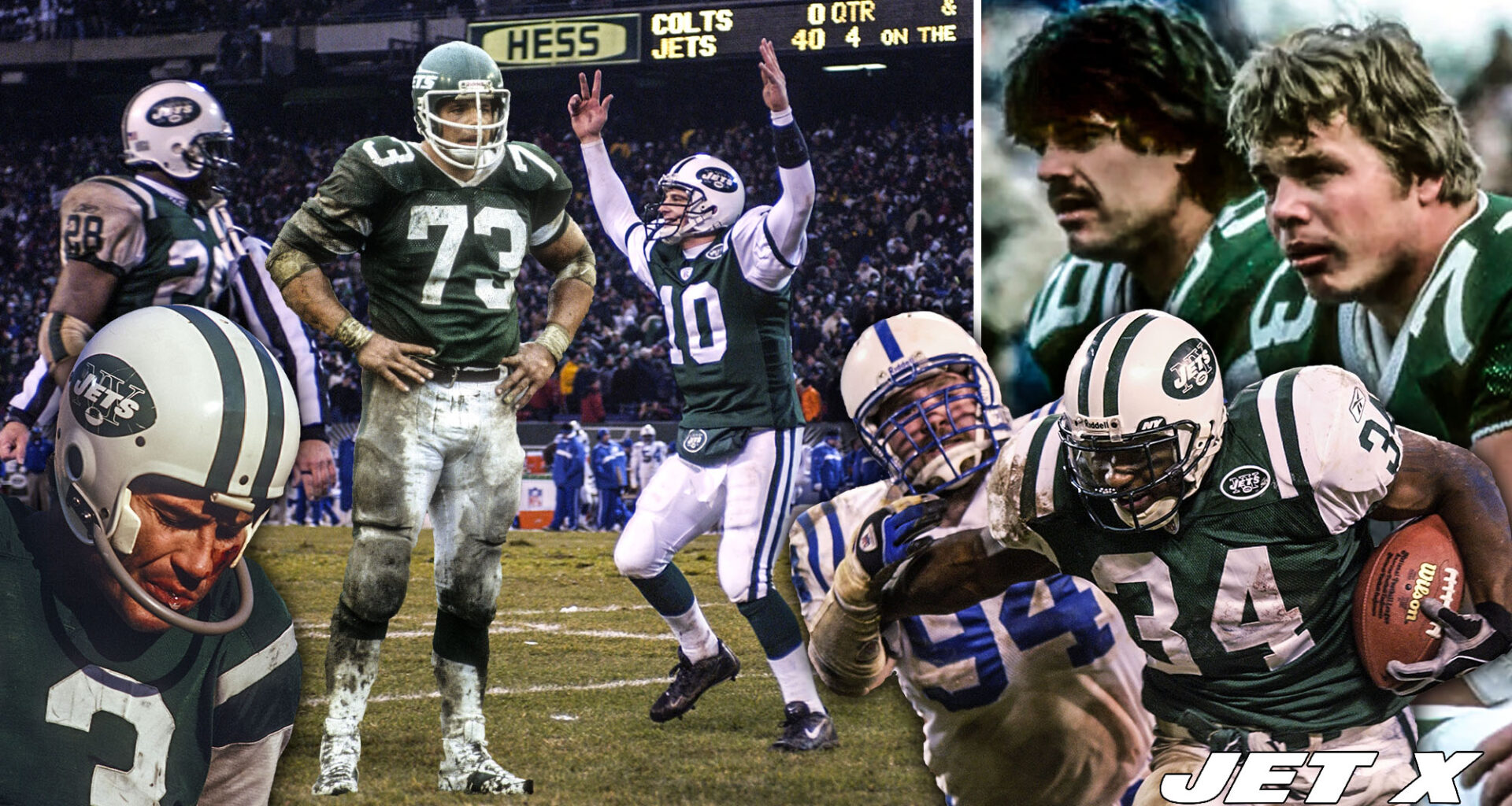
“They can put a man on the moon, but they can’t grow grass indoors.” Leave it to John Madden to put things so succinctly.
Those old enough to remember the early 1990s NFC battles between Jimmy Johnson’s Dallas Cowboys and the high-flying San Francisco 49ers recall the stark contrast in the scenes. When played in Dallas, it was tough to judge how hard a game was played by glancing at a player’s jersey.
That was hardly the case when the game shifted to the West Coast.
Those Niners-Cowboys battles at Candlestick Park weren’t just gridiron wars that decided the next Super Bowl champion, but they were also picturesque football time capsules. Even now, when watching the games back or by viewing a photo, the muddier the uniform, the better.
Quick, think fast: Please cite the last time one of your favorite New York Jets players finished a game with his white uniform so sloppy that mama had to use the strong detergent?
It hardly happens these days.
Instead, the most unique field-worn items are small rubber balls that fly up from the ground or ping-pong inside a player’s helmet. Yeah, that’s right, we’re referencing field turf, of course.
The New York Jets’ home, MetLife Stadium, uses field turf. Yet, the Jets haven’t always played on the fake stuff when hosting other NFL teams, and that’s precisely how this football love story unfolds.
The unexpected grass era: 2000-2002
Unless you were one of those weirdos, the unexpected grass era of 2000-2002 at The Meadowlands was something of a pleasant surprise for Jets fans. After all, after decades of negative noise, the infamous AstroTurf the Jets had played on for 16 years was anything but pretty.
Jets fans who turned on the TV on Sunday were greeted with a oddly-bright-green-colored field with a red circle at midfield. It’s tough to guess how many times a son asked his dad, “Why is the state of New Jersey out there on the football field?”
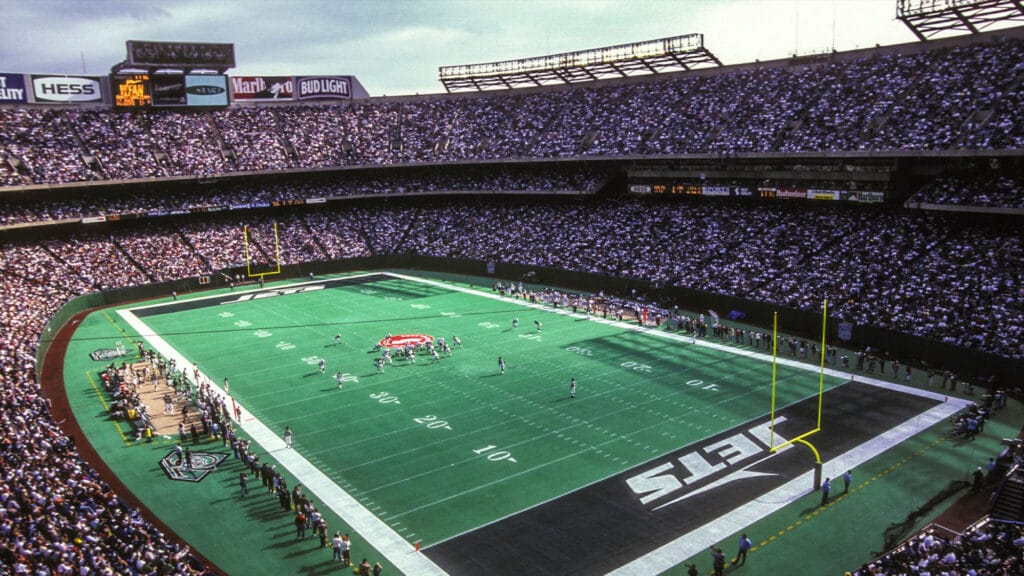
 New York Jets, Meadowlands, Getty Images
During the Bill Parcells era, Giants Stadium shifted from the red midfield logo to a more modern version, yet the turf remained intact. That was until an unexpected shift happened in 2000.
Interestingly, despite some conservatism from the Tuna — who perhaps became accustomed to the bright-green stuff as headman of the Giants — the New Jersey Sports and Exposition Authority pushed the stadium to move to grass. Of the two residing football clubs, the Giants were, by far, more eager to make it happen.
From that point forward, the likes of Curtis Martin, Wayne Chrebet, and the pulling center himself, Kevin Mawae, would play on natural grass. Sure, the “tray system,” as it would ultimately be labeled, turned out to be a disaster, but fans everywhere would rejoice.
The Jets would once again play on the stuff the football gods intended them to touch. Finally, the New York Jets would return to their roots, the very same traditional backdrop in front of which the New York Sack Exchange was born.
Meadowlands grass success
Better yet, Jets on-grass success followed. Sure, the disaster that was Bill Belichick bolting for New England stung (two years later), but while Parcells remained in the front office, Al Groh coached the team to a 9-7 record in 2000, while capturing never-say-die victories.
Chrebet’s Green Lantern game against Keyshawn Johnson and the Tampa Bay Buccaneers happened on the road (grass), but the Monday Night Miracle surely didn’t. A year later, Herm Edwards’s rookie head coaching season produced 10 wins and a playoff berth.
In 2002, Herm’s “you play to win the game” speech catapulted a lowly 2-5 team into AFC East champs with a young quarterback leading the way. A feel-good thrashing of the Green Bay Packers in Week 17 clinched it, and a dominating 41-0 playoff win over Peyton Manning’s Indianapolis Colts cemented it.
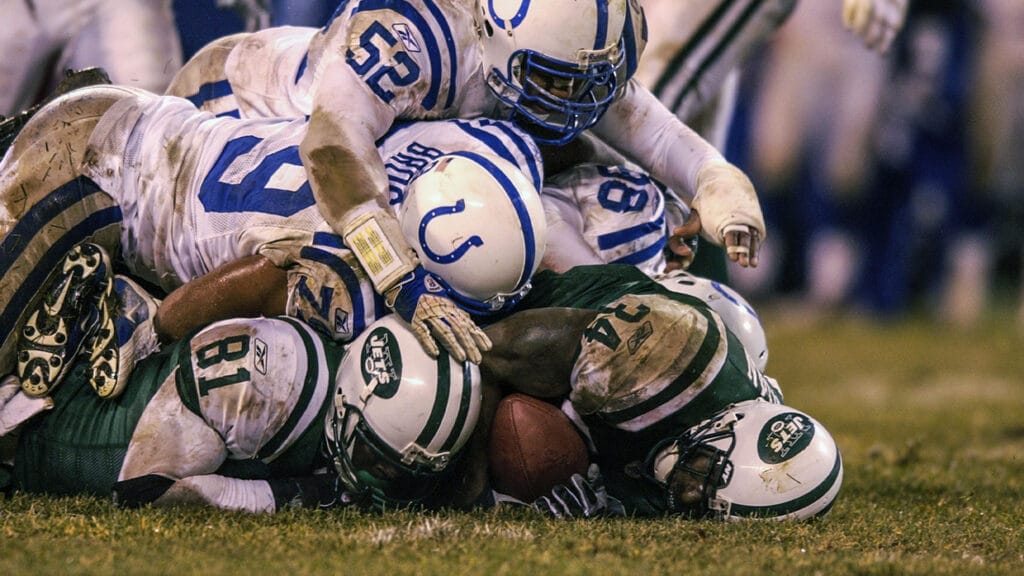
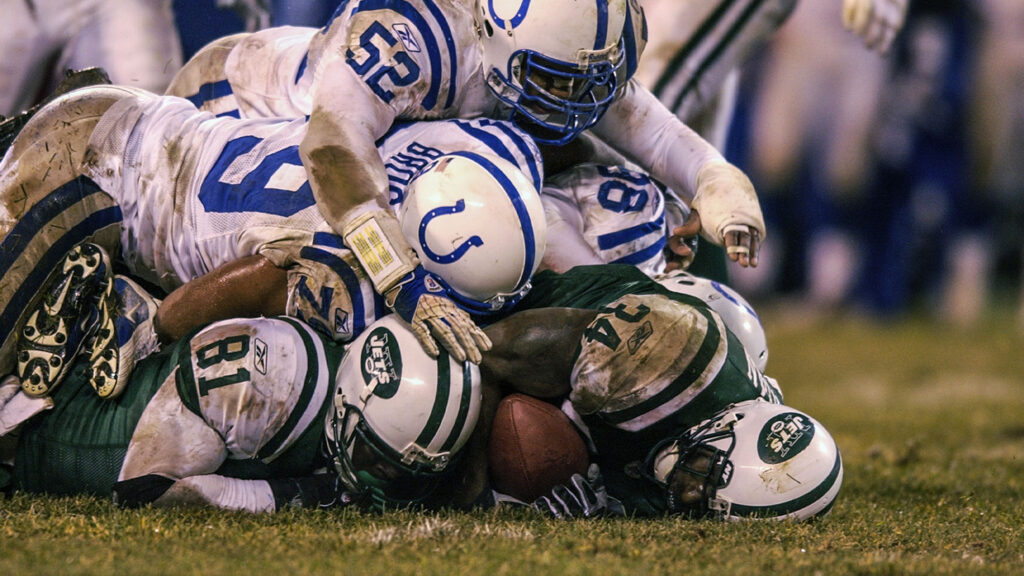 New York Jets, Indianapolis Colts, 2002 Playoffs, Getty Images
It was that Colts victory that remains the benchmark. Not only was it the Jets’ last home-field triumph on natural grass, but, to this day, it remains the franchise’s last home playoff game.
All told, the Jets finished with a 28-20 regular season record, two playoff appearances with a 1-2 postseason record, and a divisional title in those three seasons played on grass.
Incredible. Perhaps messy Jets uniforms — grass stains and mud — on those uniforms is all Woody Johnson needs these days.
At the end of the day, the Meadowlands transitioned to the revolutionary FieldTurf beginning with the 2003 season. Unfortunately, the tray system was too much of a hassle, similar to using natural grass in this area of the Northeast.
It was AstroTurf for the Jets for 16 years before the grass movement of 2000. That big red circular logo proudly displayed the geographical state of New Jersey for both the Jets and the Giants, who still called themselves “New York.”
While the Giants left New York for the Meadowlands in 1976, the Jets hadn’t done so until 1984. Before that, it was a grass haven for all Jets players and their New York-located fans.
The Jets’ roots: 1960-1983
Pictures and video snippets of Joe Namath in his white uniform are most fondly remembered from Super Bowl 3, but his dirty clothes also took a hit when his New York Jets hosted other teams.
From 1964 to 1983, the Jets played their home games at Shea Stadium, sharing it with the Mets. While sure, the team was forced to play on a baseball diamond for a good stretch of the season, this building wasn’t just a place to play football; it was the team’s one true home.
It was the Jets fans’ home.
Make no mistake about it: The Jets fan took a significant hit when they moved to the Garden State. Hofstra remained as the organization’s official headquarters, which meant training camp stayed in New York, but even that was ultimately relocated to Florham Park, NJ, in 2008.
Even before the Shea Stadium days, there was relocation turmoil. Remember, the organization was founded as the New York Titans, who initially played their home games at the Polo Grounds.
New owner Sonny Werblin, who purchased the bankrupt Titans, decided his franchise’s fate with a new name, look, and home — one that featured the sights and sounds of air traffic above.
No matter the changes, and no matter how clean today’s scenery and uniforms are, those classic moments cannot be taken away.
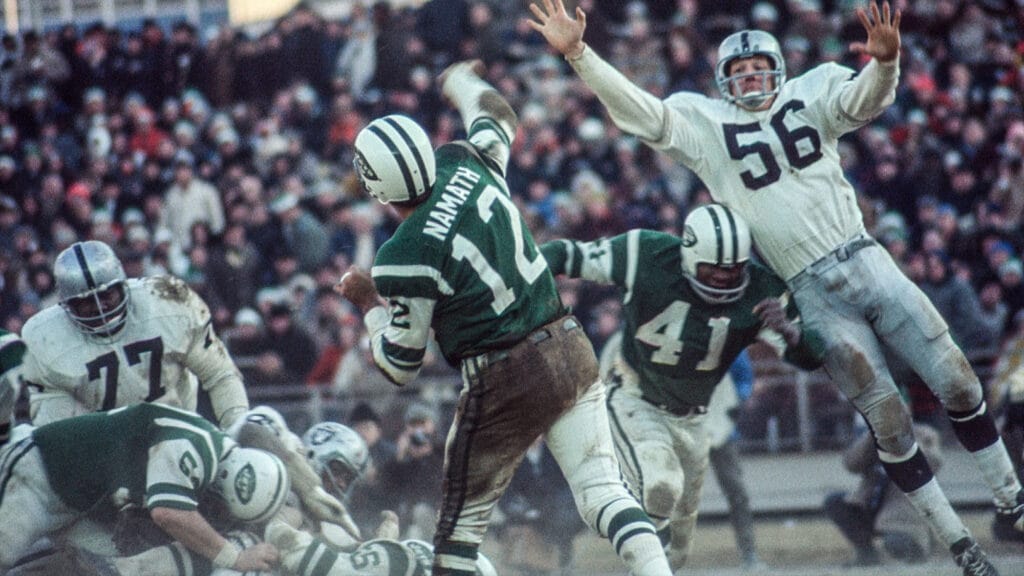
 New York Jets, Oakland Raiders, 1968 AFL Championship Game, Getty Images
Namath finding Don Maynard down the right sideline to help capture the team’s first AFL championship is just one of many. The New York Sack Exchange’s rise from the grassy surface of New York under the leadership of Walt Michaels is another.
For today’s New York Jets fans, the unbelievably messy and muddy playing surface of the early 2000s holds just as much water — particularly considering the current state of the franchise.
While it’s true that no Jets fan should ever expect his or her team to find its way back to natural grass anytime soon, or New York, for that matter, they do have the ability to finally grab a hold of that elusive success.
Besides, watching football on field turf simply means those classic snapshots of New York Jets heroes of the past, whose uniforms couldn’t help but shout a rough-and-rugged football story, are more valuable today.