
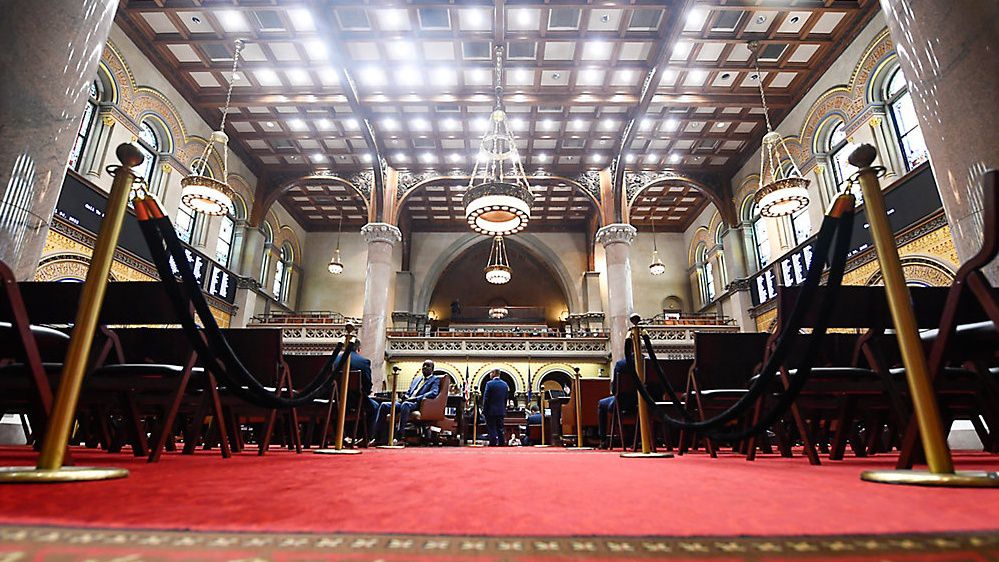
The familiar tug of war surrounding the Packaging Reduction and Recycling Infrastructure Act is unfolding once again at the state Capitol, and one of the most heavily lobbied pieces of legislation in Albany is once again pitting environmental advocates against the plastics industry.
The extended producer responsibility legislation, or EPR, aims to curb the use of several toxic chemicals used in packaging and reduce overall packaging use by 30% over 12 years with advocates pointing to the dangers of microplastics to the human body along with environmental impacts. Those opposed say it’s too tight of a squeeze on businesses.
After passing in the state Senate two years in a row but failing to make it to the Assembly floor at the last minute in both cases, those behind the push are hoping to avoid the same fate this year.
Judith Enck, former EPA regional administrator under President Barack Obama and president of Beyond Plastics, is a driving force behind the legislation, which is carried by state Sen. Pete Harckham and Assemblymember Deborah Glick.
All three are contending with sustained industry opposition which last year reportedly scared away enough ‘yes’ votes to discourage Assembly Speaker Carl Heastie from brining the bill up for a vote as hope for passage dwindled in the final hours of the legislative session.
“Every year that the Legislature fails to act means that the problem gets harder and harder to solve in a big state like New York,” Enck said. “Our plea to the speaker is to bring it up and let’s see what happens.”
Heastie reminded reporters that “contrary to popular belief,” the votes weren’t there last session, and there is still work to do this year.
“I’m the best vote counter in the Assembly and we’ll see and we’ll continue to talk — people are making their point but if the votes are there to pass a bill, we’ll pass it,” he said.
A source familiar with conversations in the Assembly told Spectrum News 1 there is confidence that the bill will ultimately pass in the lower chamber this year, and there is an expectation that additional amendments to the bill will be coming in the near future to assist in that outcome.
On the Senate side, the bill appears poised to pass once again, but the upper chamber will likely give the Assembly time to sort things out with the potential for early discussions with Gov. Kathy Hochul’s office.
Given the stance of advocates on what changes they are willing to make, it’s unlikely that any amendments will stave off the onslaught of industry lobbying, even if they are ultimately able convince reluctant yes votes in the assembly.
Those in the plastics industry like Chris Layton, sustainability director for chemical giant Eastman, stress that there is support for extended producer responsibility policy in general, but the current bill stifles economic growth both through bans on certain chemicals which they argue are necessary to keep production costs down, as well as an attempt to restrict the use of molecular recycling technology.
“There is a lot of positives but there are still things that need to be fixed,” Layton said. “For us the key part is to make sure there is a pathway in these bills to allow for these material to material recycling technologies, it strikes a balance between achieving the environmental objectives but we have to do it in a responsible way.”
In a sign of the impasse, Enck said there is an openness to making changes, but not when it comes to the innovation piece.
“A line in the sand for us is no chemical recycling,” she said.
As the legislative session ticks away, Enck is hoping to get support in her fight from one of the bills former Assembly sponsors, New York City Mayor Zohran Mamdani.
“He was a cosponsor of this bill when he was in the Assembly, and we’re hoping he will put his full political influence behind getting this bill through the Assembly,” she said.
Mamdani’s team is still reviewing the current legislation.
“This administration supports EPR policies, including for packaging,” a spokesperson told Spectrum News 1.
The bill was previously supported by the Adams administration.