
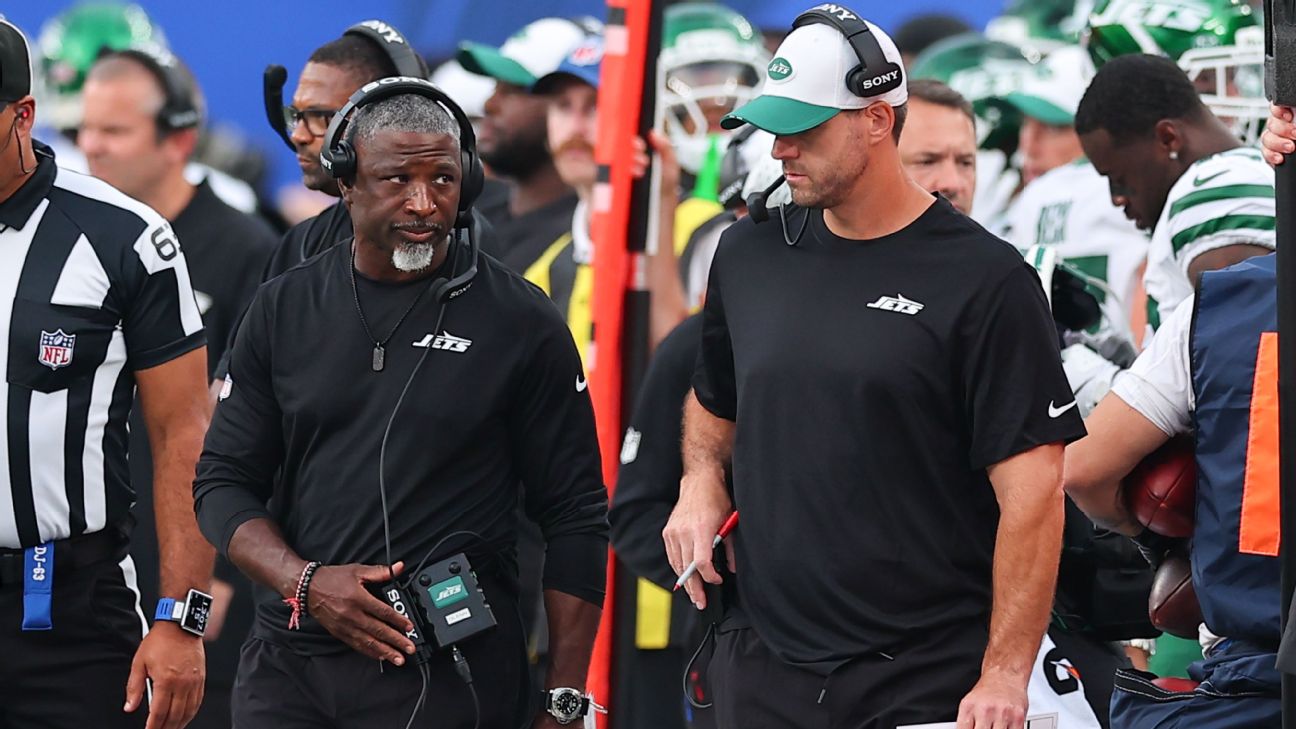
FLORHAM PARK, N.J. — TheNew York Jets‘ coaching staff overhaul, much like some of their two-minute drills last season, started slowly and appeared out of sync at times.
The most important takeaways, though, are how coach Aaron Glenn made a significant shift in managerial philosophy and raised the experience level of his staff.
After a season as a CEO-type coach, delegating most of the responsibilities to his coordinators, Glenn will be hands-on in 2026, which is a potential make-or-break year for him. He’s expected to call the defense, which he did from 2021 to 2024 as theDetroit Lions‘ defensive coordinator. His new coordinator, former Lions assistant Brian Duker, will handle all other responsibilities.
This was one component in Glenn’s plan to change the way the Jets do business.
Business wasn’t good in 2025. The Jets tied for the worst record in the NFL (3-14), with Glenn admitting after the season that his learning curve as a first-year head coach was a “huge deal.”
Evidently, one of his mistakes was the composition of his coaching staff, which he has now dismantled. Twelve of the 22 coaches on his initial staff are gone, including defensive coordinator Steve Wilks (fired late in the season) and offensive coordinator Tanner Engstrand — an unusually high turnover for one year.
Glenn cut loose some of his most inexperienced assistants and hired former players-turned-longtime coaches — offensive coordinator Frank Reich (age: 64), quarterbacks coach Bill Musgrave (58), tight ends coach Alfredo Roberts (60) and defensive line coach Karl Dunbar (58). They have 82 seasons of combined NFL coaching experience, compared to 44 years for the assistants in those roles last year.
For several reasons, the most important hire was Reich, who will have control of the offense.
With Glenn taking a more active role in the defense, he needed someone he could trust on the other side of the ball. That’s one of the factors that drew him to Reich, who has six seasons of head-coaching experience and four seasons as an offensive coordinator.
“When Frank stands up in front of a team, there’s not a lot of F bombs coming out of him,” said former NFL quarterback Boomer Esiason, who played and roomed with Reich at Maryland and became his lifelong friend. “It’s more straight to you. He’s speaking to your heart. He’s speaking to you as a human being and he’s also trying to get the best out of you as a player.”
In Reich and Glenn, the Jets will have two seasoned playcallers (Engstrand was a first-timer in 2025). Mike Macdonald showed the concept can work — he called the defense for the Seattle Seahawks— but he was an outlier. He was the first head coach in history to call defensive plays for a Super Bowl champion. The Seahawks and Buffalo Bills were the only two teams in the postseason with this setup.
At least Glenn can install and run his scheme, which wasn’t the case last season. He let Wilks do his own thing; it failed miserably, as the Jets ranked near the bottom in most major statistical categories, including zero interceptions — an NFL first.
Offensively, Reich’s system will contain the elements needed for success in the Northeast, where the weather turns cold late in the season, according to Esiason — a physical team that relies on running and play-action passing. As a former NFL quarterback, Reich certainly isn’t averse to throwing the ball.
In his first season as theIndianapolis Colts‘ coach, he leaned heavily toward the pass. They used designed pass plays 64% of the time, which was the ninth-highest rate in the league in 2018, per NFL Next Gen Stats. His quarterback was Andrew Luck, one of the most gifted passers of his generation. They made the playoffs.
Luck retired before the 2019 season, so Reich dialed back the passing. In 2020, the Colts called passes on only 58% of their plays (27th), relying on star rookie running back Jonathan Taylor. They made the playoffs again.
The primary concern with Reich is that he hasn’t coached in the NFL since 2023, so it’s fair to wonder if he’s out of touch. For instance: Pre-snap motion is such a big part of today’s NFL, but he didn’t use it much in his final two seasons. In 2022 (Colts) and 2023 (Carolina Panthers), his offenses were ranked 29th and 30th in motion usage, respectively, per Next Gen Stats.
Glenn evidently sees Reich as a cutting-edge coach, noting he’s “unique in his ability to see the game for what it is right now and adapt when appropriate” — a telling comment. That Glenn hired a coordinator with a passing background suggests a willingness to diversify the offense. Remember, he picked Reich over Greg Roman, one of the league’s foremost running game gurus. Roman was one of three finalists for the job.
Reich inherits a major question (who’s the starting quarterback?) and modest expectations: The Jets have finished 23rd or lower in scoring for 10 consecutive seasons, a period in which they employed eight different playcallers.
Glenn completed the staff Thursday with four hires on defense. The entire staff overhaul was curious in that he waited three weeks after the season before firing seven assistants on Jan. 22 — well into the hiring cycle. In the ensuing days, it got really weird.
He brought in veteran coach Wink Martindale for a second interview on Jan. 24, creating the perception that he had found his new defensive coordinator. There are conflicting versions of why he didn’t get the job, centering on whether Glenn had decided between the first and second interview to remove playcalling from the coordinator job.
Martindale’s interest was based on his ability to run his own defense, and he came away from the second meeting under the impression that Glenn had changed the parameters of the job, according to a source close to Martindale.
About a week earlier, Glenn had attended organizational meetings at owner Woody Johnson’s home in Palm Beach, Florida. The timing of those meetings, coupled with the seemingly abrupt end to Martindale’s candidacy, fueled speculation that Johnson, who has a reputation for meddling, had instructed Glenn to run the defense himself.
People in Glenn’s camp say that isn’t true, that it was his decision to take control of the defense — part of a detailed offseason plan presented to Johnson. On Jan. 28, Glenn hired the relatively unknown Duker — seemingly an eleventh-hour candidate. He wasn’t among the initial eight to interview.
Duker, most recently theMiami Dolphins‘ passing game coordinator, has no playcalling experience, but he has familiarity with Glenn’s system. He coached in it for three seasons in Detroit, so there should be nothing lost in translation.
A day before Duker’s hiring, Glenn parted ways with Engstrand, one of the coaches he took with him from Detroit. He was open to keeping Engstrand in a reduced role — no playcalling — but the result was a clean break. In the end, Glenn wound up replacing most of his key assistants on offense. Defense, too. It was a prolonged process, clunky at times. Glenn’s coaching future could hinge on whether he got it right.
Here’s a look at the new coaching staff:
Offense: Frank Reich, coordinator*; Seth Ryan, passing game coordinator*; Bill Musgrave, quarterbacks*; Steve Heiden, offensive line; Shawn Jefferson,wide receivers; Nic Mckissic-Luke,running backs; Alfredo Roberts, tight ends*
Offensive assistants: Thomas Merkle (QBs)*, Brian Natkin (OL), Al Netter (OL)*, Matthew Sargent*, Junior Taylor
Defense: Brian Duker, coordinator*; Chris Harris, passing game coordinator/defensive backs; Karl Dunbar, defensive line*; Ben Bolling, linebackers; Ryan Slowik, safeties*
Defensive assistants: Ronald Booker (nickel)*, Cameron Davis (DL), Nathaniel Willingham (LBs), Collin Bauer*
Special teams: Chris Banjo, coordinator; Kevin O’Dea, assistant
*Denotes new coachbr/]
Copyright © 2026 ESPN Internet Ventures. All rights reserved.