
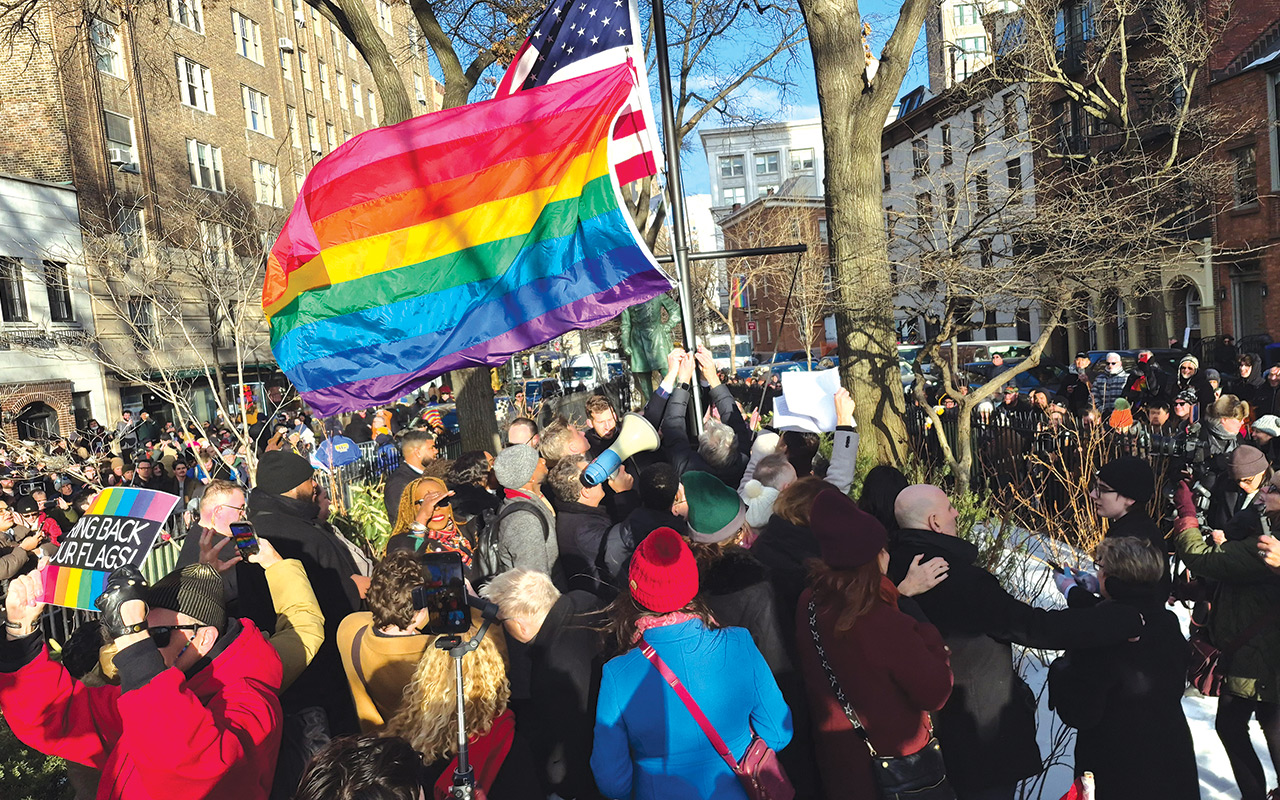
 Protest on Feb. 10 in New York City at the National Stonewall Site. Photo credit: Jay W. Walker.
New York City on Thursday, Feb. 12, defied a new federal policy that resulted in the National Park Service taking down a Pride flag at the Stonewall National Monument by raising another Pride flag in its place.
Thousands of LGBTQ community members and supporters packed into the area around the monument site Thursday afternoon across the street from the historic Stonewall Inn in Greenwich Village to raise the flag after the NPS removed one earlier this week in compliance with the federal policy issued last month.
“Raise our flag! Raise our flag!” the crowd chanted as a demonstration organizer used a megaphone to ask the crowd to make space so elected officials with the flag could get through to raise it in an act of rebellion reminiscent of the June 1969 Stonewall Uprising in which the LGBTQ community fought back against a police raid on the bar and demanded to be treated with dignity and respect. The uprising is widely regarded as the beginning of the modern-day LGBTQ civil rights movement.
“The flag is up. It’s an original presented to us today here at the Stonewall Inn. The community should rejoice. We have prevailed. Our flag represents dignity and human rights,” said Manhattan Borough President Brad Hoylman-Sigal in a Facebook video post. Baker, who died in 2017, was an American artist, Army veteran, and activist who designed the original Pride flag in 1978.
The controversy started when the NPS quietly removed the flag days before Thursday’s demonstration. Elected officials and Stonewall bar employees said they realized the flag was gone on Monday morning, according to a report in The New York Times.
The flag’s removal, which was first reported by Gay City News, followed new federal guidance issued in late January. The U.S. Department of the Interior, which oversees the NPS, said in a Jan. 21 memo to regional directors and superintendents that “…only the U.S. flag, flags of the DOI, and the POW/MIA flag will be flown by the NPS in public spaces where the NPS is responsible for the upkeep, maintenance, and operation of the flag and flagpole,” with limited exceptions.
Backlash as a result of the removal came swiftly from city, state and national public officials and LGBTQ activists, community members and allies. Many regarded the removal as an attempt to erase LGBTQ people from the nation’s history and even to invalidate their very existence.
U.S. Sens. Chuck Schumer and Kirsten Gillibrand, U.S. Reps. Don Goldman and Jerrold Nadler, Gov. Kathy Huchul, state Attorney General Letitia James, state Sens. Erik Bottcher and Brian Kavanagh, Assemblymembers Alex Bores, Deborah Glick and Jo Anne Simon, Mayor Zohran Mamdani, City Council Speaker Julie Menin, and Council LGBTQIA+ Caucus Co-Chairs Chi Ossé and Justin Sanchez were among the officials in addition to Hoylman-Sigal who opposed the removal.
Mamdani said in a post on the social media platform X on Feb. 10 that he was outraged.
“New York is the birthplace of the modern LGBTQ+ rights movement, and no act of erasure will ever change, or silence, that history. Our city has a duty not just to honor this legacy, but to live up to it. I will always fight for a New York City that invests in our LGBTQ+ community, defends their dignity, and protects every one of our neighbors — without exception,” Mamdani said.
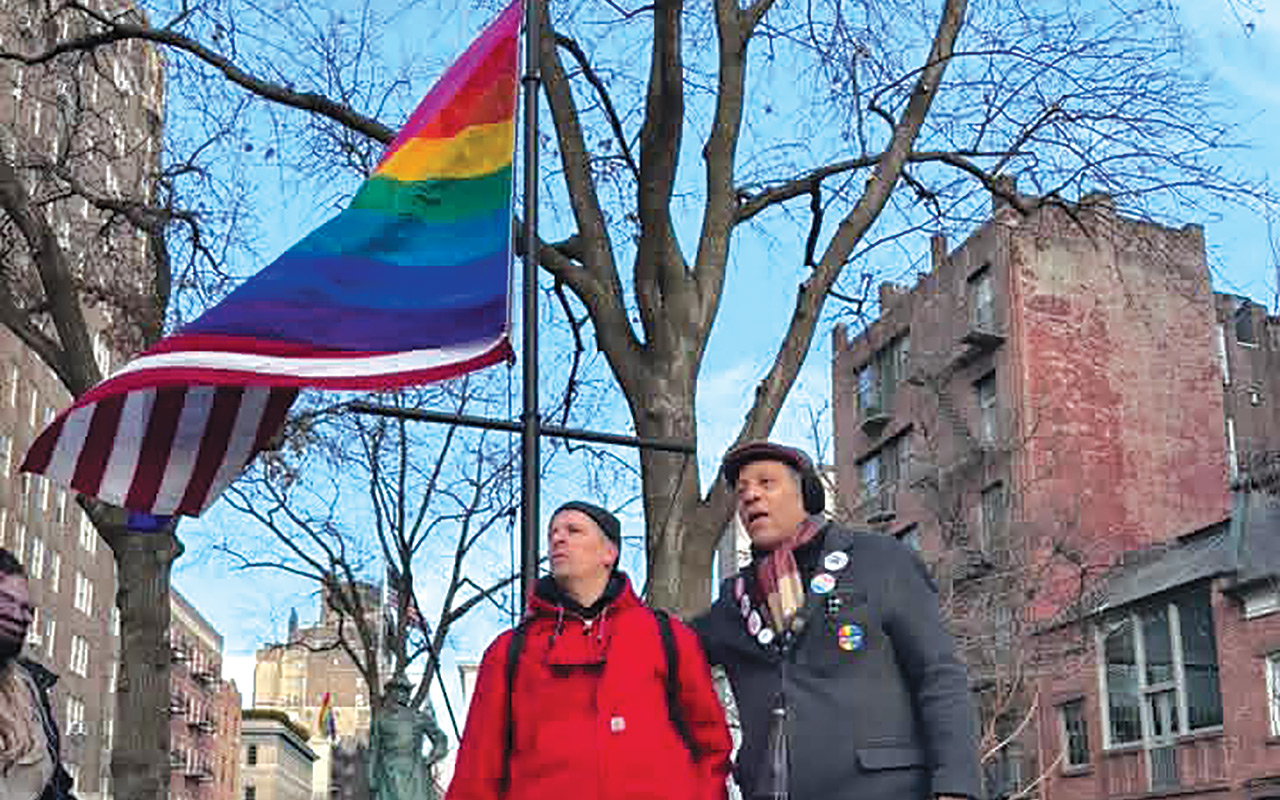 Protest on Feb. 10 in New York City after the flag was raised. at the National Stonewall Site. Photo credit: Christopher Hardwick.
Reached for comment via email Wednesday, Feb. 11, on the city’s plans to re-raise a Pride flag at the monument, the DOI responded: “While Mayor Mamdani and his City Council are trying to distract from their recent failures, it would be a better use of their time to get the trash buildup off city streets and work to get the power back on for the people of New York City.”
On Tuesday, Feb. 10, hundreds protested at the site, and Hoylman-Sigal, the city’s first openly LGBTQ borough president, announced in a Facebook video post that the city would be putting a Pride flag back up at 4 p.m. Thursday and encouraged people to come.
Jay W. Walker – a founding member and the president of Gays Against Guns and a co-founder of the Reclaim Pride Coalition, which holds the Queer Liberation March in the city was an organizer of Tuesday’s protest. He said he came Thursday as an individual and member of the community. “We cannot let these homophobic, transphobic fascists take over our park and erase our community and erase our history,” Walker told Out in Jersey on Friday, Feb. 13.
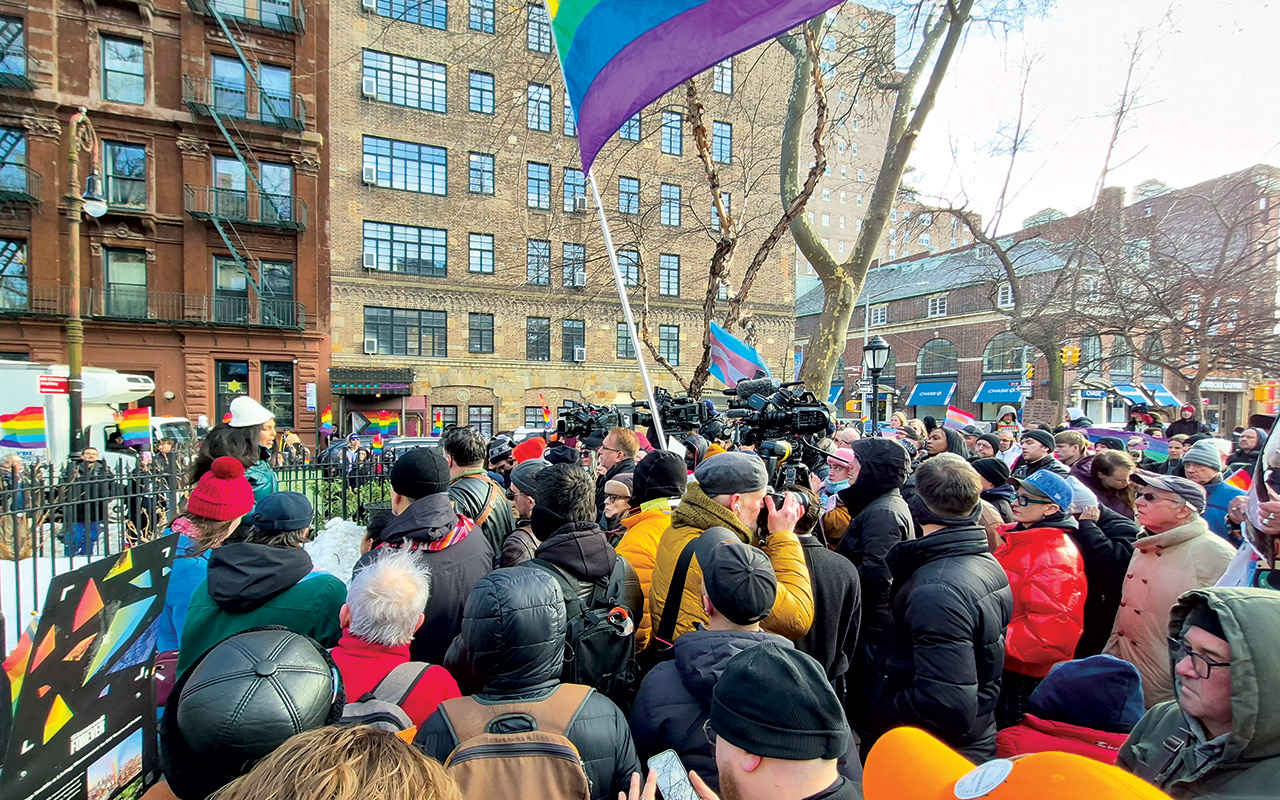 Protest on Feb. 10 in New York City at the National Stonewall Site. Photo credit: Jay W. Walker.
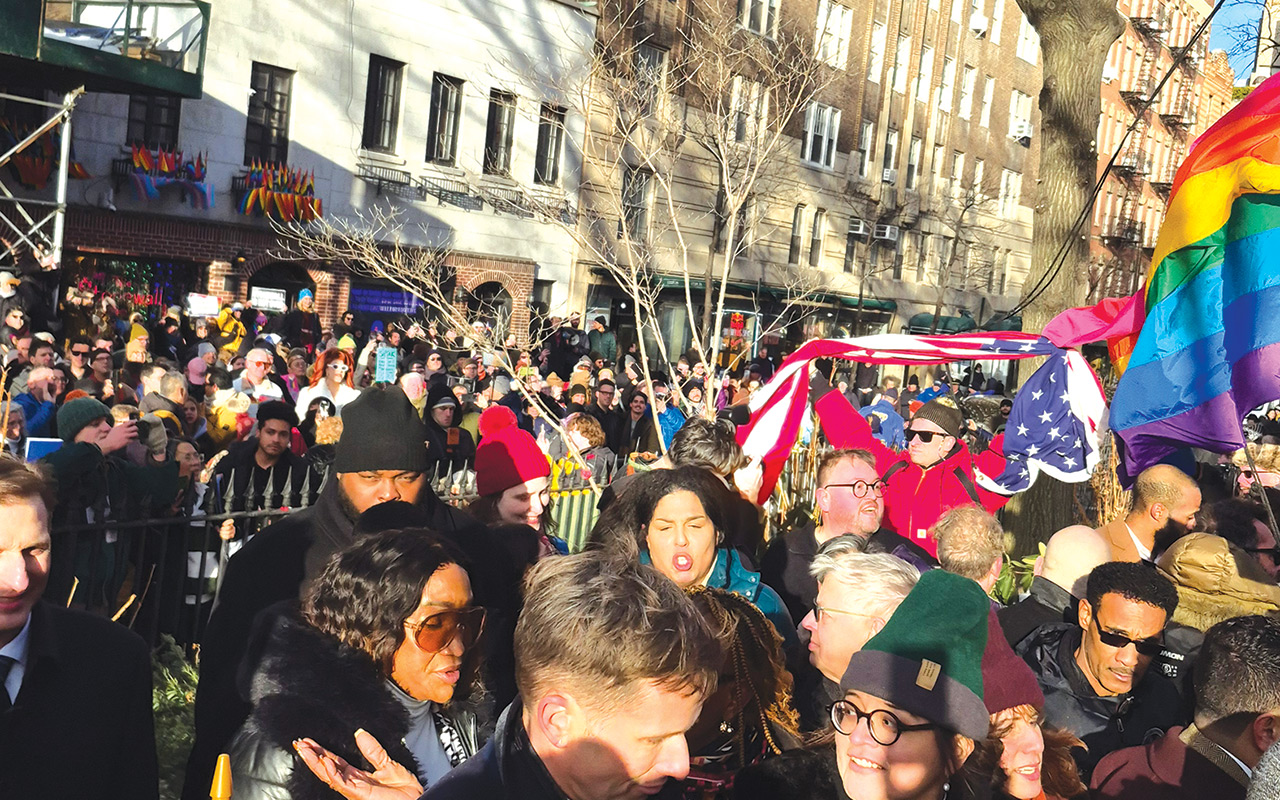 Protest on Feb. 10 in New York City. Photo credit: Jay W. Walker.
The flag is a beacon and represents community to Walker, who came to New York City when he was 18 years old and attended his first Pride parade in the city with his first boyfriend in 1988.
“That park and that flag are interwoven with the destiny of our communities and to take it away … is an attack on our community,” Walker said.
Cathy Renna, communications director for the National LGBTQ Task Force and a resident of Montclair, N.J., told Out In Jersey on Wednesday that the flag’s removal was shocking, but not surprising, as she noted that measures against the LGBTQ community, including erasing trans and queer folks from federal government websites, began to be implemented on Day 1 of Trump’s administration.
Stonewall is more than just a bar; it’s a place where the LGBTQ community comes together in both good times and in bad — to celebrate victories such as marriage equality and to mourn losses such as the Pulse nightclub shooting.
“I think while some folks may say this is a symbolic thing, having the flag, it’s our history. And having our history, which is American history, erased in that way, and minimized in that way, it’s disturbing and it’s wrong. And I think for many of us, we already know that our history is not taught in schools. We already know that our history is not recognized in all the ways that it should have been, and we have worked really hard to educate our own community as well as the general public” she said.
Both Renna and Walker talked about the significance of the area where the monument and inn are located. They both said Stonewall is more than just a bar; it’s a place where the LGBTQ community comes together in both good times and in bad — to celebrate victories such as marriage equality and to mourn losses such as the Pulse nightclub shooting.
During the flag raising Thursday, elected officials brought out the flag, which was attached to a thin, plastic flagpole, and placed it next to the monument’s flagpole, where the original flag flew, and walked away. The plastic flagpole was also shorter than the monument’s pole. The crowd became angry, so activists, including Walker, stepped in and raised the new Pride flag just above the U.S. flag on the monument’s pole.
Walker said he went to the site earlier Friday morning and saw that the flag was still flying — the NPS had not taken it down.
How the White House will react to what happened in New York is anyone’s guess, but Renna wasn’t concerned. “Frankly, I don’t really care. I’m thrilled that the local politicians are willing to stand up for our community, including the new mayor of New York City, you know, but also City Council and other leaders, not just in New York City but in the tri-state,” she said, speaking about Tuesday’s protest and noting that there was “a ton” of people there from New Jersey and other places outside Manhattan.
Renna called re-raising the flag “something that frankly is very brave.”
And what if it gets taken back down? “We’ll have to go back and put up another one,” she said.